

Explore the region
What Tachuan is, and how it differs from Hongcun
Tachuan (塔川), also written 塔上, is a village of the Hongcun Town (宏村镇) area of Yi County, on the slope below Huangdui Mountain (黄堆山) and facing Qishu Lake (奇墅湖). Its houses climb the hillside in tiers, so that from a distance the white gables stack up like a pagoda, while a stream runs down through the middle of the settlement — the “pagoda” and the “river” that give the village its name.
It is a working village, not a museum. In 2021 it counted 423 households, and more than half of them were earning something from tourism; there were over seventy farmhouse guesthouses and homestays, while the fields around the village have long carried tea, mulberry and rice. The state has recognised it repeatedly: the second batch of China’s Traditional Villages in August 2013; the second batch of national key villages for rural tourism in 2020; and in 2017 the surrounding forest was designated Tachuan National Forest Park (安徽塔川国家森林公园), whose master plan was approved by the national forestry authority in 2023. In May 2022 the China Meteorological Service Association put “Tachuan autumn colour” on its first list of fifteen weather-and-climate landscape viewing sites, in the category of leaf-colour phenology. Inside the village the county heritage inventory records at least one protected building, Jiyu Tang (积馀堂), a Qing-dynasty hall in the Tachuan group of houses — the same inventory also lists a building of that name at Guanlu, so the two records should not be run together.
The comparison with Hongcun matters, because the two are three kilometres apart and visitors usually see them on the same day. Hongcun is a walled-in, ticketed village built around a designed water system, with carved merchant halls to walk through. Tachuan has no comparable architecture: its old houses are ordinary farmhouses, and the village’s own lanes are quiet and can be walked in well under an hour. What pays here is the relationship between trees, fields, roofs and slopes, seen mostly from outside and above. Chinese travel platforms say this plainly — visitors who expect the village interior to rival Hongcun are often disappointed, and the view from the roadside decks is the better use of an hour.
Chinese media, including People’s Daily, routinely describe Tachuan as one of the country’s four great autumn destinations, alongside Beijing’s Fragrant Hills, Jiuzhaigou in Sichuan and Kanas in Xinjiang. That is a reputation rather than a measured ranking, and it is worth knowing mainly because it explains the crowds in the first half of November.
Why the colour happens, and when to come
The signature tree is the Chinese tallow (乌桕), which grows in the fields, along the stream, at the village mouth and beside the houses rather than in a planted garden. Maples, camphor and ginkgo add other greens and yellows, and the village plants about a hundred mu of rice in the fields below the houses so that the ground turns gold at the same time as the trees.
The timing is driven by temperature. According to the county’s own leaf-colour forecast, tallow leaves begin to yellow when the minimum temperature sits between 12°C and 15°C, turn red between 8°C and 12°C, and start to fall once the minimum drops below 8°C. Yixian’s long-term averages are 18.2°C in October, 11.9°C in November and 6.0°C in December, which is why colour normally appears in late October, reaches its widest extent in mid-November and holds until late November.
Two practical consequences follow. First, the exact week moves: the same forecast notes that the season shifts with the weather, and a local report in 2024 put the best window at early to mid-November, while a 2018 forecast pointed to 10 November onwards. Wind and a sharp cold snap can strip the trees in days, so check recent photographs from the previous week rather than trusting a fixed date. Second, in any given week the slope holds several stages at once — green, yellow, orange and red overlapping — because the trees turn at different times. That is what the pictures are actually made of.
The village is not only an autumn destination. Rapeseed in spring and the green of the terraced fields in summer are the other seasons people come for, and the stone path through the village is walkable year-round.
Where to stand: the roadside decks and the village platform
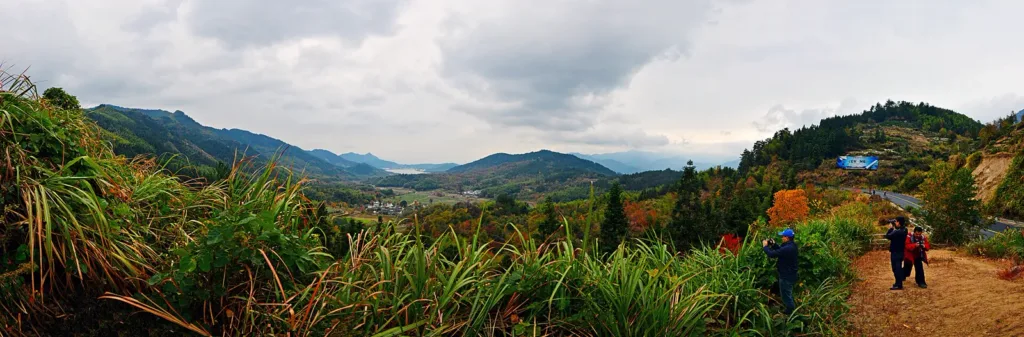
The highway climbs around the village, so the classic views are from the road above it, and the spots are signposted. An English guide to the village describes four of them: a wooden viewing deck about two kilometres along the Hongru Highway (宏儒公路) from Hongcun’s west gate, which is free and is the standard place for morning mist and sunrise; a second signposted point 200 metres further on, also free, good for the rows of white walls and grey tiles; a higher platform across the road, reached by fewer than a hundred steps, which gives the fullest view of the village and, on a clear day, Hongcun and Qishu Lake beyond — this one is sometimes staffed and tickets are checked; and a fourth spot inside the village, a short path from the second point among the tallest tallow trees, which is ticketed. A Chinese platform listing describes the same series of signposted stops on the county road, plus a fifth at the mouth of the Hongcun tunnel, from which the villages of Xieli and Fengdeng and Qishu Lake open out.
Timing is more important than equipment. In November the sun rises at about 07:00 and sets at about 17:00, and the low mist that makes the photographs sits over the valley at first light and is usually gone by mid-morning. Organised groups move between roughly 08:00 and 16:00, so the quiet light windows are before about 08:30 and after 16:00. The same forecast advises warm layers for cold mornings, sun protection for long hours outside, and rain gear in the changeable weather of late autumn.
Because the decks are on a public highway, they can be visited outside the ticket window’s hours; they also fill up on peak weekends, and the county road itself jams badly in the last week of October and through November, which is why walking from Hongcun is often faster than driving.
Walking into the village
From the road, a path drops through the woods at the village mouth and into the lanes. Follow the stream: it runs between the houses, and the local phrase for the effect is “the stream winding around the front of the houses” (溪绕前屋). Stone steps carry the path up through the settlement; above and below it are vegetable plots, tea bushes and rice terraces, with the stepped gables of Huizhou houses on the slope.
What is worth looking at, slowly: the stepped horse-head gables seen against the wooded hillside; the field margins and drying floors, where maize, rice and chillies are spread out after harvest and persimmon trees hang over the walls; the stream and its stone edging, where the water is still used for washing; and the ordinary working detail — tea terraces, bamboo, firewood, laundry — that makes this a village rather than a set. Early morning and dusk are the hours the light is best and the smoke from cooking fires is in the air.
Two courtesies matter here. Do not walk into the crops to get a photograph: the fields are the scenery, and the harvest is someone’s income. And ask before photographing people or stepping into a courtyard, because most of the houses are lived in.
On the ground: the village is built on a slope, with stone paths, steps and uneven surfaces, and no published step-free route; paths through the fields are muddy after rain. Ticketing platforms suggest two to three hours for the village and the nearby viewpoints, which is realistic if you are not waiting for light.
Tickets, hours and what is free
Chinese booking sites list the adult ticket at about CNY 40, sold online from about CNY 35; the operator’s own promotional material also gave CNY 40 when Tachuan was listed among its scenic areas, and Trip.com’s English listing quotes roughly USD 5 for a dated ticket. Prices, promotions and ticket types change, so treat these as indicative and check before travelling.
Concessions published by a Chinese platform: free entry for children 1.2 m or under or aged 6 and under, and for visitors aged 65 and over; half price for ages 6 to 18, full-time students, visitors aged 60 to 64, and serving or retired military personnel; free entry for visitors with a disability certificate, journalists and licensed guides. Documents are checked and the notice at the gate governs.
Hours are published inconsistently. A Chinese booking listing gives 07:30–17:30 with ticket collection until 16:30; Trip.com’s English page shows 08:00–17:00. Both are third-party listings rather than an official notice, so confirm locally — and note that the roadside viewpoints are outside any gate, which is why photographers are on them before the ticket window opens.
Two points that are often assumed wrongly. The ticket does not cover Hongcun and no Hongcun ticket covers Tachuan: they are separate operations, and Tachuan was not among the fifteen paid 4A-and-above scenic areas in Huangshan that a November under-18 free-entry promotion listed. And whether the Tachuan ticket is single-entry for its day or allows re-entry is not consistent across listings: one says the ticket is valid for the day and that leaving and re-entering requires a new ticket, while community reports describe going in twice on one ticket. Ask at the gate if you plan a dawn and an afternoon session.
One piece of background is worth knowing because it explains the village’s own interest in your ticket: under a 2015 arrangement with the county’s Huihuang scenic-management company, the village collective receives 14 to 18 per cent of ticket revenue, with annual dividends to residents; the village recorded 179,500 visitors and CNY 3.96 million in ticket income in 2019, and by 2021 more than half of its households were involved in tourism.
Getting there and away
There is no metro in Huangshan or in Yi County and no railway station at the village. Every route ends with the same short last leg from Hongcun — two to three kilometres along the Hongru Highway towards Mukeng.
- By high-speed rail to Yixian East (黟县东站), the closest station. Bus 10 runs from the station to Hongcun Bus Station in about 40 minutes for a reported CNY 8, calling at the Xidi scenic area and other stops, with return departures from Hongcun listed between 08:00 and about 18:50; a separate Hongcun–Yixian East service was listed at CNY 8 running every 30 minutes from 08:00 to 17:00 with later departures to 18:40, and a coach-station shuttle at CNY 13. Fares and times are published differently by different sources, so confirm the day’s last departure.
- By coach from Huangshan North Railway Station (黄山北站), the city’s main gateway: coaches leave the Huangshan Tourism Passenger Transport Centre (黄山旅游客运中心) on the west side of the station for Hongcun, about 90 km and roughly 1.5 hours, at CNY 30, calling at Xidi, Guiyuan, Pingshan and Xiuli — but not at Tachuan. Return coaches from Hongcun Bus Station to the station run 08:30–17:30 at the same fare, so a late train means a taxi.
- From the county town (黟县汽车站): bus route 1 runs 黟县汽车站–宏村–木坑竹海 about every 30 minutes from 06:30 to 17:00 at a flat CNY 2. Because the route continues past Hongcun towards Mukeng, it travels the road past Tachuan; whether it sets passengers down at the village is not published, so ask the driver. The operator’s own directions for reaching Tachuan simply say to change at Hongcun and continue on foot or by taxi, and an English guide describes a county minibus towards Tachuan through the day.
- From Mount Huangshan‘s south gate at Tangkou (汤口): buses run from Hongcun Bus Station through the day, listed 06:20–17:30 at CNY 15.
- From Tunxi, downtown Huangshan (屯溪): coaches from Hongcun Bus Station were listed at 10:00 and 15:25 for CNY 26.
- Taxi and ride-hailing: give the driver the destination in Chinese — 塔川景区 or 塔川村(黟县宏村镇). From Hongcun it is a few minutes by car, and because the signposted viewing decks sit on the highway itself, a driver can drop you at the roadside deck and pick you up further along; agree the point.
- Walking and cycling: the usual approach is to leave Hongcun by the west gate and follow the road — roughly 30 minutes on foot or about 15 minutes by rented bicycle — which also avoids the November traffic. A longer half-day or full-day loop runs Hongcun → Fengdeng → Xieli → Tachuan → Hongcun on paved lanes, with the tunnel-mouth viewpoint over Qishu Lake on the way.
- Onward: Mukeng Bamboo Sea is a few kilometres further along the same road; Lucun, with its wood-carved halls and a well-known sunrise platform, is about two kilometres the other way from Hongcun; Xidi is around 20 km southeast; the old county town of Yixian is reachable from the county bus station.
Times and fares above are those published by the sources listed below, all consulted on 22 October 2026. Services in Yi County change with the season and with public holidays, so confirm the last bus of the day at Hongcun Bus Station or the county station before you rely on it.
Find Tachuan Village
塔川 · 黟县
The pin marks the area, not the entrance.
Sources & visit information
Sources checked on 22 October 2026. Hours, tickets, reservations and transport can change; confirm with the operator before you go.
- 绚丽塔川秋色浓 人民日报海外版 2023-11-23 ↗
- 黟县宏村镇:打造农旅综合体的塔川示范 中新网安徽 2021-12-14 ↗
- 中国最美秋色安徽塔川红叶预报 中国天气网安徽 2018-11-04 ↗
- 黟县:塔川秋色进入最佳观赏期 中安在线 2024-11-05 ↗
- 安徽22个村新入选全国乡村旅游重点村名单 中国网 2020-09-07 ↗
- 全国首批15个天气气候景观观赏地名单公布 央视新闻 2022-05-14 ↗
- 发展院编制的安徽塔川国家森林公园总体规划获批 国家林业和草原局 2023-09-14 ↗
- 从黄山北站出发,畅达黄山市各景点的公交班车全攻略 澎湃新闻 ↗
- Tachuan Ancient Village China Discovery ↗
- Tachuan Lonely Planet ↗
- 塔川景区介绍与观景台说明 去哪儿网 ↗
- Tachuan Scenic Area tickets and opening hours Trip.com ↗
- 塔川景区门票与取票说明 欣欣旅游同程 ↗
- 黟县徽黄旅游集团旗下景区推出优惠政策 转载自徽黄旅游集团 2019-12 ↗
- 塔川村 中文维基百科 ↗
- 黄山市15家4A级以上收费景区11月1-30日对18周岁以下免票 黄山发布 经大风号转载 ↗
- 积馀堂 中文维基百科 ↗
- 宏村景区到黄山高铁北站、黟县东站班车时刻 知了订 2024-11-12 ↗
- Yixian East Station to Hongcun Village by Bus and Timetable chinatrain12306 ↗
Image credits & notes (1)
- Several people with cameras standing on a dirt shoulder beside a mountain road, looking out over a wooded valley with a village and terraced fields belowPhoto: fish4fish, via Panoramio, uploaded to Wikimedia Commons by Panoramio upload bot · CC BY-SA 3.0