

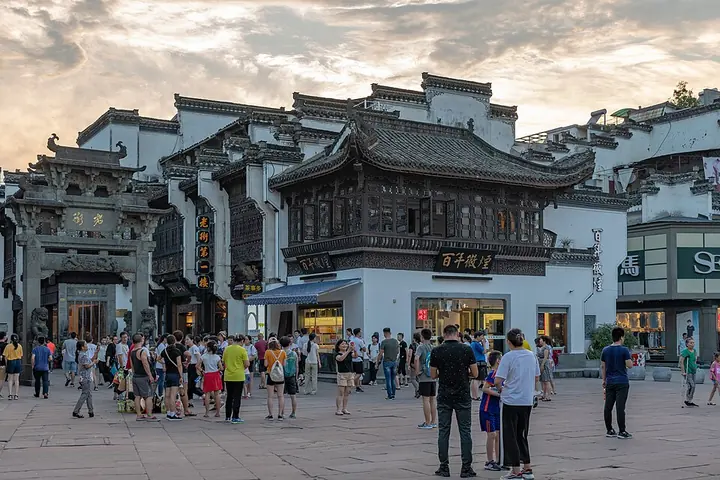
Photo adjustments
Full frame retained; proportionally resized and converted to WebP. No retouching or changes to the photographed subject. Card displays may crop the view.
Explore the region
About Tunxi, Huangshan city
Tunxi Old Street preserves a linear commercial streetscape of Huizhou-style shopfronts, while Liyang across the river combines old residences with newer cultural and leisure uses. The Shi family courtyard on Liyang Street is one specific building to seek out. A short town visit can focus on these two street districts before a separate journey to the mountains or surrounding villages.
Tunxi's administrative history began in the late Eastern Han dynasty, in 208 AD, when Sun Quan established Liyang County (犁陽縣) here. The county was abolished in 464 and merged into Haining County (海寧), present-day Xiuning County, then re-established in 553 under Xinning Commandery. The People's Liberation Army took control of Tunxi in April 1949, and Huizhou District was established the following month with its government based in Tunxi.
In 1987 the former Huizhou District was abolished and replaced by Huangshan City, with Tunxi becoming a city district and the seat of the municipal government. Tunxi District has a population of 217,637 (2010) and covers an area of 249 square kilometres (96 sq mi), with jurisdiction over four subdistricts and five towns. It is close to the Huangshan mountain range and Hongcun Village, both World Heritage Sites.
What to look for
- Tunxi Old Street’s traditional commercial frontages and pedestrian lanes.
- Liyang’s historic residences, including the Shi family courtyard at No 12 Liyang Street.
Location & getting there
Getting to Tunxi, Huangshan city
Huangshan North railway station is outside the old centre and needs an onward transfer to Tunxi. Use Tunxi Old Street for the historic commercial district, or Liyang Street for the opposite-bank quarter; neither is the Huangshan mountain entrance.
Combine your visit
A suggested sequence linking the specific features of this visit.
-
Tunxi Old Street
Explore the older commercial street and its Huizhou building frontages.
-
Liyang historic quarter
Compare the adapted courtyard houses across the river.
-
Shi family courtyard exterior
Look for a documented surviving residence at 12 Liyang Street.
This order is editorial. Confirm access and any transfers between stops; it does not establish a walking route, same-day connection or common admission ticket.
Find Tunxi, Huangshan city
黄山市屯溪区 · 黄山市
The pin marks the area, not the entrance.
More places nearby
Approximate straight-line distances between map pins, not travel distances.
Qiankou 潜口民宅
20 km awayQiankou’s historic residences form a collection of Huizhou buildings in Qiankou village. From the 1980s, threatened Ming-period structures from surrounding settlements were dismantled and reconstructed here.
View guide →Tangyue Memorial Archways 棠樾牌坊群
20 km awayTangyue’s memorial archways stand in Tangyue village, Zhengcun town, She County. Seven Ming- and Qing-period arches commemorate members of the Bao family and the moral virtues celebrated by the imperial state.
View guide →She County, Anhui 歙县
21 km awayShe County’s historic core was the seat of Huizhou, and its monuments show the wealth of officials and merchants from the region. Xu Guo’s stone memorial arch anchors the old centre, while Doushan Street leads past high-walled…
View guide →Sources & visit information
The sources below support the place-specific description and arrival information. Suggested combinations are editorial planning ideas; confirm current opening, entry arrangements and transport services for your date.
- Tunxi District ↗
- Huangshan ↗
- www.huangshan.gov.cn ↗
- www.huangshan.gov.cn ↗
- English Wikipedia: Tunxi District (revision 1331082533, 2026-01-04) ↗
Visitor information adapted and edited from Wikivoyage contributors, “Huangshan” · CC BY-SA 4.0.
Visitor information adapted and edited from Wikipedia contributors, “Tunxi District” · CC BY-SA 4.0. Source revision 1331082533.
Background paragraphs condensed from Wikipedia contributors, "Tunxi District", English Wikipedia · CC BY-SA 4.0. Source revision 1331082533.