

Explore the region
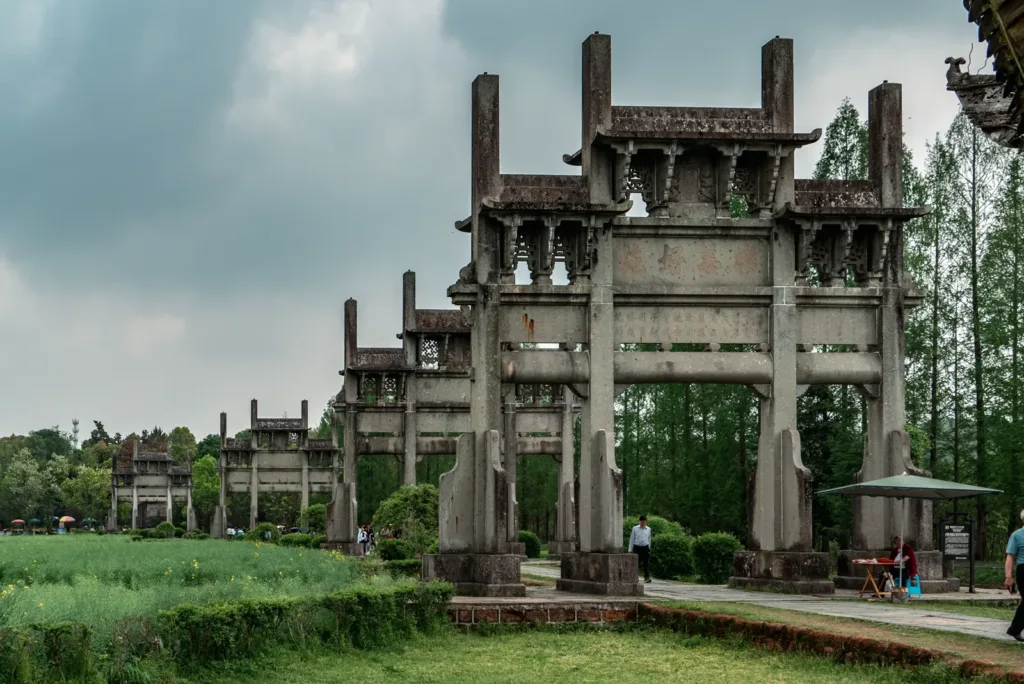
Seven free-standing stone arches, raised between 1420 and 1820, line the east avenue of Tangyue village (棠樾村) in Zhengcun township, She County — a short ride west of Shexian‘s old town. One family, the Baos, built all seven to record the virtues the imperial state rewarded: loyalty, filial piety, chastity and charity. The Bao lineage’s ancestral halls stand within a few minutes’ walk, the family’s garden (鲍家花园, Bao Family Garden) is about 500 m away, and the group has been a Major Historical and Cultural Site Protected at the National Level since the fourth batch of listings in 1996.
What the arches are
A paifang (牌坊) is a memorial, not a gate. The court approved the wording carved on the lintel and the family paid for the stone, which is why these seven read as one family’s public record rather than as a row of village entrances. In Huizhou, archways, ancestral halls and merchants’ houses are counted as the region’s “three masterpieces” of building, and Tangyue is the largest and best-preserved group of archways in Anhui.
Read west to east along the avenue and the row runs: Bao Can’s arch (鲍灿孝行坊, Ming, Jiajing period), Cixiaoli (慈孝里坊, 1420), the chastity arch for Bao Wenling’s wife (鲍文龄妻汪氏节孝坊, Qianlong reign), the Charity Arch (乐善好施坊, 1820), the chastity arch for Bao Wenyuan’s second wife (鲍文渊继妻吴氏节孝坊, Qianlong reign), Bao Fengchang’s arch (鲍逢昌孝子坊, 1797) and Bao Xiangxian’s arch (鲍象贤尚书坊, 1622). Three are Ming, four are Qing. Chinese references commonly give 1534 for Bao Can’s arch and 1776 and 1787 for the two Qianlong widow arches, but other listings give different years inside the same reigns, so treat the carved panels as the better record.
What to look at, in order:
- The top panel. Cixiaoli carries the two characters 御制, “imperially made”, which marks an arch paid for by the state rather than commissioned by the family — the only one of the seven built that way.
- The four-character citations, which are the actual award: 矢贞全孝 and 立节完孤 on Bao Wenling’s wife; 节劲三冬 and 脉存一线 on Bao Wenyuan’s wife; 天鉴精诚 and 人钦真孝 on Bao Fengchang; 命涣丝纶 and 官联台斗 on Bao Xiangxian; 乐善好施 on the Charity Arch. The side panels name the person and the deed.
- The joints. The arches are cut from locally quarried bluish “Shexian green” (歙县青) stone and assembled without nails or rivets — stone resting on stone. Bao Can’s arch carries paired lions in relief under the eaves, while the finer ornament sits on the arch boards and crescent beams of the later Qing arches; the Charity Arch is the tallest of the row, at about 11.7 m.
- The setting. Farmland is kept on both sides of the avenue, so the arches stand clear of the village and are seen as a line rather than a street of gates. The small square Congbu Pavilion (骢步亭), nicknamed the official’s-hat pavilion, sits on the group’s axis and was built in the Ming Longqing reign (1567–1572) as a road pavilion; its plaque is in the clerical script of the Qing calligrapher Deng Shiru, and the flagstones in front carry deep cart ruts said to have been worn by the carts hauling archway stone. It is the natural point to turn off the avenue into the old lanes.
The stories are what the stone is for. Cixiaoli records a father and son taken by bandits at the end of the Song who each begged to die in the other’s place until their captors let them go; the Yongle emperor wrote a poem about them, and Qianlong, on a southern tour, is said to have praised Tangyue as a village of filial piety “unmatched under heaven” and paid for repairs to the arch. The Charity Arch was petitioned for by local officials after the salt merchant Bao Shufang (鲍漱芳) and his son Bao Jun put money into military supplies, famine relief, dykes, bridges and schools. The two chastity arches record women who kept their husbands’ households going for decades — twenty years in one case, sixty in the other, raising a stepson and restoring the family graves.
The three halls beside the arches
- 敦本堂 Dunben Hall, the men’s hall. Built for a branch ancestor and rebuilt and enlarged in the early Jiaqing reign by the salt merchants Bao Zhidao and his son, finishing in 1801. It faces south, five bays wide and three courtyards deep, and shows the standard Qing Huizhou hall section — heavy crescent beams over slender columns, with light falling from the central courtyard. Seventeen stone steles are kept inside, among them the three Jiaqing imperial edicts and the rules of the lineage’s charitable fields.
- 清懿堂 Qingyi Hall, the women’s hall. Built in the Jiaqing reign (Chinese sources commonly date it to 1805) with money from the salt merchant Bao Qiyun (鲍启运) and dedicated to Bao women, whose names were carved and worshipped inside. It faces north rather than south, and its gate wall is covered in brick carving. English-language reporting has called it the only ancestral hall in old China built for women; the safer reading is that it is exceptionally rare, and it is why the site is studied for lineage and gender history.
- 世孝祠 Shixiao Hall. Dedicated to Bao sons known for filial piety, with a plaque in the hand of Deng Shiru and walls carrying steles that name the family’s filial sons and record the hall’s founding.
Bao Family Garden
The garden 500 m from the arches began as the private garden of the Qing salt merchant Bao Qiyun, was destroyed in the Taiping wars and has been rebuilt as a display ground for Huizhou bonsai (penjing), with thousands of pots; its large old banyan penjing, “Southern Style” (南国风情), is presented as the centrepiece. The archways and the garden are covered by one combined ticket, issued at either ticket window.
Tickets, opening hours and reservations
The archways and Bao Family Garden are ticketed together. Chinese listings and an English guide updated in 2025 quote about CNY 100 for adults, and booking platforms list packages from roughly CNY 100–130, so plan for that and confirm at the window, since prices move with promotions. Free and reduced entry is defined by group — children below 1.2 m, visitors aged 65 and over, serving soldiers and disabled visitors with ID on the standard exemptions, half price for children between 1.2 and 1.5 m, students and visitors aged 60–65 — and by seasonal campaigns: Anhui’s culture-and-tourism channels published fourth-quarter 2026 programmes that included free entry for under-18s during November 2026 and ticket-stub offers from 15 October to 31 December 2026. Those campaigns expire, so check the operator’s current notice rather than assuming they still apply.
Daytime hours are usually given as 07:30–17:30 for the archways, with the garden sometimes listed 07:00–18:00 and booking platforms showing seasonal windows such as 06:30–18:30; the archways were lit for a night-time scene from September 2026. Toilets, luggage storage and Wi-Fi are listed for the scenic area, and individual halls can close for conservation work without notice.
Getting there and back
Huangshan has no metro, so there is no subway option for this site; you arrive by tourist bus, county bus or taxi.
Tourist bus 游1路, Huangshan North railway station ↔ Huizhou Ancient City. This is the simplest link from the high-speed rail: it stops at 棠樾牌坊群(鲍家花园) between 黄山北站 and 徽州古城游客中心, and also calls at 歙县公路客运站, 歙县人民政府 and 歙州广场. Buses run in both directions roughly hourly; the regular timetable revised in April 2025 had first and last departures at the railway station around 09:00 and 19:40, and the holiday timetable issued for 25 September–7 October 2026 ran 08:30–19:40 from the station and 08:20–19:40 from the ancient-city end. The full route costs CNY 10, with CNY 5 for shorter hops that do not cross the boundary stop at 汪村边; free travel is limited to children under 1.3 m not occupying a seat, serving and disabled soldiers, disabled police officers, and blind or severely mobility-impaired passengers, all with ID.
Tourist bus 游2路, Huizhou Ancient City ↔ Xixinan. Trial operation began on 3 April 2026 on a 45 km line with 17 stops, including 棠樾牌坊群(鲍家花园), 唐模, 呈坎, 潜口民宅 and 西溪南. It runs at weekends and on public holidays only, with first and last departures around 08:00 and 16:00 at each end; the full route is CNY 20, with CNY 5 added at each boundary crossing, and 棠樾牌坊群 is one of the boundary points. This is the bus to take if you want the arches on the same day as the other Ancient Huizhou sites.
County buses. She County’s own services also stop by the village; the 2路 from the county town is the one most often named for a direct ride to the archways. Route numbering is not stable across listings, so read the board at the stop.
By train. 歙县北站 Shexian North, on the Hefei–Fuzhou and Hangzhou–Huangshan high-speed lines and open since 28 June 2015, stands a few kilometres from the county town with a bus terminal on the station square, where the 高铁1 and 高铁2 shuttle lines run to 歙州广场 (the tourist transfer centre) and 歙县公路客运站 (the county bus station); continue from either on 游1路, 游2路 or a county bus. 黄山北站 Huangshan North, the city’s main high-speed gateway, has the direct 游1路 stop. Some Chinese listings also route travellers through the older 歙县站 on the conventional Wan-Gan line, taking bus 4路 to the county bus station and then 2路; check that slow trains still call there before planning around it.
Taxi or ride-hailing. Give the driver 棠樾牌坊群, or 歙县郑村镇棠樾村东大道 for the avenue itself: the ticket office and car park are on the avenue, and the garden has its own entrance about 500 m away. No fare is quoted here — the county town is a short ride, while 屯溪 and 黄山北站 are much further, so use the meter or the app price.
On foot at the site. The seven arches line one paved avenue and the garden is about 500 m beyond; the visit is a walk on stone paving, open to sun and rain, so carry water in summer and take care on wet stone. Chinese listings put the distance at about 10 km to Huizhou Ancient City and about 27 km to Tunxi, while an English guide gives about 6 km west of Shexian — either way it is a ride, not a walk, from the county town.
Combine your visit
A suggested sequence through the named features described in the source.
-
Memorial archway group
Compare the stone carving and inscriptions of the seven memorial arches.
-
Dunben Hall
Continue to the Bao family’s principal ancestral-hall setting.
-
Qingyi Hall
Examine the separate women’s ancestral hall and its family-history context.
The order is an editorial suggestion. Internal opening arrangements and transfers between sectors need checking; no walking duration or access entitlement is implied.
Find Tangyue Memorial Archways
棠樾牌坊群 · 黄山市
The pin marks the area, not the entrance.
More places nearby
Approximate straight-line distances between map pins, not travel distances.
She County, Anhui 歙县
5 km awayShe County’s historic core was the seat of Huizhou, and its monuments show the wealth of officials and merchants from the region. Xu Guo’s stone memorial arch anchors the old centre, while Doushan Street leads past high-walled…
View guide →Qiankou 潜口民宅
7 km awayQiankou’s historic residences form a collection of Huizhou buildings in Qiankou village. From the 1980s, threatened Ming-period structures from surrounding settlements were dismantled and reconstructed here.
View guide →Chengkan 呈坎
10 km awayChengkan’s village lanes lead between houses and communal buildings of the Luo clan. The Luo Dongshu ancestral hall is the main architectural focus: its courtyards lead to Baolun Pavilion, where painted timber framing gives the…
View guide →Sources & visit information
Sources checked on 22 October 2026. Hours, tickets, reservations and transport can change; confirm with the operator before you go.
- 棠樾牌坊群 — 维基百科(中文) ↗
- 棠樾牌坊群 — 百度百科 ↗
- 牌坊群·鲍家花园景区 — 百度百科 ↗
- 骢步亭 — 百度百科 ↗
- Tangyue Archways: Walking Through Centuries of Hui Culture — Easy Tour China ↗
- Tangyue Memorial Archway — TravelChinaGuide ↗
- Unique ancestral hall for women in Huizhou — CCTV English ↗
- 棠樾牌坊群・鲍家花园景区 — Klook ↗
- 关于黄山北站至徽州古城旅游公交“中秋、国庆”节期间调整运营时间的公告 — 黄山市城际公交有限公司、歙县杭徽公共交通有限公司(搜狐转载,2026-09-18) ↗
- 黄山北站至徽州古城旅游公交,优化调整运营(来源:黄山市人民政府发布)— 凤凰网安徽,2025-04-26 ↗
- 串联17个景点!黄山市这条旅游公交专线开始试运营 — 凤凰网安徽,2026-04-03 ↗
- 歙县北站 — 维基百科(中文) ↗
- 【免票政策】收藏!棠樾牌坊群免票及优惠指南来了(来源:安徽文旅)— 搜狐,2026-10-16 ↗
- 棠樾村七座牌坊 — 黄山日报(安徽新闻网),2026-09-06 ↗
- 歙县棠樾牌坊群迎来旅游热潮 — 中新网安徽,2025-04-20 ↗
Image credits & notes (1)
- The row of Ming and Qing arches along the east avenue at Tangyue, seen from the farmland beside the processional way. Photo: 王淞 (uploaded to Wikimedia Commons by user 来斤小仓鼠吧)Photo: CC BY-SA 4.0