

Explore the region
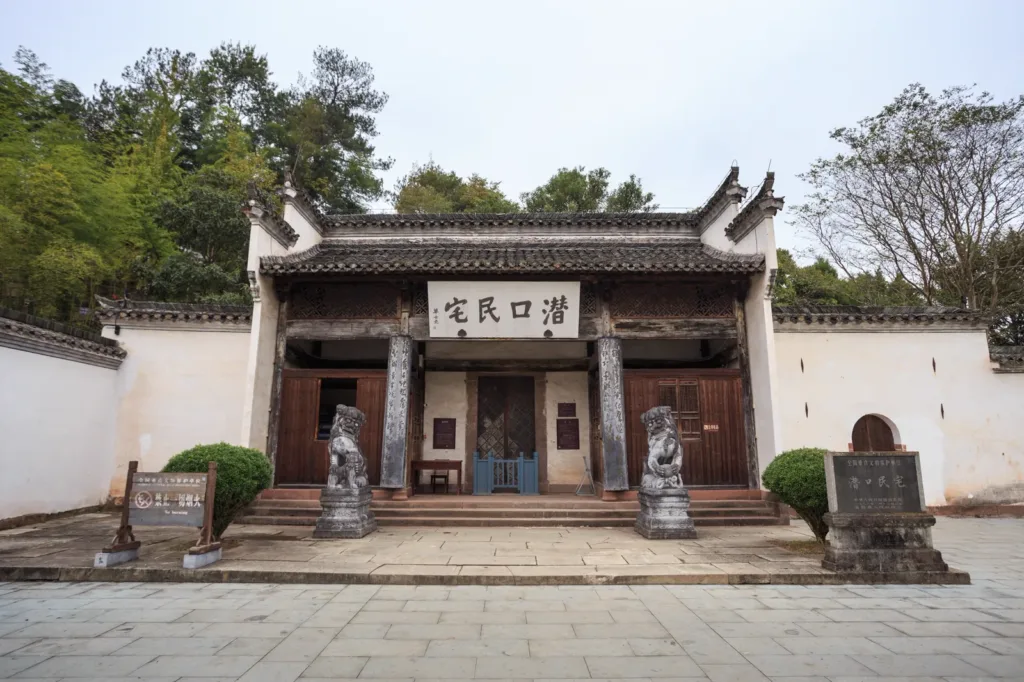
Qiankou Minzhai — the Qiankou Residence Museum, also called Zixia Mountain Villa (紫霞山庄) — is an open-air assembly of Huizhou buildings on the slope of Zixia Hill in Qiankou village (潜口村), Qiankou town, Huizhou District, about 23–27 km from downtown Tunxi and roughly 18 km west of Shexian town. Local tradition links Qiankou with the poet Tao Qian, and the name is also explained as “the mouth of Huangshan”; in the Qing dynasty the spot was the Wang Yuan family’s garden, Shui Xiang Yuan (水香园), destroyed during the Taiping wars.
The buildings here are originals, not copies. A rescue programme approved by the national heritage administration in 1982 and begun in 1984 dismantled Ming-period houses, ancestral halls, a stone archway, a bridge and a roadside pavilion that could not be protected where they stood — in Zhengcun, Xucun, Xixinan and other villages of Huizhou District and She County — and rebuilt them on this hillside in the manner of a village. The Ming Garden (明园) opened in 1990, with later moves recorded up to the end of 1994. A second phase approved in 1998 added eleven Qing buildings on the lower ground; the Qing Garden (清园) is dated 2006 in one official reference and 2007 in others. Twenty-four buildings stand on the site today.
Qiankou Minzhai has been a national key cultural relic under protection since 1988, and it is part of the Ancient Huizhou Cultural Tourism Area, rated 5A in 2014. Chinese heritage specialists promoted it as a model for saving buildings that could not be saved in place, and the line often quoted in Chinese sources — “to see imperial palaces, go to Beijing; to see ordinary houses, go to Qiankou” — is attributed to the architectural historian Shan Shiyuan.
Why it is worth the detour
Villages such as Hongcun, Xidi or Chengkan are lived-in places where you walk the lanes; Qiankou is a curated group, so what you get instead is comparison. Within a few hundred metres you can look at an ordinary farmer’s house beside a merchant’s courtyard house, and Ming halls beside late-Qing ones. What you lose is context: the buildings keep their own frames, joinery and carvings, but not their original lanes, wells, ponds or neighbours.
The Ming Garden: what to look at
You enter through the 山门 gate complex, which incorporates the surviving front of Liushuntang (六顺堂), the Wang family’s communal hall. A short walk brings you to 荫秀桥 (Yinxiu Bridge), a single-arch stone bridge built in 1554 and paid for by a nun; its name is carved half in relief and half incised, and it once separated the nunnery on one bank from the village on the other.
Beyond it stands 方氏宗祠坊 (the Fang family archway), set up in the Jiajing period in the mid-1500s. There is no inscription on the front. Instead a grinning ghost carries a writing brush and stands on a square grain measure (dou): ghost plus dou makes the character 魁, the top graduate in the imperial examinations. The back carries a moon-palace and cassia design — the same wish for scholarly success.
Steps lead up past 善化亭 (Shanhua Pavilion), a roadside rest pavilion dated 1551 and brought from beside the stone road at Yangchongling in Xucun; merchants paid for it, and it still works as a place to sit.
The halls come next. 乐善堂 (Leshan Hall), also called 耄耋厅, was where clan members over eighty met and were entertained; it is a two-courtyard, single-storey hall with unusually heavy timbers and rounded beams. Beside it, 曹门厅 is a Wang branch ancestral hall whose main hall was destroyed during the Cultural Revolution; only the nine-bay gate front and two side corridors remain, and specialists come for the bracket sets that still carry Song- and Yuan-style details. 司谏第, built in 1495 as a family shrine by five grandsons of the censor Wang Shan, is one of the earliest surviving Ming halls in Huizhou; an imperial plaque granted in 1406 hangs in the hall.
Then come the houses, and this is where a slow look pays. 方观田宅 is a modest farmer’s three-bay house: note the wooden pad inserted between each post and its stone base, and the plain plank partitions. 吴建华宅 was originally a three-storey house, later reduced to two; because the plot was irregular, the front door sits in the right-hand corridor instead of facing the street. 方文泰宅 has the finest carving of the group and a curved “flying chair” balustrade on the upper floor that projects past the columns. 苏雪痕宅 came from Zhengcun, where in the late Qing a Su family bought it and ran a tobacco shop; its eaves are carried on octagonal posts standing on an arc-shaped railing. The detail that architectural historians cite is that the railing and eave construction in 方文泰宅 and 苏雪痕宅 match drawings in a Ming carpenter’s manual, the Lu Ban jing, preserved at Ningbo’s Tianyi Pavilion — which makes them documents as much as buildings. 罗小明宅, from Chengkan, is the only three-storey dwelling here, with service stairs tucked in and a family shrine on the top floor.
The Qing Garden
The Qing Garden lies on the lower ground to the south, arranged along a loop: eleven buildings, including houses, halls, an opera stage and a shop. The largest is 畊礼堂 (Gengli Hall), a late-Qing official’s mansion of about 440 square metres with five bays and three courtyards. The 古戏台 is a two-level stage placed facing the clan hall, so that in the Ming and Qing periods the living watched opera sitting opposite their ancestors. 万盛记, moved here from Xixinan, is a Guangxu-period shop-house with the shop in front and the family’s courtyards behind — a rare documented example of that plan; the family traded silk, grain and tea, and later sold honey from its own apiary. 程家祠堂 was added to the Qing Garden as late as 2011. Qing work is more ornate — heavier wood, brick and stone carving — and many visitors find it feels newer than the Ming houses, which it is; several television productions have filmed here.
How to visit
Admission is free. Current listings give opening hours of 08:00–17:00 with the last entry at 16:30 and a weekly closure on Mondays except national public holidays; one older Chinese reference still describes 08:00–17:00 all year, so confirm on the day. The same listings state that entry now requires a reservation made through the museum’s official WeChat account (公众号, “门票预约”) and give the museum’s telephone numbers as 0559-3535986, 0559-3535501 and 0559-3531790. Guided interpretation is charged separately, at rates that differ between listings. Bring your passport: reservations in China are normally tied to an identity document, though the museum’s own requirement is not published in English.
A sensible order is to start in the Qing Garden, cross the pond and climb into the Ming Garden — most of the hill path is stone steps — and finish at the upper houses, where you can look down over the white walls and grey roofs of present-day Qiankou town. Budget one and a half to three hours. Visitor reports note two things worth expecting: the interiors are largely empty of furniture, so you are reading architecture rather than rooms, and several houses contain small souvenir stalls. The museum also runs craft sessions such as fish-lantern painting and architectural rubbing, and recorded 347,000 visitors in 2024, so it is not a secret; weekends and holidays are busier. The district continues to promote the site as a place to read Huizhou building aesthetics in the courtyards, layered eaves and carvings.
Getting there and back
There is no metro in Huangshan and no station at the site itself. The nearest rail gateway is 黄山北站 (Huangshan North Railway Station), and the main coach station is 黄山市汽车客运总站 (Huangshan Bus Station, also called 屯溪汽车站) in Tunxi.
The most convenient scheduled service is the tourist bus 游2路, which links 徽州古城 (Huizhou Ancient City in Shexian) with 西溪南 (Xixinan) and stops at 潜口民宅 between the 呈坎 south gate and Xixinan — 17 stops in all. It began trial operation on 3 April 2026 and, as announced, runs only on weekends and national public holidays. First and last departures from both ends are at 08:00 and 16:00, it alternates with 游1路 at roughly 50–60 minute intervals, and fares are distance-based: 20 CNY end to end and about 5 CNY per boundary point crossed, so 5–20 CNY in practice (a district official quoted departures at 08:00, 10:30, 13:00 and 16:00 in each direction). Note that 游1路 itself, the 黄山北站–徽州古城 line, does not list a stop at the museum.
From 黄山北站, local bus 徽州17路 runs to 呈坎 through Qiankou town; published departures from the station are 07:30, 08:40, 09:50, 10:45, 12:30, 14:00, 15:20 and 16:20, returning from Chengkan at 07:20, 08:40, 09:40, 11:00, 12:10, 13:40, 15:00 and 16:20 (2025 listing). Ask the driver for the 潜口民宅 stop rather than assuming a stop name, since the route’s stop list is not published consistently.
From Tunxi, coaches toward 呈坎 leave 黄山市汽车客运总站 and pass 潜口民宅, listed at 08:00, 10:00, 14:00 and 16:00; a tourist shuttle line 3 has also been listed as 黄山市汽车站–西溪南–潜口游客中心–潜口民宅–呈坎. Schedules of this kind change, so confirm at the station counter before setting out.
By taxi or ride-hail, give the Chinese destination 潜口民宅博物馆, 徽州区潜口镇潜黄路1号 (No. 1 Qianhuang Road). A Taiwanese travel site puts the drive from Huangshan city at about 30 minutes, and the museum lies 23–27 km from downtown Tunxi depending on the listing.
For the return trip, keep the clock in mind: the last 游2路 leaves each terminus at 16:00 and the last 徽州17路 leaves Chengkan at 16:20 (2025 listing), so without a car you want to be leaving the museum by mid-afternoon. Nearby, 唐模 (Tangmo) is about 4 km east and 呈坎 (Chengkan) about 8 km north, so either can be joined to the same half-day; 徽州古城 and 西溪南 sit further along the same tourist-bus line.
Practical notes
The site is outdoors and partly on a slope: stone steps and paved paths become slick in rain, so wear shoes with grip. The climb through the Ming Garden is short but steady. Most labels are in Chinese and English interpretation is not guaranteed; the craft workshops and any guided tour are Chinese-language by default. Qiankou town, immediately outside, has simple places to eat and stay, and there is a small shop area at the museum entrance. Photographs in the museum’s online listings and in older guidebooks date from different years, and the site keeps being adapted — new walking routes and lighting were added in 2024.
Combine your visit
A suggested sequence through the named features described in the source.
-
Residential buildings
Examine Residential buildings as a separate part of Qiankou.
-
Ancestral-hall group
Examine Ancestral-hall group as a separate part of Qiankou.
-
Pavilion and stone arch
Ancestral halls, a roadside pavilion and a stone arch extend the collection beyond domestic architecture.
The order is an editorial suggestion. Internal opening arrangements and transfers between sectors need checking; no walking duration or access entitlement is implied.
Find Qiankou
潜口民宅 · 黄山市
The pin marks the area, not the entrance.
More places nearby
Approximate straight-line distances between map pins, not travel distances.
Chengkan 呈坎
6 km awayChengkan’s village lanes lead between houses and communal buildings of the Luo clan. The Luo Dongshu ancestral hall is the main architectural focus: its courtyards lead to Baolun Pavilion, where painted timber framing gives the…
View guide →Tangyue Memorial Archways 棠樾牌坊群
7 km awayTangyue’s memorial archways stand in Tangyue village, Zhengcun town, She County. Seven Ming- and Qing-period arches commemorate members of the Bao family and the moral virtues celebrated by the imperial state.
View guide →She County, Anhui 歙县
12 km awayShe County’s historic core was the seat of Huizhou, and its monuments show the wealth of officials and merchants from the region. Xu Guo’s stone memorial arch anchors the old centre, while Doushan Street leads past high-walled…
View guide →Sources & visit information
Sources checked on 22 October 2026. Hours, tickets, reservations and transport can change; confirm with the operator before you go.
- 百度百科:潜口民宅 ↗
- 百度百科:黄山市徽州区潜口民宅博物馆 ↗
- 中国青年报:拯救远去的古宅(2020-09-22) ↗
- 去哪儿网:潜口民宅博物馆 ↗
- Trip.com:Qiankou Residence Museum(官方景点页) ↗
- 凤凰网安徽:串联17个景点!黄山市这条旅游公交专线开始试运营(游2路公告,2026-04-03) ↗
- 人民网安徽:黄山市徽州区:坐上公交游徽州“游2路”串起诗画风景新体验(2026-04-03) ↗
- 澎湃新闻:从黄山北站出发,畅达黄山市各景点的公交/班车全攻略(2025-04-04) ↗
- 凤凰网安徽:黄山北站⇌徽州古城!旅游公交班次调整公告(2026-09-20) ↗
- TravelChinaGuide: Qiankou Residence ↗
- Easy Tour China: Qiankou Residence Museum ↗
- 黄山旅游资讯网(台湾):潜口民宅博物馆 ↗
- 中新网安徽:漫步潜口民宅 品读文脉徽州(2026-10-02) ↗
Image credits & notes (1)
- The entrance gate of Qiankou Minzhai, with the museum name board, stone lions and the national key cultural relic stele; the Ming Garden lies up the wooded slope behind. Photo: Zhangzhugang (猫猫的日记本 / Zhangzhugang, Wikimedia Commons)Photo: CC BY-SA 4.0