

Explore the region
She County‘s county seat, Huicheng (徽城镇), was the seat of Huizhou prefecture for centuries, and the monuments packed into its walled core — the eight-pillared Xu Guo archway, the rebuilt Ming Prefectural Office, the merchant lane of Doushan Street — were paid for by the officials and salt merchants who ran the region. One kilometre downstream, the Tang-era Yuliang Dam and its cobbled wharf street show how that money actually moved: by water.
Why this place, and how it differs from the villages
She County is the easternmost county-level division of Huangshan City, on the border with Zhejiang, with a population of about 363,000. Its town of Huicheng was not one village among many: prefecture and county offices sat inside the same walls for centuries, producing a “city within a city” layout that still shapes the street pattern, and the county has been on the national list of Historic and Cultural Cities since 1986. Tourism writing often groups the old town with Pingyao, Lijiang and Langzhong as China’s four best-preserved ancient cities — a widely repeated framing rather than an official ranking.
That administrative and commercial role is what separates She County from Hongcun, Xidi or Chengkan. Those are single Huizhou villages; this is the prefectural town and its river port, where the region’s taxes, loans and shipping were handled — plus a county hinterland of 167 recognised traditional villages, the largest number of any county in China.
The walled core, in walking order
Start at the surviving stretch of the Ming wall on the south side and pass through 南谯门 (South Watchtower Gate); the Prefectural Office is directly ahead. The 徽州府衙 (Huizhou Prefectural Office) was first built in the late Yuan to early Ming period and reconstructed in 2009 on its Ming Hongzhi-era plan: one axis, five gates, courtyard after courtyard, offices in front and residence behind. Look for the Ming timber vocabulary — 月梁 (crescent beams), 梭柱 (shuttle-shaped columns) and 平盘斗 (flat bearing blocks).
Walk east along 中和街 (Zhonghe Street), the old main street, which passes the Prefectural Office, 阳和门 (Yanghe Gate), the archway and then the lanes of the residential quarter. Yanghe Gate is also the 东谯楼 (East Watchtower), a Song gate tower of 1150 that served as the east entrance to the government compound. Just beyond it stands the 许国石坊.
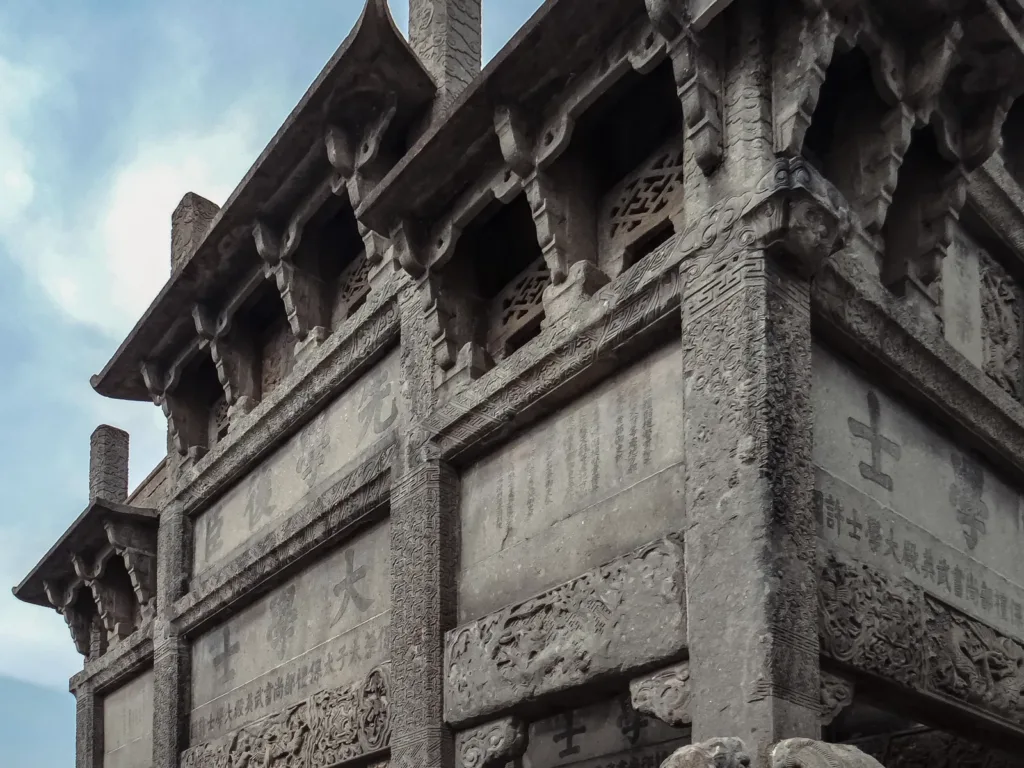
The Xu Guo Archway (1584) is the one structure to slow down for. Instead of the usual four pillars, eight stone columns close into a rectangle, so the monument has four decorated faces and can be read from every side — the only surviving archway of this type in China. Twelve lions sit on the plinths; each face carries a different carved rebus (a leaping dragon, a fish crossing the dragon gate, phoenix and unicorn, cranes and deer), and the inscriptions are in the hand of the Ming painter-calligrapher Dong Qichang. It honours Xu Guo, a Grand Secretary under the Wanli emperor, and has been a national key cultural relic since 1988.
斗山街 (Doushan Street) climbs away from Zhonghe Street into the merchants’ quarter: high whitewashed walls, carved stone gateways, courtyard houses with ornamented lintels. People still live here. Owners have historically invited visitors into their courtyards for a small payment — if that happens, agree the amount before you go in, and treat it as an informal arrangement rather than a museum ticket.
The 安徽徽州历史博物馆 (Anhui Huizhou History Museum) sits inside the old town and is the quickest way to make sense of what you are looking at: five galleries on Huizhou history, more than 30,000 objects, 64 of them national first-class relics, opened in September 2021. Admission is free with a valid ID; the museum closes on Mondays except public holidays, and since March 2023 it has been trialling extended 10:00–20:00 hours on Fridays and Saturdays.
The river port at Yuliang
Yuliang (渔梁) lies about a kilometre south of the county town, on the 练江 (Lian River), a tributary of the Xin’an. The 渔梁坝 (Yuliang Dam) was first built in the Tang and rebuilt in 1605; it runs roughly 140 m across the river, 27 m thick at the base and 4 m at the top, built of granite blocks locked to each other with stone dovetails and “ingot” pins. It ponded water upstream and made the river navigable downstream, which is why this was the wharf from which Huizhou merchants set out for Zhejiang and Jiangsu.
Above the dam, 渔梁街 (Yuliang Street) is paved with fish-scale cobbles; the village is shaped like a fish lying against the water, with the street as its spine and narrow lanes running down to the old landing stages. Downstream stands the Ming 紫阳桥 (Ziyang Bridge), 14 m high with unusually tall arches — built that way so masted boats could pass.
The old town’s streets were freed of ticketing on 1 January 2022, when the county removed the gate ticket and the gate controls; walking the lanes now costs nothing, while individually managed sights inside sell their own tickets. The county also sells “one-pass” and 门票+演出+民宿 packages that bundle sights with performances and accommodation, and adjusts them by season. Prices and package contents change; check the operator’s own channel rather than a resale listing.
Beyond the county town
Tangyue (棠樾), in Zhengcun town (郑村镇), has seven memorial archways standing in a single line, built between 1420 and 1820 to honour filial sons, chaste widows and the charitable spending of the Bao salt-merchant family; three Bao ancestral halls stand beside them, including the rare 清懿堂, a hall for women. The group is a national key cultural relic (1996). The archways and the neighbouring Bao Family Garden are separate ticketed sights, and the adjacent 棠樾云起 area now stages an evening fish-lantern show.
The rest of the county is a set of separate trips rather than a walking extension: 许村 (Xucun) in the north-west, with more than 200 Yuan, Ming and Qing buildings; the rammed-earth 阳产土楼 houses above 深渡; and 石潭 (Shitan), whose hillsides are the county’s spring blossom viewpoint. Buses 931 and 938 run from 歙县客运站 to 深渡港 at the southern end of the county, the base for the Xin’an River landscape; 938 takes about 90 minutes. Villages off those lines need a taxi or a hired car.
Getting there
There is no metro in Huangshan or She County; the realistic options are intercity rail plus tourist and local buses, taxis or ride-hailing, or a car.
By high-speed rail. 歙县北站 (Shexian North) opened on 28 June 2015 with the Hefei–Fuzhou high-speed line and is also served by the Hangzhou–Huangshan line that opened in December 2018; the station is in 富堨镇承狮村 just outside the county town, with bus services from its forecourt toward the county centre. Most visitors, however, arrive through 黄山北站 (Huangshan North), the region’s main high-speed hub about 38 km by road from the old town. The conventional 歙县站 (Shexian station) on the Anhui–Jiangxi line also exists; check timetables before planning around it.
By tourist bus from Huangshan North. 游1路 and 游2路 were launched on 1 October 2024 by the Huangshan intercity bus company and run from 黄山北站 to the old town in about 55–65 minutes, with a full-route fare of 10 yuan (zonal pricing, no discount or free-ticket policies). The route strings together 西溪南, 鲍家花园 (棠樾牌坊群), 歙县客运站, 歙州广场, 徽州古城游客中心 and 渔梁景区 — so the archways, the old town and the dam can all be reached on one line. Buses run roughly hourly from mid-morning; the last departure from the station has been listed between 17:50 and 19:40 in different versions of the timetable and is adjusted at holidays, so confirm the day’s last bus before a late arrival.
Local buses. 歙县2路 connects 歙县客运站 with the 徽州府衙 stop in the old town and continues to 鲍家花园 and the 牌坊群 terminus; the bus station operates roughly 06:15–18:15 at about 30-minute headways. Bus 931 to 深渡港 also calls at the 徽州府衙 stop, which makes it useful for the southern half of the county. Shuttle services linking the old town with 呈坎 and with the Huangshan scenic area’s south gate also start from the old town; they run a few times a day.
By taxi or ride-hailing. Give the driver a Chinese destination: 徽州古城游客中心 (Huizhou Ancient City Visitor Centre) for the main entrance area, 徽州府衙 or 许国石坊 for the middle of the old town, and 渔梁景区 (Yuliang scenic area, off 长青路) for the dam and the wharf street. From 歙县客运站, the old town is about a 20-minute walk across the river bridge.
Practical notes
- The county town is split by two hills: the eastern half was the county’s suburb city, crescent-shaped and ringed by hills; the western half is the former prefectural city on open ground facing the Lian River. Lanes climb, step and turn — allow more time than the map suggests.
- Yuliang Street is cobbled and the dam’s stone slabs are slippery when wet. June is the county’s wettest month, averaging around 357 mm.
- Half a day on foot covers the walled core; add Yuliang as a separate short extension by bus or on foot along the river, and give Tangyue its own half-day.
- The old town is lived in: expect scooters in the lanes, and check opening days for the ticketed halls and the museum before you build a day around them.
Combine your visit
A suggested sequence linking the specific features of this visit.
-
Xu Guo memorial arch
Start with the prominent stone monument in the old centre.
-
Doushan Street
Explore the lane’s old residences and architectural details.
-
Yuliang Dam
Add a separate riverside extension to understand the town’s water-borne trade.
This order is editorial. Confirm access and any transfers between stops; it does not establish a walking route, same-day connection or common admission ticket.
Find She County, Anhui
歙县 · 黄山市
The pin marks the area, not the entrance.
More places nearby
Approximate straight-line distances between map pins, not travel distances.
Tangyue Memorial Archways 棠樾牌坊群
5 km awayTangyue’s memorial archways stand in Tangyue village, Zhengcun town, She County. Seven Ming- and Qing-period arches commemorate members of the Bao family and the moral virtues celebrated by the imperial state.
View guide →Qiankou 潜口民宅
12 km awayQiankou’s historic residences form a collection of Huizhou buildings in Qiankou village. From the 1980s, threatened Ming-period structures from surrounding settlements were dismantled and reconstructed here.
View guide →Chengkan 呈坎
15 km awayChengkan’s village lanes lead between houses and communal buildings of the Luo clan. The Luo Dongshu ancestral hall is the main architectural focus: its courtyards lead to Baolun Pavilion, where painted timber framing gives the…
View guide →Sources & visit information
Sources checked on 22 October 2026. Hours, tickets, reservations and transport can change; confirm with the operator before you go.
- 歙县:“徽州古城”的“蝶变新生”(中新皖间观察) ↗
- 中国之城丨歙县:一座没有屋顶的徽派文化艺术馆(新华社) ↗
- 一票通游昼夜皆景 歙县多元联票激活中秋文旅热潮(中新网安徽) ↗
- 这座县级博物馆“徽”韵十足(感知文化里的中国)(人民日报) ↗
- 参观指南(安徽徽州历史博物馆官网) ↗
- 黄山高铁北站至歙县徽州古城旅游公交直通车开通了(黄山市城际公交公司) ↗
- 从黄山北站出发,畅达黄山市各景点的公交/班车全攻略(澎湃新闻) ↗
- 黄山北站交通指南(2026)(HSLY) ↗
- 歙县北站(维基百科) ↗
- 歙县(维基百科) ↗
- She County, Anhui(Wikipedia) ↗
- 许国石坊(维基百科) ↗
- 渔梁坝(维基百科) ↗
- 棠樾石牌坊群(维基百科) ↗
- 中和街(维基百科) ↗
- Huizhou Old Town(Lonely Planet) ↗
Image credits & notes (1)
- Carved faces and stone brackets of the Xu Guo Archway (许国石坊), Huicheng, She County, April 2023. Photo: 邹璞 (uploaded by Wikimedia Commons user 来斤小仓鼠吧)Photo: CC BY-SA 4.0