

China Customs: What to Pack and Declare
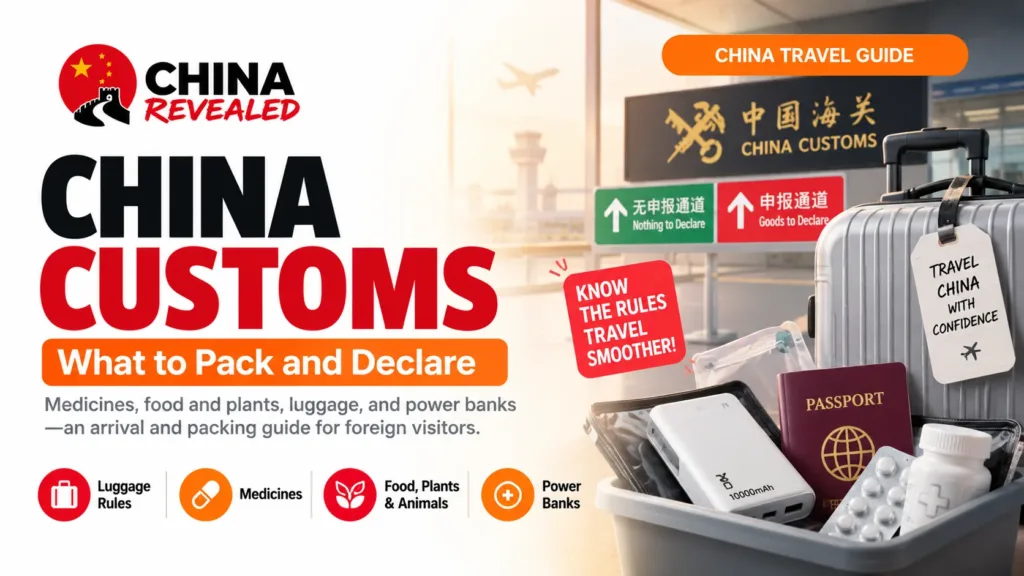
China customs rules for foreigners are straightforward for normal holiday luggage: bring what you need for the trip, leave fresh food and agricultural products at home, and check your medicines and power bank before flying. I recommend sorting those last two items before packing your suitcase—not at the airport security queue.
Quick takeaways
- Ordinary clothes and personal travel equipment are usually the easy part. Declare goods when the rules require it; use the red channel if you are unsure.
- Keep medicines identifiable, carry prescription documents, and check controlled ingredients before departure.
- Leave fresh fruit, meat, dairy products, seeds, plants and soil out of your holiday luggage.
- Airline baggage allowances come from your ticket. Power banks belong in your carry-on, never your checked suitcase.
- For mainland domestic flights, choose a power bank with a clear CCC / 3C mark, readable energy details and no applicable recall. A unit at 100Wh or below is the simplest choice.
1. What happens after you land
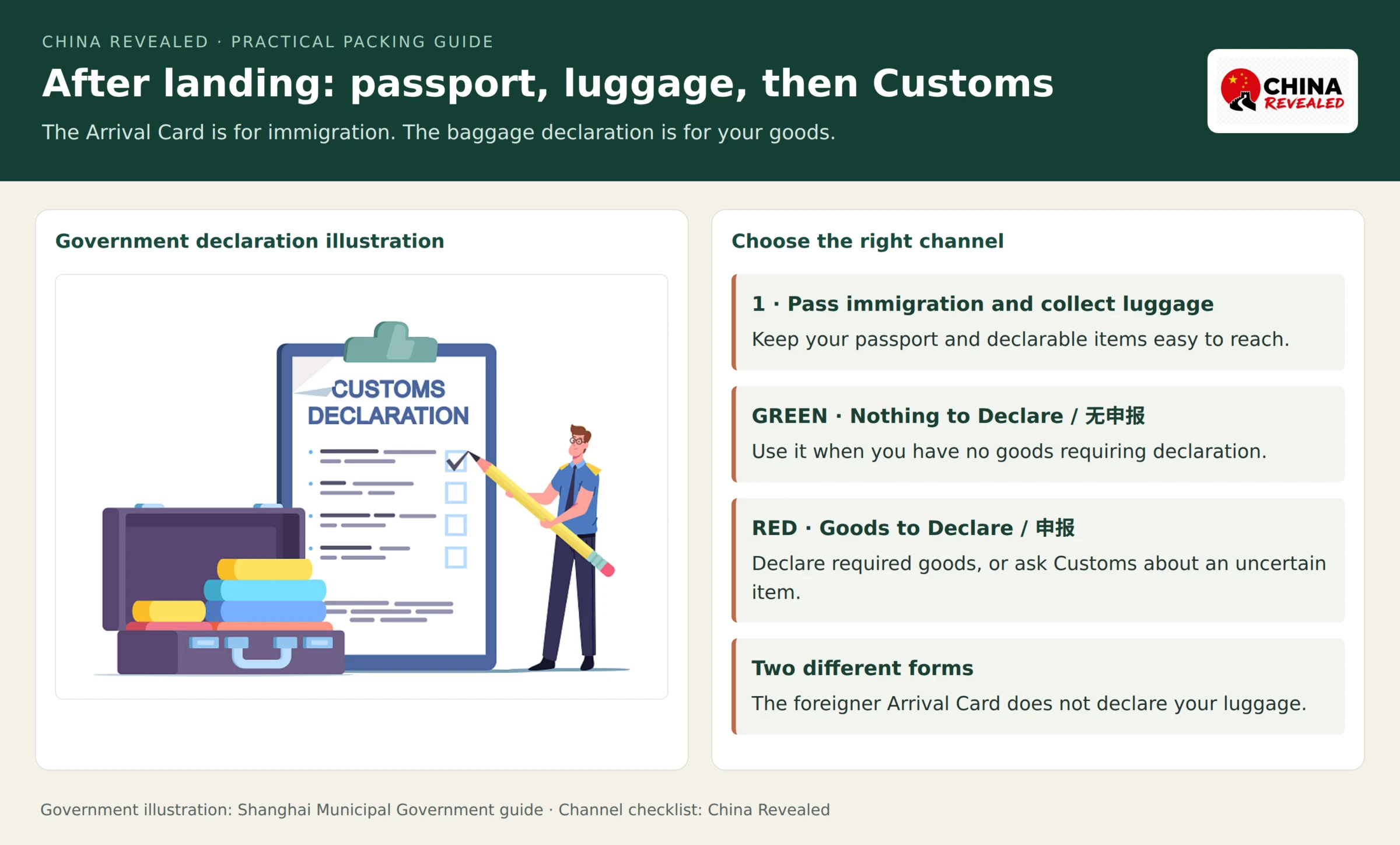
Follow the signs for Arrivals / 入境. The usual sequence is passport inspection, baggage reclaim, then Customs before you reach the public arrivals hall. Keep your passport and any item you may need to declare easy to reach.
Three different checks are involved:
- Immigration / border inspection: your passport and permission to enter. The foreigner Arrival Card belongs to this step.
- Customs / 海关: the goods, food, medicines and cash you bring into the mainland.
- Aviation security / 安检: what you may take onto an aircraft, including liquids, batteries and sharp objects.
Completing an Arrival Card does not declare your luggage. If you also need help with entry documents, use our China Visa and Entry Guide.
After collecting your suitcases, look for Nothing to Declare / 无申报通道, usually green, and Goods to Declare / 申报通道, usually red. Choosing red simply means you need to declare something or ask Customs to check it.
2. Red or green channel—and how to declare
When green is the straightforward route
For normal holiday clothes, toiletries and personal equipment you will take home, with nothing that requires declaration, use the green channel. You do not need to complete a Customs baggage declaration merely because you hold a foreign passport. Customs may still inspect luggage in either channel.
When to use red
Use red for goods that require declaration: restricted items or quarantine goods, cash above the declaration threshold, goods above duty-free limits, commercial goods or samples, and separately shipped luggage. If you cannot confidently classify an item, ask at the declaration desk rather than guessing.
The main figures most short-term visitors need are:
| What you carry | Practical rule |
|---|---|
| Personal-use goods you intend to leave in China | For a non-resident visitor, the general duty-free value allowance is RMB 2,000 in total. Declare goods above it. |
| Foreign-currency cash | Declare amounts above the equivalent of USD 5,000. |
| RMB cash | The ordinary carriage limit is RMB 20,000 per person per trip; do not plan to exceed it. |
| Alcohol and tobacco | Check the limits on the current declaration form, especially if entering from Hong Kong or Macau, which have lower allowances. |
The RMB 2,000 figure concerns goods remaining in China—it is not the value limit for the laptop and camera you bring for your holiday and take home. “Non-resident” refers to your usual place of residence, not simply your nationality. Large quantities for sale are not tourist personal effects.
How to make the declaration
- Use the official channel. You can prepare electronic baggage data through China Customs’ passenger service, or search 海关进出境人员指尖服务 in WeChat or Alipay. Look for Goods Declaration / 行李物品申报, not an old health-declaration tutorial.
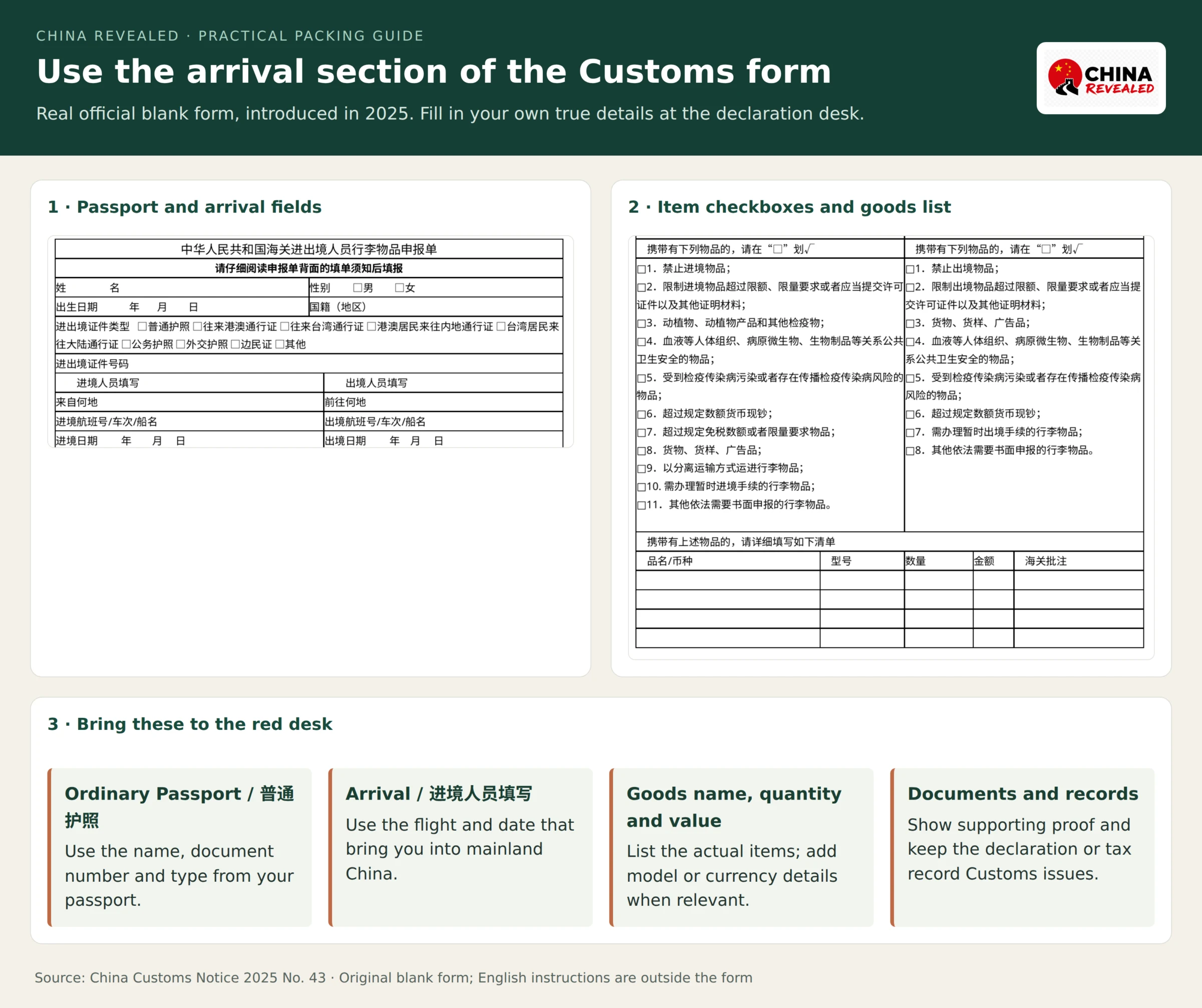
- Choose entry, not exit. Enter your real passport name, document type and number, where you are arriving from, your mainland-arrival flight and date. On a Chinese paper form, 普通护照 means ordinary passport and 进境人员填写 identifies the arrival section.
- List the actual goods. Identify their names, quantities and values or currency amounts; include model details when relevant. Carry receipts, prescriptions and any required permissions with the item.
- Go to the red declaration desk. Submit the paper form or confirm your electronic data there, show your passport and supporting documents, and present the goods for inspection. Ask staff for a paper form if the website or mini-program will not work.
- Keep the result. Retain any declaration record, tax-payment receipt or temporary-import paperwork Customs issues—particularly for valuable equipment you will take out again.
An online draft is preparation for the desk, not permission to take a restricted item through. Declaring a prohibited item does not make it admissible.
3. Medicines: what to prepare
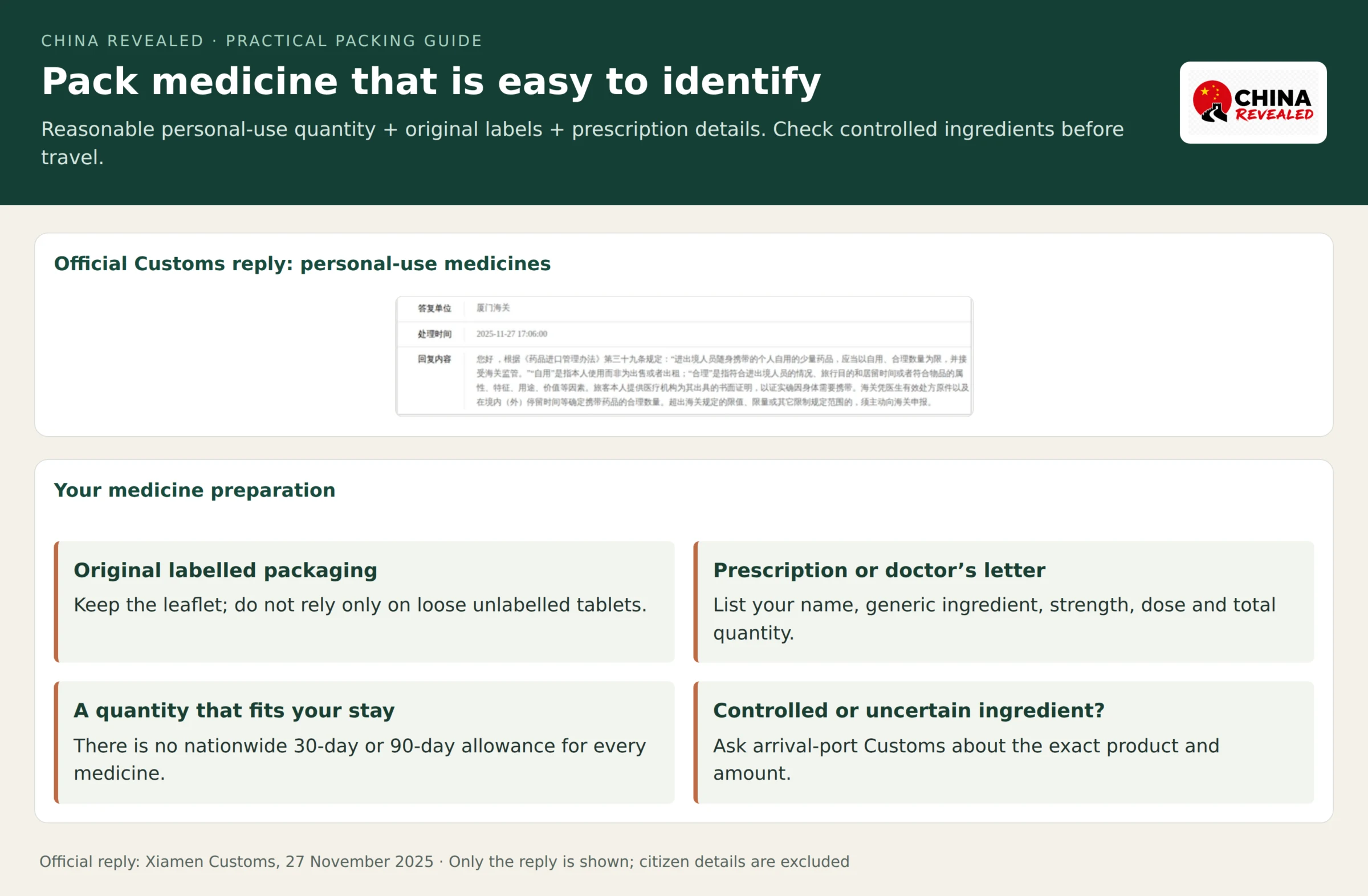
For ordinary personal treatment, pack a reasonable quantity that makes sense for your stay. There is no single nationwide “30-day” or “90-day” allowance for every medicine.
My recommendation is simple: keep the medicine in its original labelled packaging, with the leaflet, and carry your valid prescription or a doctor’s letter for prescription treatment. The documents should identify you, the medicine’s generic name and active ingredient, strength, daily dose and total quantity. A Chinese translation of the key details can make a conversation much easier.
Keep essential medicines and documents in your cabin bag so a delayed suitcase does not interrupt your treatment. A pill organiser is convenient, but do not make unlabelled loose tablets your only way of identifying the medicine.
Check the ingredient—not just the brand
Some ADHD medicines, strong painkillers, sleeping medicines and codeine-containing cough or pain products involve controlled ingredients. Ask the Customs office at your arrival airport before departure about your exact product, dose and total quantity. Controlled personal medicines have specific documentation and quantity requirements; your home-country prescription alone does not settle them.
Leave cannabis, THC products and casual CBD oils or gummies at home. If CBD is part of prescribed treatment, have Customs confirm the exact product and requirements before you travel rather than treating it as an ordinary supplement.
For liquid medicine, insulin, needles or a cooling pack, also contact your operating airline about cabin security and storage. Customs entry permission and permission to carry something through aircraft security are different checks. Keep the medical proof handy and tell security staff what you are carrying.
For a specific answer: in China, call 12360 for Customs advice; use the arrival city’s area code when contacting a different local Customs office. From abroad, use the official enquiry channels or ask a Chinese-speaking contact to help you contact the arrival port. Give the ingredient, strength, total quantity and travel dates—not just “Can I bring my medicine?”
DeepSeek or Doubao can help translate the label and draft that question in English. Ask it to find the current official information, then use the Customs answer for controlled or uncertain products. There is no need to upload a passport or private medical record to get a translation.
4. Food, plants and animals: what to leave behind
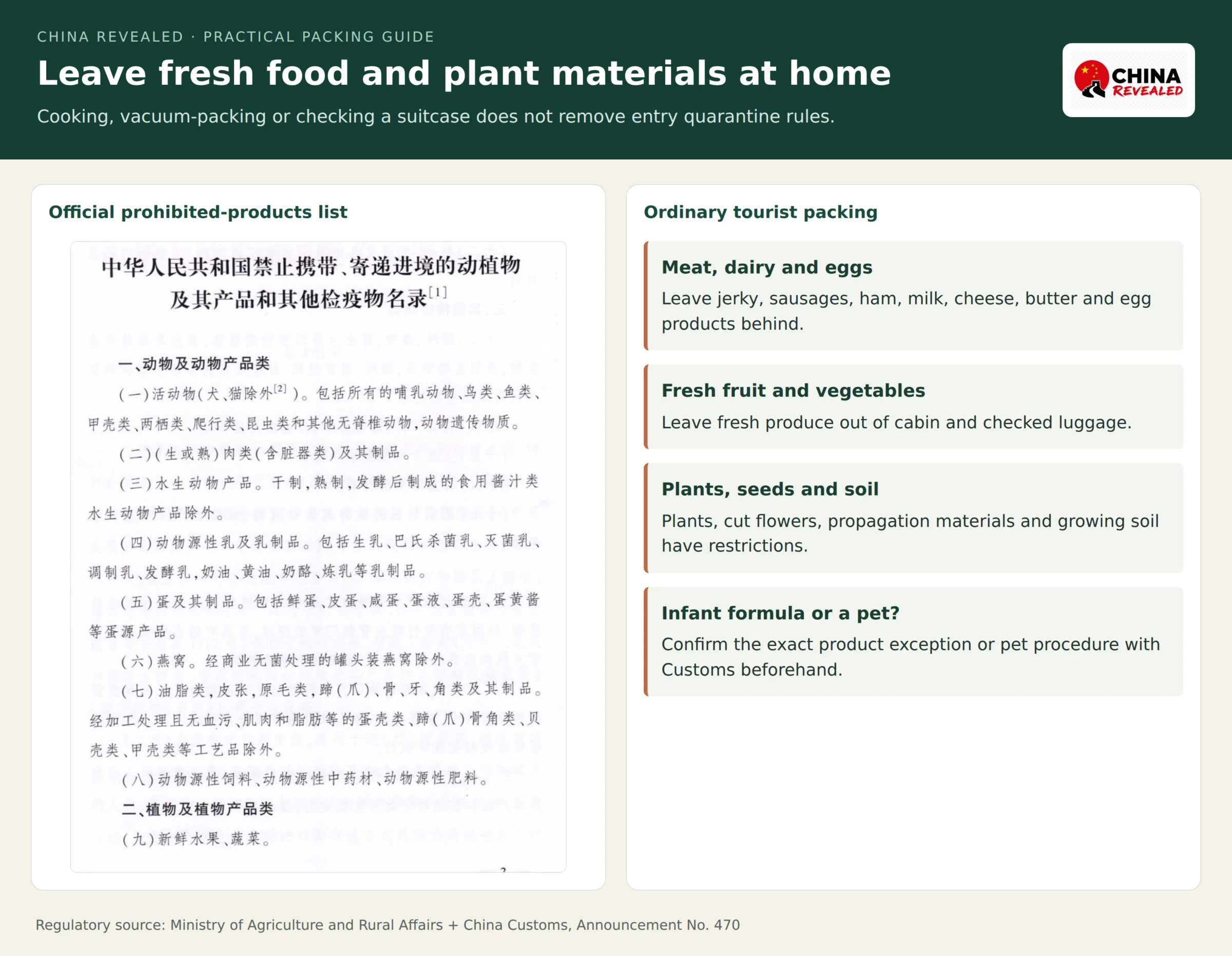
For a normal holiday, I would leave the food gifts and gardening items at home. China has excellent supermarkets and convenience stores; there is little reason to use your luggage for items that complicate quarantine checks.
These are the main categories to leave out of ordinary tourist luggage:
| Leave behind | Common examples |
|---|---|
| Fresh fruit and vegetables | Apples, oranges, fresh chillies, salad vegetables |
| Meat and meat products, raw or cooked | Jerky, sausages, ham, meat-filled food gifts |
| Animal milk and dairy products | Milk, cheese, butter, cream |
| Eggs and egg products | Fresh eggs, salted eggs, egg liquids, mayonnaise |
| Plants and propagation materials | Seeds, seedlings, live plants, cut flowers |
| Soil and organic growing material | Potting soil, compost and plants with soil attached |
Vacuum-packing, cooking or buying something duty-free does not remove these restrictions. The same entry rules apply whether the item is in a checked suitcase or your cabin bag. If you discover one in your luggage on arrival, tell Customs rather than taking it through green.
For infant formula or a medically necessary food, check the exact product, form and origin with Customs before travelling. Do not assume it has an automatic exemption simply because it is for a baby or sold in a sealed container.
Bringing a pet is a separate arrangement
Dogs and cats can enter through a specific pet-quarantine procedure; they are not an ordinary carry-on exception. The usual personal limit is one dog or cat per person per entry, with the required official health documents, rabies-vaccination proof and microchip. Whether quarantine is required depends on the origin and documents. Arrange this with Customs and the airline before booking the pet’s travel; leave other live animals out of a normal holiday itinerary.
Book hotels, flights, train tickets, attractions and other travel services on Trip.com.
5. Your suitcase and cabin bag
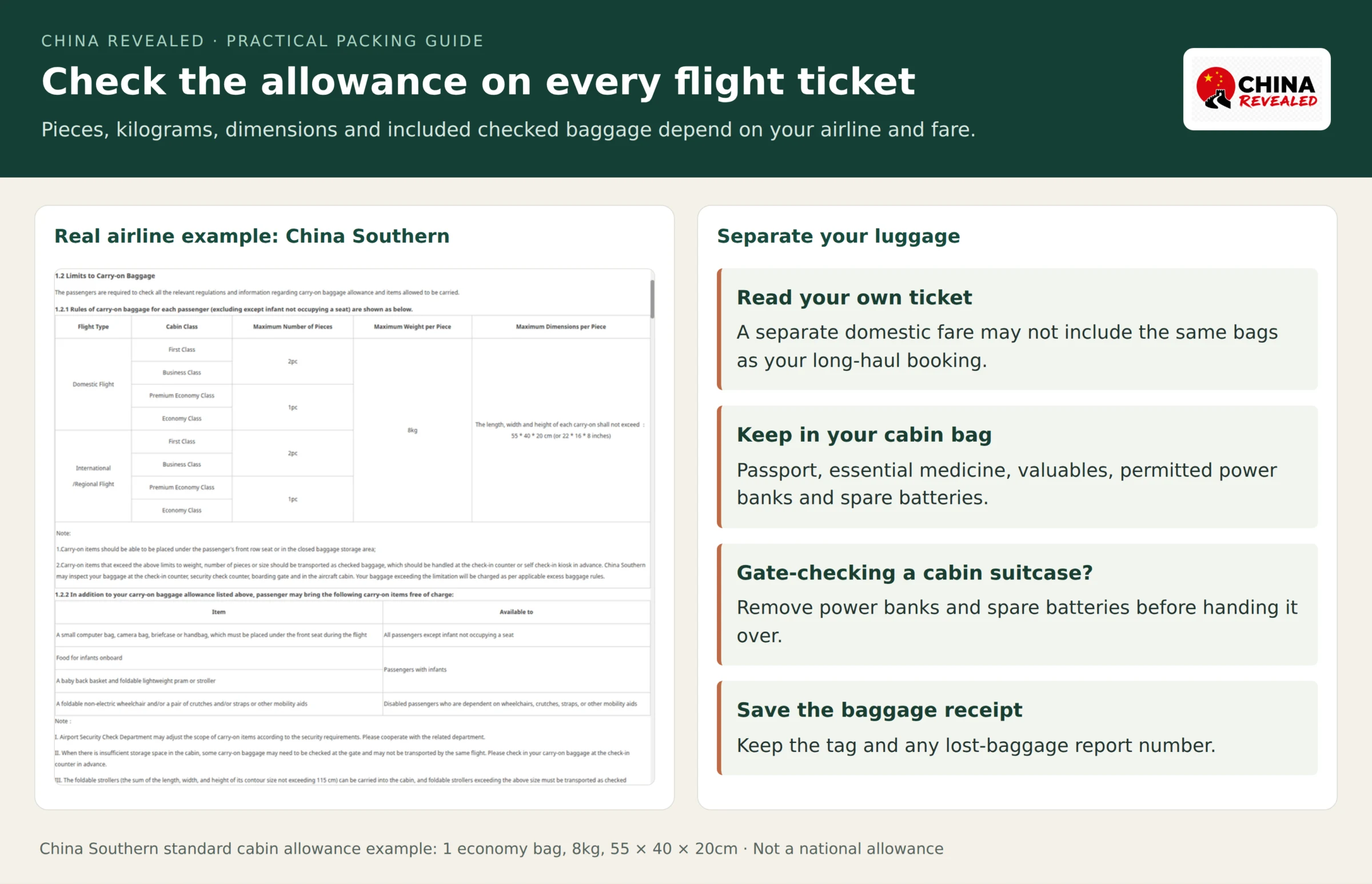
Check the baggage allowance on each ticket, including any separately booked domestic flight. A generous international allowance does not automatically carry over to a cheap domestic fare.
Look for four things: the number of checked bags, weight per bag or total weight, cabin-bag weight, and size limits. Some fares have no included checked baggage. Buying an allowance before departure is usually less hassle than discovering this at the counter.
As a concrete example, China Southern’s current standard economy cabin allowance is one bag up to 8kg, measuring no more than 55 × 40 × 20cm, plus its permitted small personal item. That is an airline example—not a China-wide entitlement. Your own airline and ticket are the ones to follow.
I would divide the bags like this:
- Cabin bag: passport, travel documents, essential medicine, phone, laptop, camera, valuables and permitted power banks or spare batteries.
- Checked suitcase: clothes and larger toiletries, plus items that your airline allows in the hold but not in the cabin.
- Neither bag: prohibited goods, damaged batteries and anything your airline or Customs has refused.
Follow the departure airport’s liquid-security rules; China’s domestic cabin-liquid rules are not identical to every international departure airport’s rules. Put larger toiletries in checked luggage and arrange essential liquid medicines separately with the airline. Customs does not set your cabin shampoo allowance.
If staff take your cabin suitcase for gate-checking, remove the power bank and spare batteries first. Keep the baggage-tag receipt until your suitcase is back with you. Report a missing or damaged bag at the baggage-service desk before leaving the airport and keep the report number.
6. Power banks: capacity, CCC and domestic flights
This is the item I would check first if your itinerary includes flights within mainland China. A perfectly familiar charger from home may be unsuitable for a later domestic flight.
Choose a small, clearly labelled unit
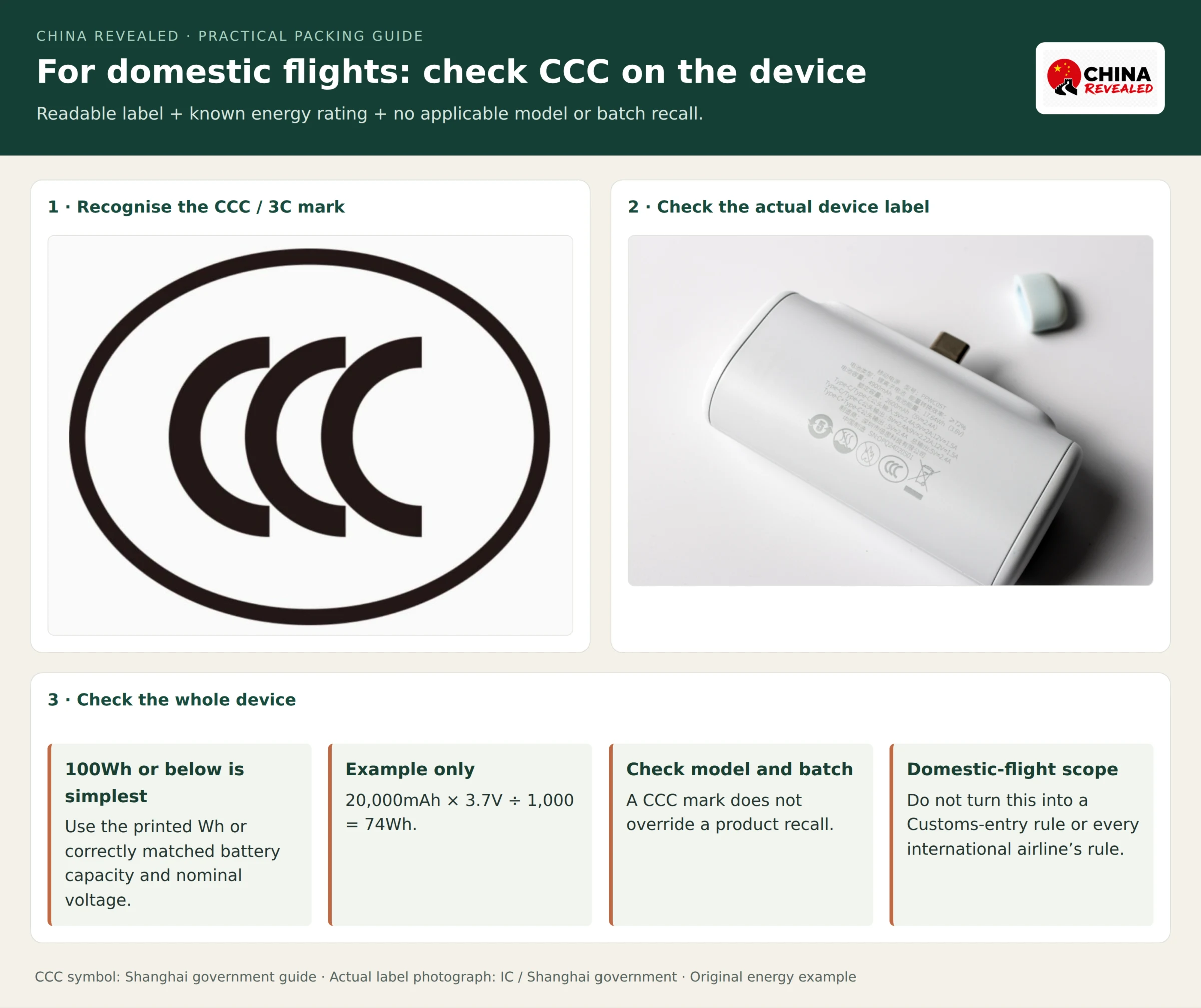
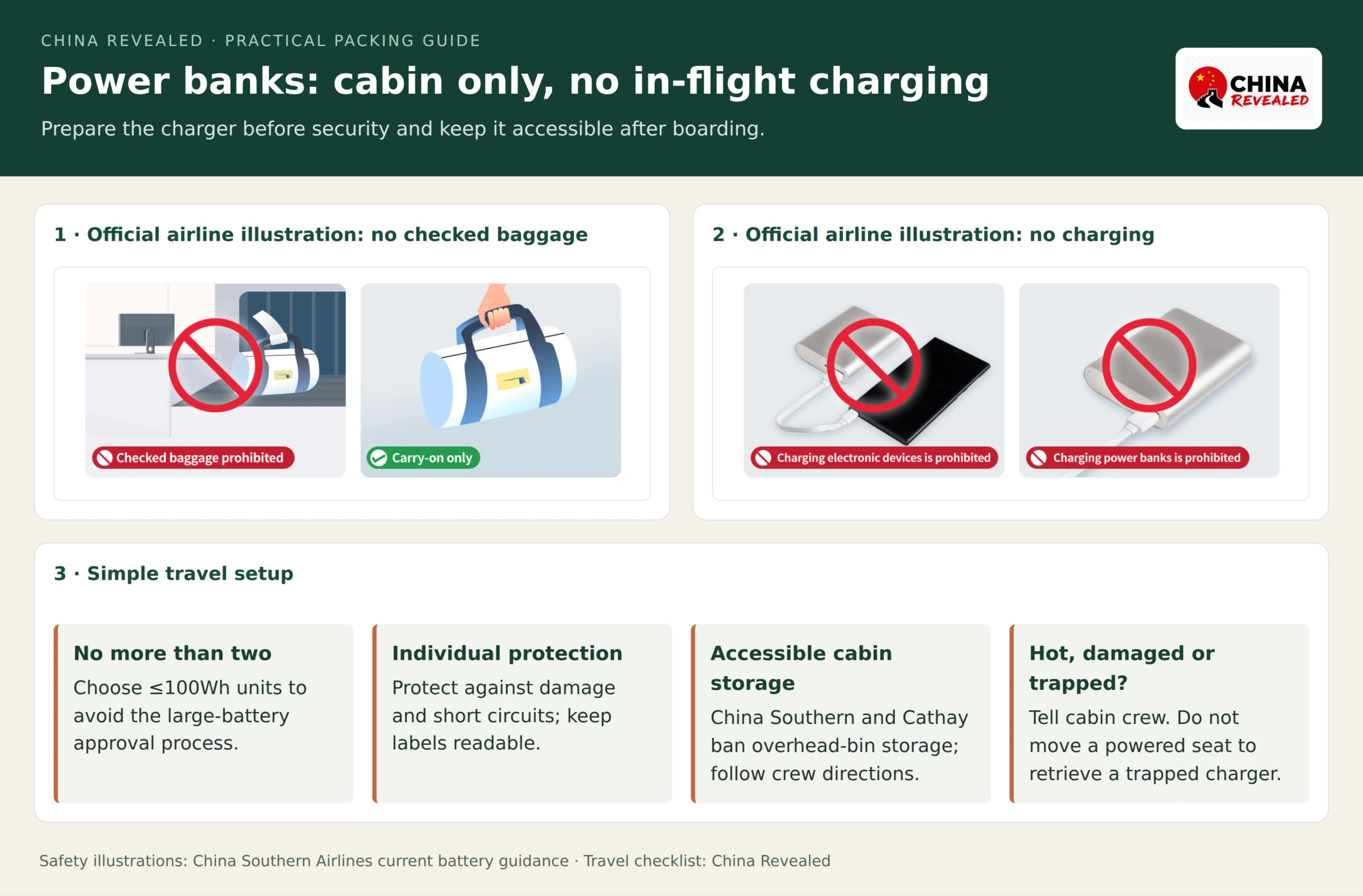
For the easiest journey, choose no more than two power banks, each 100Wh or below, with readable manufacturer, model and energy information. Pack them in your carry-on only and protect each one from damage and short circuits.
A power bank above 100Wh and up to 160Wh requires advance approval where the operating airline permits it. Above 160Wh is not permitted in ordinary passenger baggage. I would avoid the approval complication and use a smaller unit.
Read Wh, not just the big mAh number on the front. If the battery label gives its nominal voltage and capacity, the calculation is:
Wh = nominal battery voltage × mAh ÷ 1,000
For example, 20,000mAh at 3.7V = 74Wh; 30,000mAh at 3.7V = 111Wh. These are calculations, not blanket approvals for every 20,000mAh or 30,000mAh product. Use the voltage corresponding to the stated battery capacity—not the USB output voltage. If the label is unreadable or the energy cannot be established from its markings, choose another unit.
For mainland domestic flights, check CCC / 3C
China’s domestic-flight restrictions cover power banks without a CCC mark, with an unclear mark, or from recalled models or batches. Look at the actual device for the three connected C shapes—CCC, also called 3C certification. A CE or FCC mark is not the same certification.
Check the model and batch against the manufacturer’s recall information. Having a CCC mark does not override a recall, and a picture of a certificate on a seller’s listing is not a substitute for checking your own device.
The practical route for a visitor whose home charger lacks CCC is to buy a compliant replacement from a reliable retailer in China before the domestic flight. Show this:
我要有清晰3C标志、100Wh以下、没有被召回的充电宝。
I’d like a power bank with a clear 3C mark, below 100Wh, that is not recalled.
The CCC domestic-flight requirement is not an entry-Customs rule, and should not be applied automatically to every foreign airline flying into China. Check your international carrier too, then prepare for any mainland domestic segment separately.
Once you are on board
Keep the power bank accessible, switched off if it has a switch, and disconnected. Do not use it to charge your phone or charge the power bank itself during the flight. China Southern and Cathay Pacific also prohibit storing power banks in overhead bins; use the under-seat bag or the place specified by the crew.
If your charger becomes hot, swollen, damaged or trapped in a seat mechanism, tell cabin crew immediately. Do not move the powered seat to retrieve it yourself.
7. The final packing check
Before closing your bags, check these six things:
- Medicines: original labels, prescription documents, sensible quantity and any controlled-ingredient answer.
- Food and plants: no fresh produce, meat, dairy, eggs, seeds, plants or soil slipped into a gift bag.
- Customs: identify anything you must declare; keep receipts and supporting documents together.
- Luggage: confirm each flight’s allowance, not just the long-haul ticket.
- Power bank: readable energy details, permitted quantity, clear CCC for domestic travel, no recall or damage, cabin bag only.
- Offline records: passport/entry preparation, flight details and useful Customs or airline replies saved where you can find them.
My advice is to keep the airport routine simple: sort unusual items before departure, collect your luggage after passport inspection, and ask at the red declaration desk when an item needs checking. You do not need to turn normal holiday packing into a paperwork project.
Mainland-China rules and airline examples checked on 15 October 2026.
About China Revealed
China Revealed is an independent English-language travel guide dedicated to China.
We bring together China travel guides, destination information, local insights and practical travel resources in one place.
Our travel database covers China's provinces, cities, famous attractions, hidden gems, local cuisine, transportation, accommodation, visa requirements, digital payments, mobile connectivity and the other practical details travelers need to explore China.
We focus on depth, careful research and accuracy. Our guides combine official sources, detailed destination data, local knowledge and regularly updated information to give reliable, practical travel advice.
Whether you're visiting China for the first time or exploring beyond the popular destinations, China Revealed is an all-in-one resource for discovering the real China.
China Revealed — Your practical guide to China.
Some links on China Revealed, such as Trip.com booking links, are affiliate links. If you book through them, we may earn a commission at no extra cost to you. This does not change what we recommend.