

Your First Day in China: Airport Transfers, Hotel Check-in and Useful Addresses

Your first day in China does not need a packed itinerary. Get through the airport, make sure your phone works, reach the right hotel and get checked in. Once those things are done, a meal and a short walk are usually enough.
The small details matter more than the number of apps you install. A saved Chinese hotel address can be more useful than an airport Wi-Fi connection that keeps dropping. Knowing which night your room is booked for can save you an awkward conversation at reception at one in the morning.
This guide follows the journey from landing to your first evening. It brings together China Revealed’s arrival, connectivity, payment and transport guides, with reference screenshots and practical cards you can save before travelling.
In this guide
- Before landing: save the details you cannot afford to lose
- 1. Get through the airport before arranging the city journey
- 2. Make sure your phone works before you leave arrivals
- 3. Choose an airport transfer that suits your arrival
- 4. Find the actual pickup point—not just the blue map dot
- 5. Check in with your passport and confirm the charges
- 6. Know who registers your accommodation
- 7. Save your hotel before your first walk
- 8. Make an offline address card you can show a driver
- 9. Save a few useful places around your hotel
- Frequently asked questions
Before landing: save the details you cannot afford to lose
Put these in an offline note or downloaded folder: your passport and entry-document details, the accommodation confirmation, return or onward booking, and the hotel’s Chinese name, full address and telephone number. Keep the original passport accessible; a photo is a backup, not a replacement for the document.
Save the exact hotel branch. An international or Chinese hotel chain may have several properties with almost the same English name. Ask the property for its Chinese name and address, an Amap location and the entrance where cars should stop. A booking reference alone will not help a driver find a side-street reception.
If you need a China Arrival Card, use the free official NIA arrival-card service. Most ordinary foreign tourists need the declaration, including many visa-free visitors. An arrival card does not give you a visa or establish visa-free eligibility. Check your entry route before travelling using our China visa and entry guide.
Install and open the apps you actually plan to use while you still have a familiar connection. For day one, a working map, a translation option and one reliable payment or transport setup matter more than a screen full of unfamiliar icons.
Landing after midnight? Check which hotel night you booked
This is easy to get wrong. Arriving at the hotel at 1:00 am on October 14 does not mean a normal booking starting October 14 gives you a room immediately. That booking may begin at the property’s afternoon check-in time.
If you want to sleep as soon as you arrive, arrange the room for the night of October 13, and get the hotel’s written confirmation that it will hold the reservation for your October 14 early-morning arrival. Otherwise, the hotel could treat the booking as a no-show. This is a date example, not a universal hotel check-in time.
For a morning arrival, ask separately about early check-in, its cost and availability. If it is not confirmed, plan for luggage storage until the room is ready. Update the hotel when a flight delay substantially changes your arrival time.
1. Get through the airport before arranging the city journey
Follow the live signs for arrivals, immigration, baggage and customs. Keep the passport, applicable visa or entry permission, hotel address and onward evidence ready. Answer border questions plainly and truthfully; the officer may ask where you are staying and when you will leave.
If you are using 240-hour visa-free transit, follow the appropriate transit or temporary-entry instructions. Do not join a random line because it looks shorter. Transit permissions can restrict your stay and travel area, so make sure the hotel and any onward domestic journey fit your actual permission.
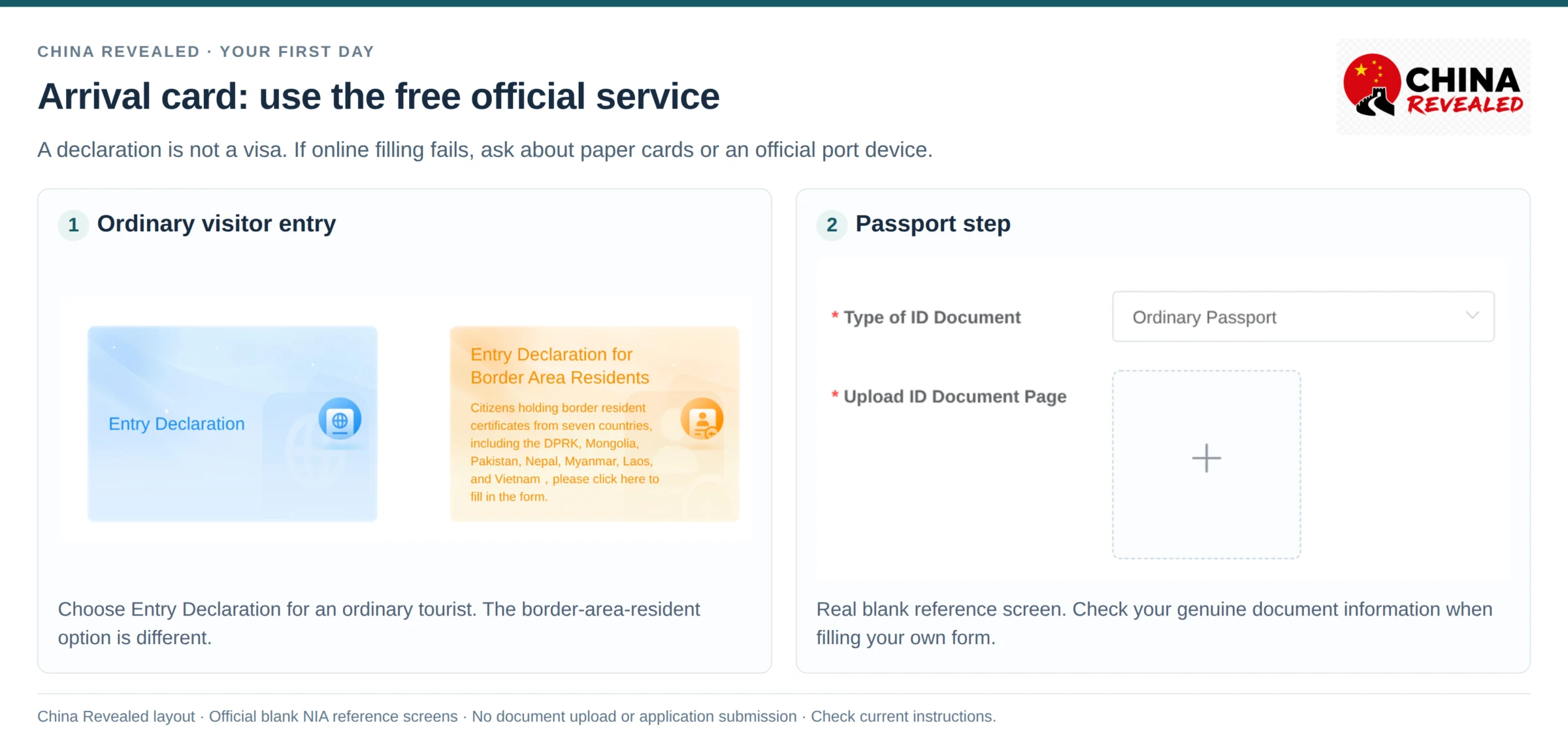
If the online arrival-card service did not work before departure, paper cards and official port devices remain available. Ask airport staff rather than paying a look-alike website. If your entry date or authorised stay is unclear, ask while you are still at border inspection.
Collect your luggage before requesting an immediate ride. Check the carousel and airline process for missing or damaged bags before leaving the baggage area. A waiting driver is not a reason to skip an airline baggage report.
Do not assume the whole process takes a fixed number of minutes. Immigration queues, luggage and an unfamiliar terminal can all add time. A same-day train booking needs a buffer for those steps as well as the journey to the correct railway station.
2. Make sure your phone works before you leave arrivals
Open the map and check whether it can load a destination. Open your chosen transport or payment app too. Seeing a signal indicator is not the same as having a connection that works for the tasks you need.
If you installed a travel eSIM, choose it as the mobile-data line and follow the provider’s activation and roaming instructions. A data-only eSIM does not give you an SMS-capable Chinese phone number. Keep the number used for your accounts available for verification messages, subject to your home carrier’s roaming settings and charges.
If you need a local SIM, use an official carrier counter or business hall and bring your original passport. Airport counters and available plans vary. You can finish non-urgent setup in the city rather than spending your whole arrival trying to buy a particular package. Our China SIM vs eSIM guide explains the trade-offs.
Where to ask for help
Start with the airport’s official information desk or international-visitor service point. In Shanghai, one-stop centers in the international arrivals halls at Pudong T1 and T2 and Hongqiao T1 provide help with communication, payments, transport and local information. Those are Shanghai examples—not a promise that every Chinese terminal has the same facilities.
If airport Wi-Fi asks for a number you do not have, ask about a visitor authentication option. Pudong’s published guidance describes passport-page verification for its free Wi-Fi. Use only the airport’s genuine login service; do not upload passport images to an unfamiliar page someone sends you.
Hotel Wi-Fi and mobile data can behave differently. Some international roaming or travel-eSIM services route data outside the mainland, while ordinary local connections restrict certain overseas services. Save your bookings and Chinese addresses offline instead of relying on Gmail, Google Maps or any one online service being available.
Book hotels, flights, train tickets, attractions and other travel services on Trip.com.
3. Choose an airport transfer that suits your arrival
There is no single best transfer for every airport. Choose according to the time you leave the terminal, your luggage, the hotel’s location and the setup you can actually use.
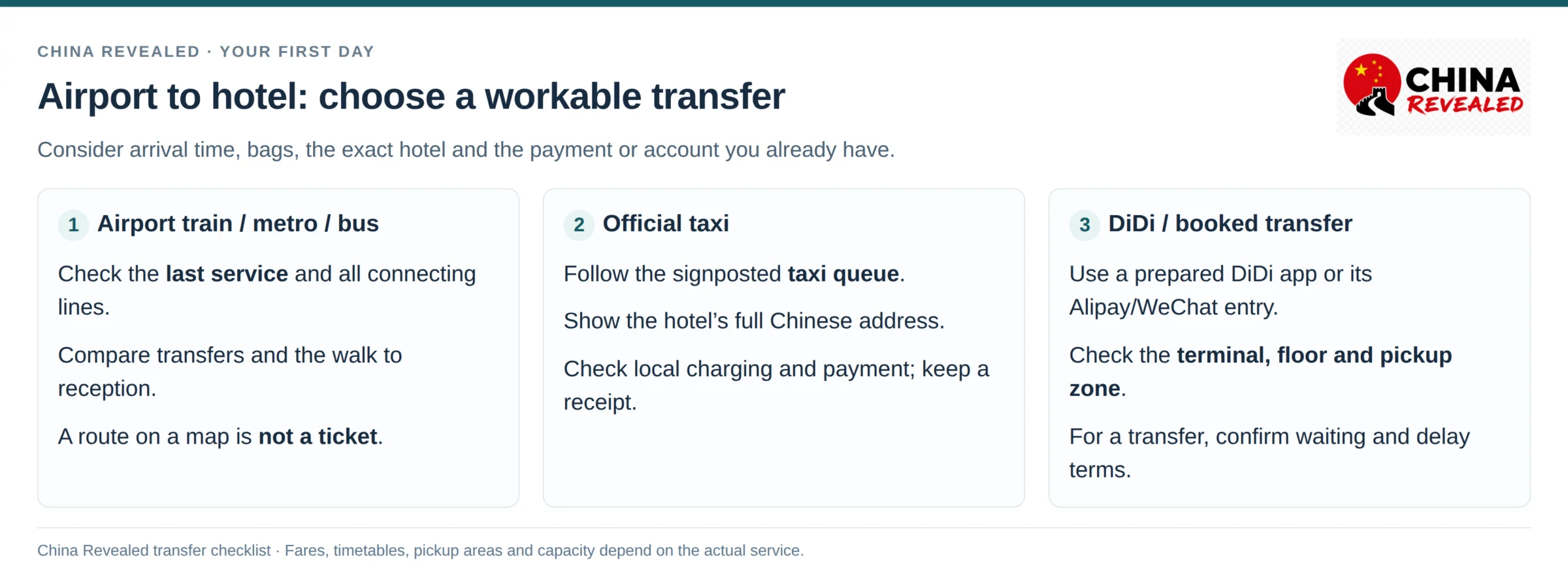
Airport train, metro or bus
Public transport can be a good choice when it is running, the hotel is close to a station and you can manage the transfers with your luggage. Use Amap to compare the whole route (see comparing subway and bus routes in Amap), including changes and the walk from the final stop to reception.
Check the last service from the airport and any connecting line. A train departing the airport is not useful if the city connection has already stopped. A daytime screenshot is not evidence that the route will work after your late flight.
Special airport trains may end outside the neighborhood where you are staying. For example, Shanghai’s Pudong Maglev ends at Longyang Road, where many visitors need another connection. It is not a direct train to every central hotel. Buy the appropriate ticket or use an accepted local fare method; a map route is not a transit ticket.
An official taxi
A taxi is often the simpler choice if you are tired, carrying several bags or struggling with your phone. Follow the airport signs to the official taxi queue. Avoid unsolicited drivers approaching you in the arrivals hall.
Show the hotel’s Chinese name and full address, not just an English brand name. Follow the local taxi’s lawful fare arrangement—usually a meter—and clarify any applicable tolls or other charges. There is no one airport-to-city taxi price for all of China.
Check payment before setting off. Carrying some RMB cash is a useful fallback, but do not assume every taxi has an international-card terminal. Keep the receipt for a lost bag or fare query.
DiDi through its app, Alipay or WeChat
You can enter DiDi through the standalone DiDi China app, the DiDi mini-program in Alipay, or the DiDi service/mini-program in WeChat. Search for DiDi / 滴滴出行 if the host app’s shortcut is not visible.
Once you reach the actual DiDi page, the basic process is similar: pickup, destination, vehicle, request and payment. The entrances, account permissions and payment authorisations can differ. You do not need to install all three, and a generic ride-hailing page may include providers other than DiDi.
Use the route you have already prepared. If your account or card fails, an official taxi or an arranged transfer is a better fallback than repeatedly starting new registrations beside the road. Our DiDi guide for foreigners covers setup, payment and pickup step by step, and the DiDi YouTube walkthrough shows the ride process.
A pre-booked hotel or private transfer
Before paying for a transfer, confirm the airport, terminal, flight number, meeting place, passenger and luggage capacity, waiting allowance and delay policy. Find out whether someone will meet you inside arrivals or whether you must walk to a car park.
Keep the operator’s official contact and booking offline. If your flight changes, tell both the transport provider and hotel. The word “airport transfer” alone does not guarantee a named greeter, unlimited waiting or space for all your suitcases.
4. Find the actual pickup point—not just the blue map dot
For an app-based ride, clear immigration and collect bags first. Then follow Ride Hailing / 网约车 signs or the live order’s airport guide. The taxi queue and ride-hailing zone can be in different places.
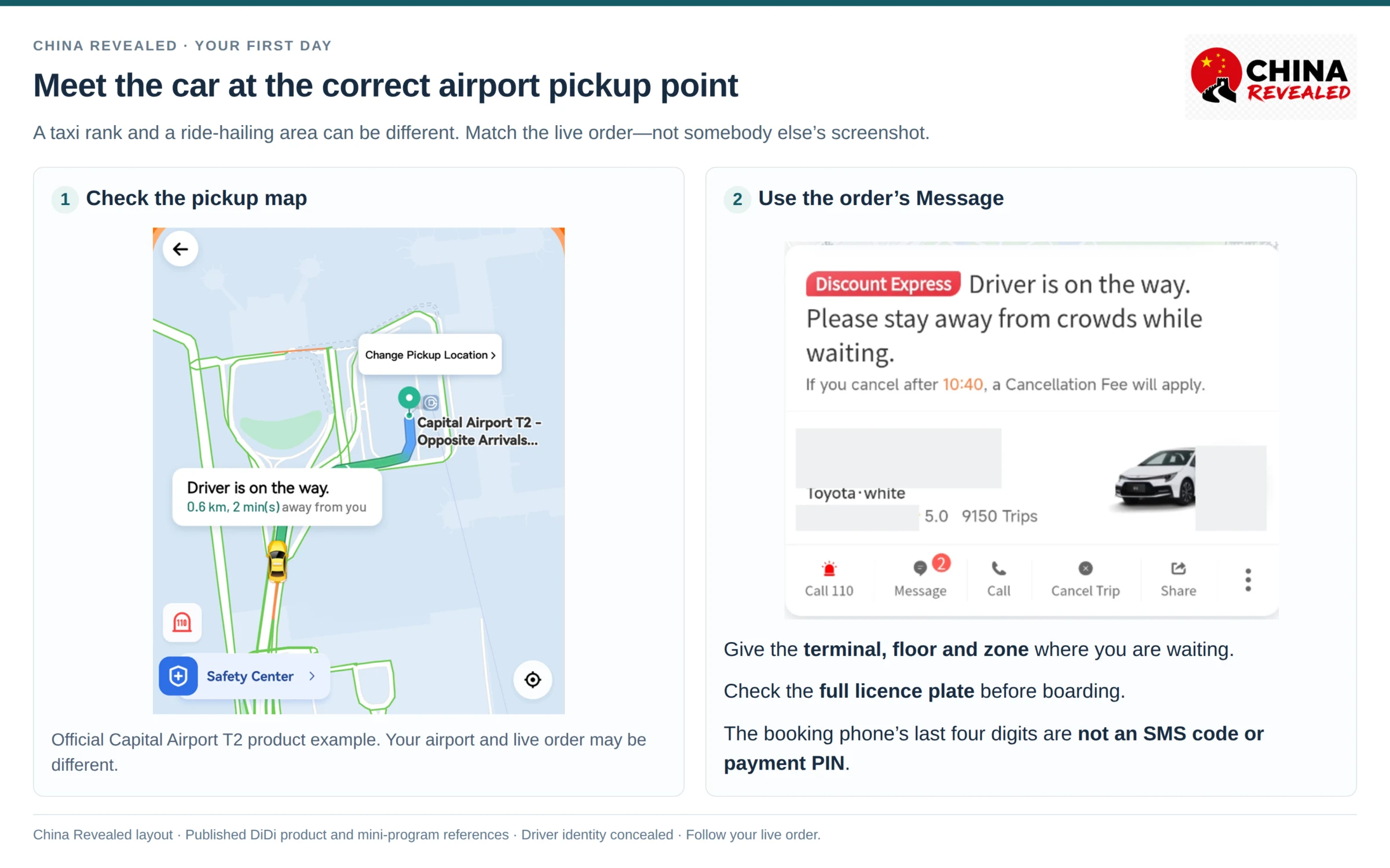
Check the terminal, floor, exit and zone or bay number. A pin just outside the building may be on another level. Reach the agreed point before requesting the car whenever possible.
Once matched, use the order’s message function if a call is difficult. DiDi’s Chinese–English text translation can help, but it does not mean the driver speaks English or that a phone call is translated. “I am at pickup zone 3” is useful only if that is where you really are.
Before boarding, compare the full licence plate and vehicle details with your order. If the driver asks for the last four digits, use the phone number attached to that booking. Never give a driver an SMS verification code, bank code or payment PIN.
Keep your phone connected until the ride and payment are complete. At the hotel, check your bags and phone before leaving the car.
5. Check in with your passport and confirm the charges
At reception, show the reservation and original valid passport used for the booking. Each guest needs the applicable identity document, including children. Do not assume one adult’s passport registers everyone in the room.
If you entered visa-free, say so when asked about your entry basis; you do not need to invent a visa number. Staff may need to check the relevant entry information as well as the passport. Wait for the document to be returned after the check-in process rather than leaving it overnight as a deposit.
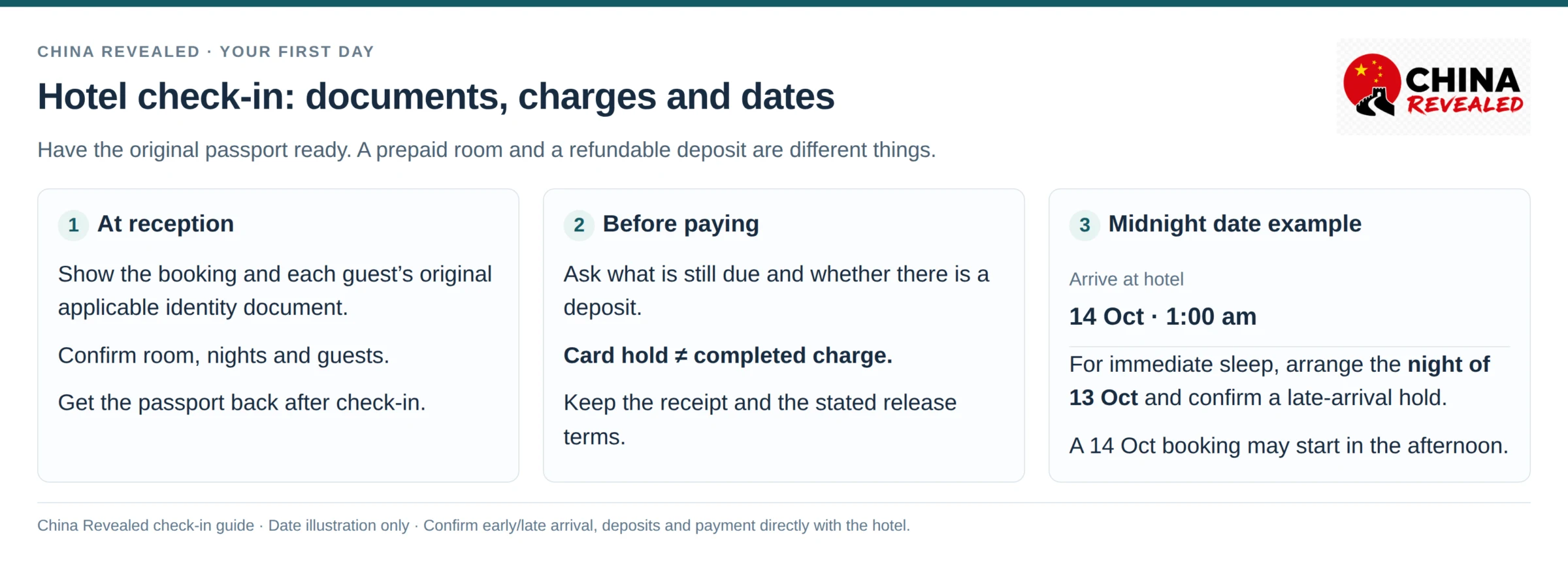
Confirm the room type, guest count, nights and anything still due. A prepaid room can still have a separate deposit. Ask the amount, accepted methods and how it will be returned before you pay.
A card pre-authorisation holds funds; a charge collects them. The hotel’s release and the bank’s visible release can happen at different times. There is no universal deposit amount or guaranteed refund time. Get a receipt for a cash deposit and retain card or mobile-payment records.
Pay through the hotel’s normal payment process, not a staff member’s personal wallet. If your foreign card fails, ask for another supported method and contact the issuer where appropriate. Do not assume that a successful small shop purchase means a large hotel payment or deposit will automatically work.
Before leaving reception, ask about checkout time, breakfast, Wi-Fi, after-hours access and the correct hotel entrance. In the room, check that the key and lock work, identify the emergency exit route and report a serious problem while reception is available.
What if the hotel says it cannot accept foreigners?
Chinese authorities have directed hotels not to refuse foreign guests merely because they claim to lack “foreign-related qualifications.” The old rule of thumb that tourists must find a special “foreigner-licensed” hotel is not a reliable guide.
Registration difficulties can still happen in practice. Show your confirmation, ask for the manager and contact the booking platform through the actual reservation. Keep the reason and support conversation recorded. Ask for help resolving check-in or finding a nearby replacement; do not assume a refund or free rebooking is guaranteed until support confirms it.
Late at night, prioritize a safe, staffed place to sleep rather than a long argument. Before travel, written confirmation of passport registration and late-arrival arrangements at the exact branch can reduce this risk.
6. Know who registers your accommodation
At a hotel, the hotel handles your accommodation registration and reporting. Ask reception to complete it. You normally do not need a separate police-station visit for that same hotel stay.
For a friend’s home, private apartment or other non-hotel accommodation, you or your host must register with the local public-security authority within 24 hours of checking in. Agree on this before arrival. A self-check-in code or a host saying “it is fine” is not proof that registration has been completed.
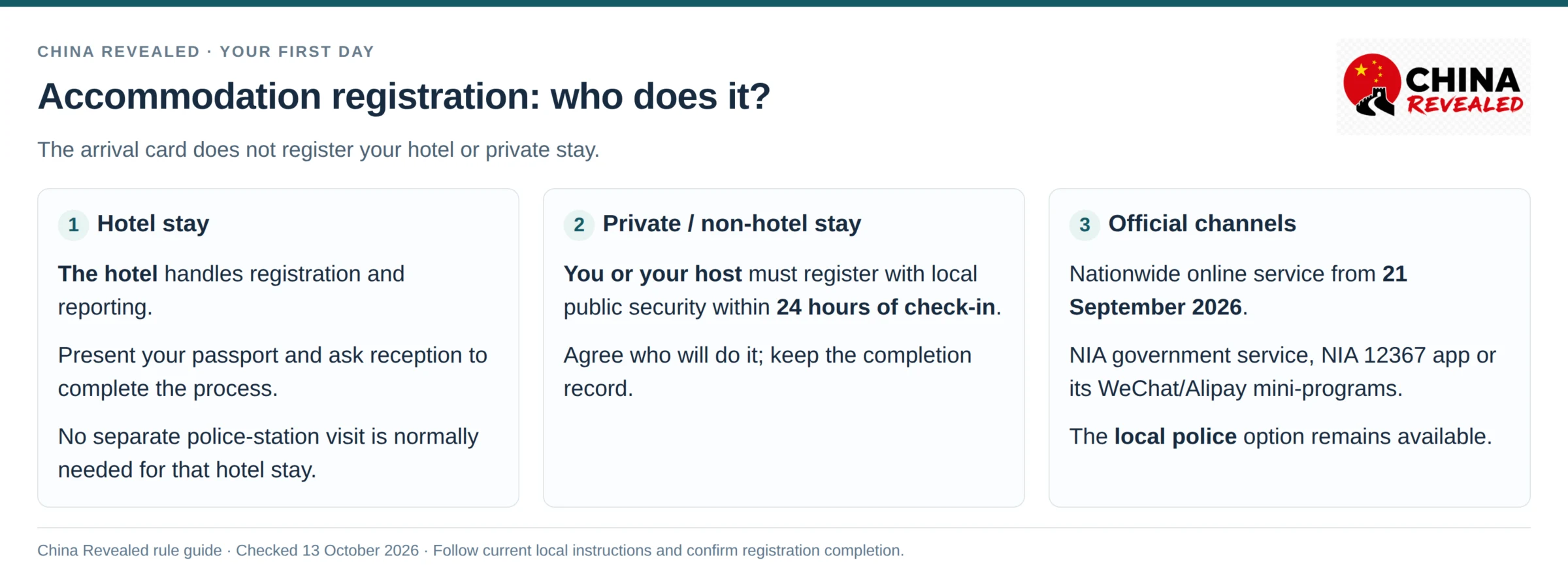
From September 21, 2026, online non-hotel registration is available nationwide through the NIA government-service website, NIA 12367 app, and its WeChat or Alipay mini-programs. The local police route remains available with the same legal effect. Use the official channel and check the completed registration record; an unsuccessful attempt is not completion. Our visa and entry guide covers registration and staying within your permitted stay.
If the online process does not work for your documents or address, ask the host or local police how to complete it before the deadline. Keep the confirmation where available. When moving to another private address, arrange the registration for that stay too. Entry and registration rules can change, so follow current instructions for your actual circumstances.
7. Save your hotel before your first walk
Do this while you are still at reception. Ask staff to confirm the hotel’s Chinese name, full address, map location and main guest entrance. A business card or written address is a useful second backup.
In Amap, search using that Chinese name or address. Check the branch and pin, then look for Save / Favorites / 收藏, often shown by a star. Some versions also have China Travel Guide → My Hotel. Use whichever is available; signing into extra services is not necessary just to understand where the hotel is.
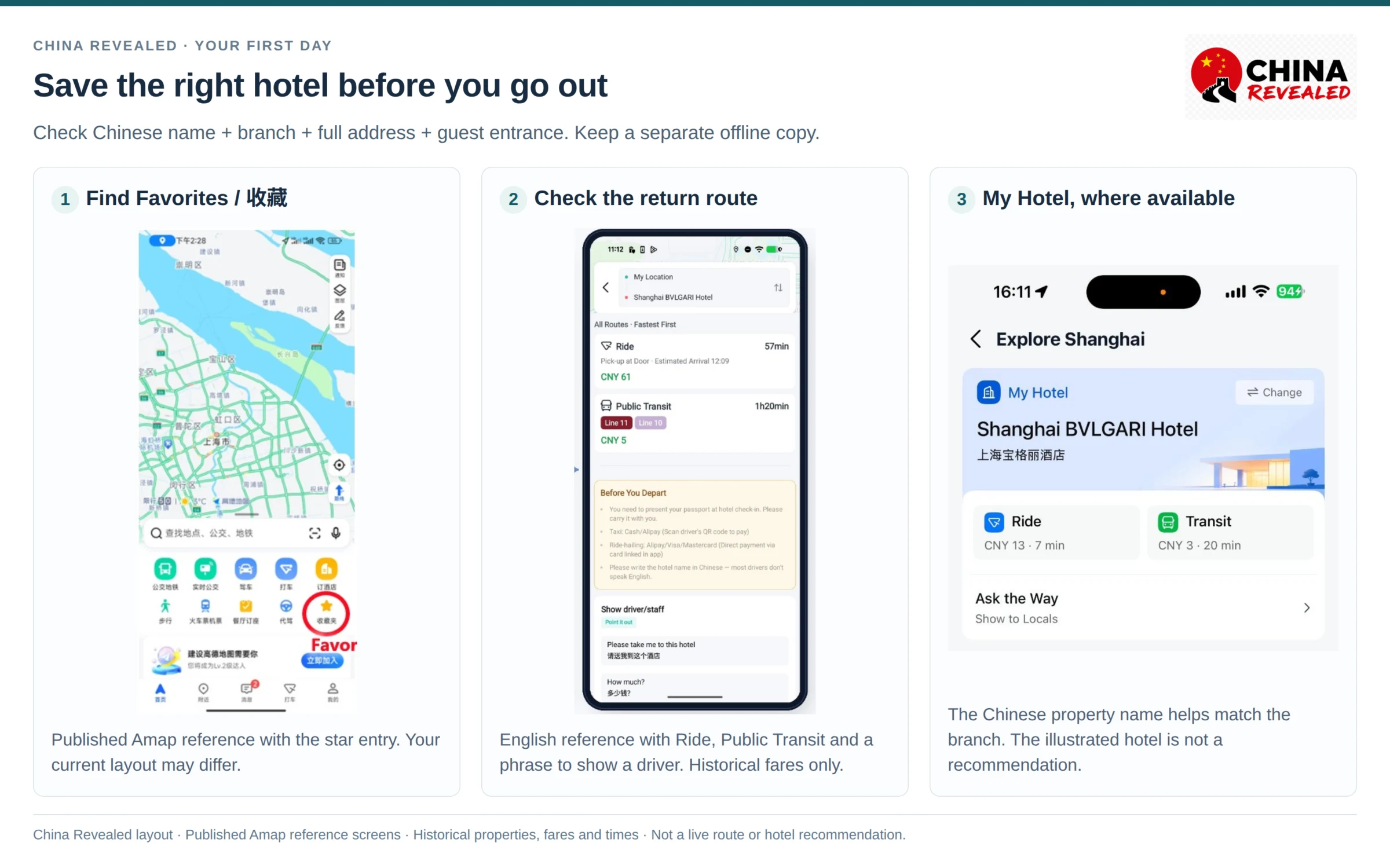
Keep the address in a separate offline note too. A saved app pin may require a connection or account to retrieve on another device. For the actual steps, see our Amap guide for foreigners.
When returning on foot, select Walking / 步行, not a driving route. Check the guest entrance and building access; the hotel might be upstairs or inside a larger complex. A map pin near the building is not always the reception door.
8. Make an offline address card you can show a driver
Use the card below as a template. Replace every bracketed field with your real hotel information. Do not paste the placeholder text into an arrival card, booking or taxi order.
My hotel / 我的酒店
Chinese hotel name and branch / 酒店中文名称及分店:[Your hotel’s confirmed Chinese name]
Full address / 详细地址:[Building, street number, district and city]
Guest entrance / 入口:[Confirmed entrance or drop-off point]
Hotel telephone / 酒店电话:[Confirmed telephone number]
Please take me to this hotel. / 请送我到这家酒店。
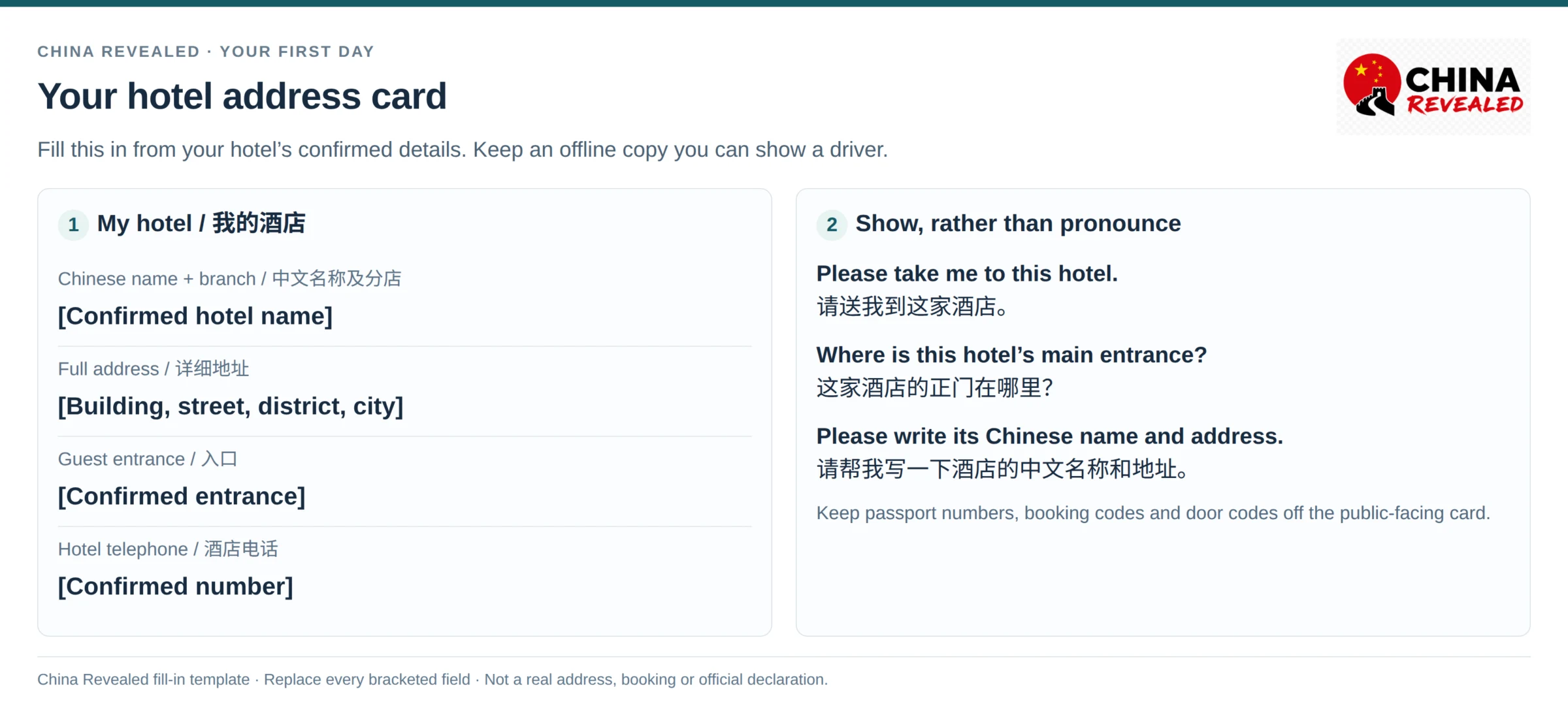
Copy the Chinese characters directly from the hotel or booking. Do not rely only on a machine translation of a brand name, and do not write only the city. For an apartment, add the building, unit and access instructions you actually need. Keep door codes private.
Two useful phrases to show rather than struggle to pronounce:
“Where is this hotel’s main entrance?” — “这家酒店的正门在哪里?”
“Please write the hotel’s Chinese name and address for me.” — “请帮我写一下酒店的中文名称和地址。”
A driver may not speak English, but a clear Chinese address makes the task much easier. Do not put passport numbers, bank information or payment codes on the card you show in public.
9. Save a few useful places around your hotel
Start the search from the hotel location, not from the airport or a train you are still sitting on. Save a nearby convenience store, a simple place to eat, the metro entrance you will use and your next departure station or airport terminal.
For basic map searches, these Chinese terms can help: 便利店 means convenience store, 超市 supermarket, 药店 pharmacy and 地铁站 metro station. 急诊 means emergency department; it is not interchangeable with an ordinary pharmacy.
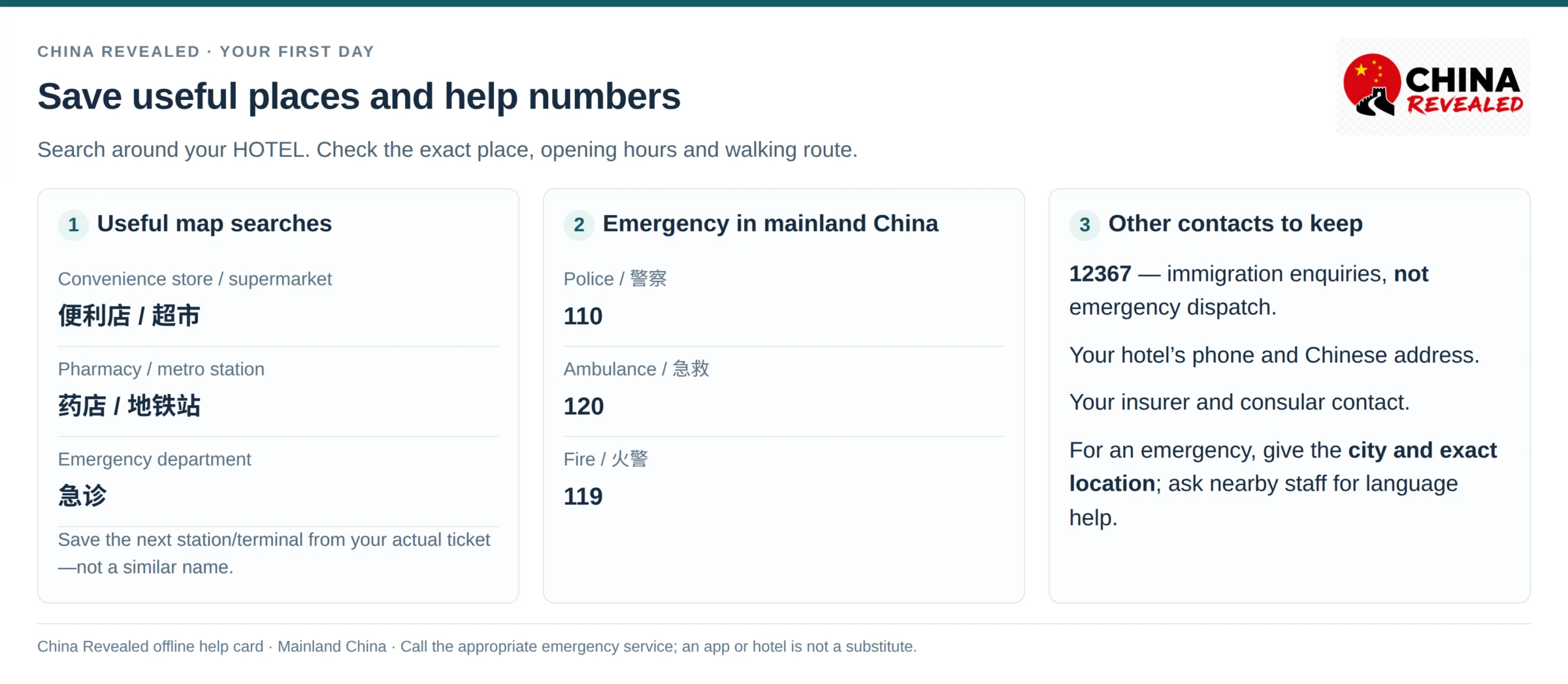
Check opening hours, the exact branch and walking time, not only the straight-line distance. A recommendation across a river may not be an easy stroll. For tomorrow’s train or flight, save the exact station or terminal from the confirmed ticket. Hongqiao Railway Station is not Hongqiao Airport; Beijing Capital Airport is not Beijing Daxing.
For emergencies in mainland China, save 110 for police, 120 for an ambulance and 119 for fire. Give the city and exact location as clearly as you can, and ask nearby staff for language help if needed. 12367 is for immigration enquiries, not an emergency ambulance or police dispatch line. Your hotel’s phone, insurer and consular contact are also worth keeping offline.
Keep the first evening simple
Pick an easy meal close to the hotel, make sure you know how to return and leave time to rest. If you want delivery, ask reception to help enter the real Chinese delivery address and check where food must be collected. Do not assume a rider can enter the lift or bring it to your room. Our Meituan guide explains the ordering steps.
For payment, use the method you already prepared. Alipay offers broader travel services. TenPayGo can be a simpler option for supported everyday merchant QR payments, but it is not a substitute for every mini-program or hotel deposit arrangement. There is no need to finish a complicated WeChat registration just to buy your first meal if another method works; our WeChat Pay guide covers it when you are ready.
Charge your phone, keep the hotel card handy and check tomorrow’s departure time. That is a perfectly good first day.
Frequently asked questions
Can I use DiDi without downloading another app?
Yes. You can use its service inside Alipay or WeChat where available. Complete the account, location and payment setup requested by that entry. Once inside DiDi, the main booking process is broadly the same as in the standalone China app.
Do I need a Chinese phone number immediately?
Not always. A travel-data connection and eligible overseas number can cover many first-day tasks. A local SIM can help with calls or services requiring local SMS, but a data-only eSIM does not provide those features. Check the requirements of the service you are using.
Can I check into a hotel with a passport photo?
Bring the original valid passport for check-in. An offline photo or booking screenshot is a backup, not an equivalent identity document. If the passport is lost, contact the appropriate authorities and your consular service rather than assuming a photo will solve it.
Do I need police registration when staying at a hotel?
The hotel handles registration for a normal hotel stay. For non-hotel accommodation, you or the host must complete registration within 24 hours of checking in. The arrival card does not replace it.
What if my hotel booking starts today but I arrive at 1 am?
Check the room’s actual availability with the hotel. A booking beginning today may start in the afternoon. Arrange the previous night and a confirmed late-arrival hold if you need a bed immediately after midnight.
What if my phone or payment app fails at the airport?
Use the official airport information or visitor-service point. Your offline Chinese hotel address helps with an official taxi. If you booked a transfer, use its verified contact. Do not depend on an unprepared app or an unsolicited driver as the only way out.
Prepared by China Revealed from our first-time visitor and app guides, with current arrival and accommodation rules checked for this edition. Screens are genuine published references; instructional cards are labelled templates, not completed official forms or personal booking records. Recheck airport services, hotel arrangements and entry requirements before travelling.
About China Revealed
China Revealed is an independent English-language travel guide dedicated to China.
We bring together China travel guides, destination information, local insights and practical travel resources in one place.
Our travel database covers China's provinces, cities, famous attractions, hidden gems, local cuisine, transportation, accommodation, visa requirements, digital payments, mobile connectivity and the other practical details travelers need to explore China.
We focus on depth, careful research and accuracy. Our guides combine official sources, detailed destination data, local knowledge and regularly updated information to give reliable, practical travel advice.
Whether you're visiting China for the first time or exploring beyond the popular destinations, China Revealed is an all-in-one resource for discovering the real China.
China Revealed — Your practical guide to China.
Some links on China Revealed, such as Trip.com booking links, are affiliate links. If you book through them, we may earn a commission at no extra cost to you. This does not change what we recommend.