

Photo adjustments
Wikimedia thumbnail; fitted to the ranking-card frame.
Explore the region
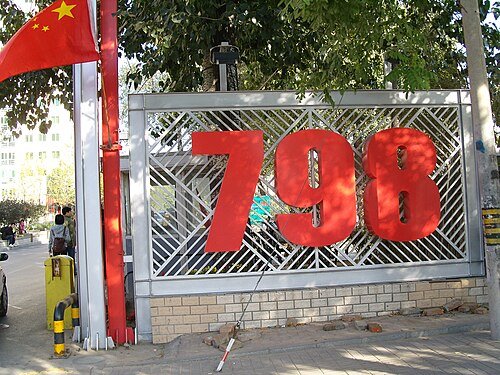
About 798 Art Zone
The factory architecture is part of the attraction: repeated roof curves and north-facing windows were designed to admit even working light, and now frame contemporary art. UCCA is a major institution within the district, but the wider lanes contain many separate venues. Start with one confirmed exhibition, then explore the factory streets and building exteriors; an art-district visit depends on individual gallery programs rather than one shared collection or opening schedule.
The site originated as the 718 Joint Factory (718联合厂), a key industrial project of China's first Five-Year Plan. Lacking domestic electronic-component expertise, the Chinese government turned to East Germany, which designed and built the roughly 1.10 million square meter complex using East German war-reparations funds; the buildings followed a German Bauhaus style rather than Soviet models. Factory 798 and the neighboring Factory 751 were both part of 718, which was dissolved in April 1964, its constituent factories placed under direct central-government control.
By the 1980s and 1990s Factory 798 was declining, and in 1999 it merged with other former 718 factories into the Beijing Seven Star Huadian Technology Group (北京七星华电科技集团有限责任公司), still headquartered nearby. From 2002, low rents drew artist studios and contemporary-art institutions from in and around Beijing, gradually forming an art community; as a result Factory 798 and the neighboring Factory 797 and Factory 751 were preserved as industrial heritage. The district is now managed by the state-owned Beijing 798 Culture and Technology Co (北京七九八文化科技有限公司).
What to look for
- Factory rooflines and windows: look for the repeated industrial forms that controlled daylight in the workshops.
- UCCA and neighboring gallery spaces: choose an exhibition, then compare its reuse of the factory shell with the surrounding buildings.
Location & getting there
Getting to 798 Art Zone
The complex lies around lanes 2 and 4 of Jiuxianqiao Road, south of the Dashanziqiao flyover in Chaoyang.
- Set your first gallery as the destination within 798; the district name covers several former factory buildings and entrances.
Combine your visit
Suggested order within this visit:
-
Factory lanes
Read the industrial layout and roof forms before entering a gallery.
-
Selected exhibition venue
Anchor the visit around a program that matches your interests.
-
UCCA surroundings
Compare the major art institution with the reused factory streets around it.
This sequence is an editorial suggestion based on the features described in the sources. Access to individual buildings or areas should be checked locally; no travel time or shared admission is implied.
Find 798 Art Zone
798艺术区 · 朝阳区
The pin marks the area, not the entrance.
More places nearby
Approximate straight-line distances between map pins, not travel distances.
Chaoyang Park 朝阳公园
5 km awayChaoyang Park is a large urban green space between Beijing’s eastern ring roads, with lakes, flower planting, landscaped lawns, and recreation areas. Its scale allows a visit centered on walking and waterside views rather than…
View guide →Temple of Earth 地坛
8 km awayThe Temple of Earth, or Ditan, stands outside the northern edge of Beijing’s former inner city near Andingmen. Its central Fangze Altar uses a square plan to express the traditional association between the earth and that shape…
View guide →Yonghe Temple 雍和宫
8 km awayYonghe Temple, also called the Lama Temple, began as a Qing prince’s residence and later became a Tibetan Buddhist monastery. That history is visible in the procession of courtyards and major halls along a north–south axis…
View guide →Sources & visit information
The linked encyclopedia sources support background and place descriptions. Current opening hours, ticket prices, booking rules and transport schedules have not been independently verified for this guide. Confirm them with the venue or operator before travelling.
Visitor information adapted and edited from Wikipedia contributors · CC BY-SA 4.0. Source revision 1353041055.
Background paragraphs translated and condensed from Wikipedia contributors, "798艺术区", Chinese Wikipedia · CC BY-SA 4.0. Source revision 93405677.