

Explore the region
A purpose-built platform above the old city
The observatory was established in 1442, during the Ming dynasty, as an imperial institution for observing the sky and keeping calendrical knowledge. It continued in use through the Ming and Qing periods and into the early twentieth century. Its setting is especially legible: the elevated brick platform preserves the relationship between an observing station and the old city wall, while the courtyard buildings beside it now interpret astronomy and the site’s history.
This is not a general-purpose science museum with a large campus. The visit is compact and concentrated on the historic site. The main reward is seeing instruments, architecture and explanatory displays together, rather than treating the bronze as monumental decoration alone.
How to look at the instruments
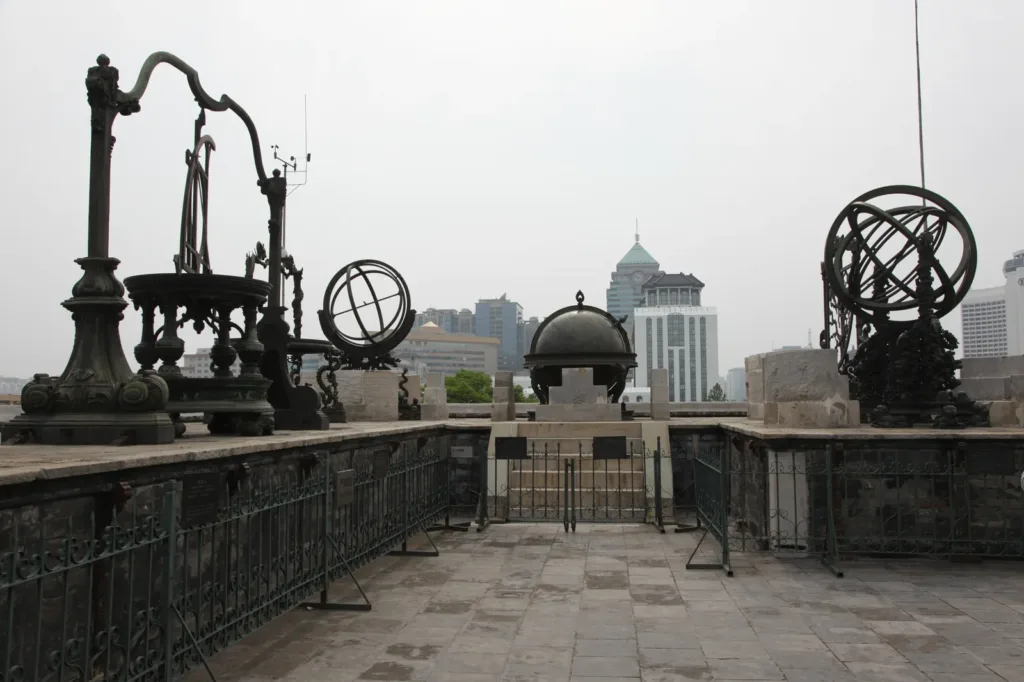
The roof platform displays eight large bronze instruments made or installed during the Qing. Look first at the variety of rings and sighting frames: different instruments measured celestial positions in different coordinate systems, while the celestial globe modelled the sky. The equatorial instrument, for example, was designed to measure solar time and celestial equatorial coordinates. The forms are easier to read after seeing the displays below, which explain the observatory’s instruments and the history of Chinese astronomy.
The group also tells a story of exchange rather than a simple divide between “Chinese” and “Western” science. In the seventeenth century, instruments designed under the direction of the Belgian Jesuit Ferdinand Verbiest introduced European astronomical methods and forms into Qing court practice. The eighteenth-century 玑衡抚辰仪, by contrast, followed the traditional armillary-sphere design while using a European-style 360-degree scale. Compare its layered rings and ornament with the other instruments to see how imported methods were adapted within a Chinese institutional and craft tradition.
The site’s history includes disruption as well as technical achievement. During the 1900 invasion of Beijing, instruments were taken away; five were returned by France in 1902 and five by Germany in 1921. Other older instruments were later moved to Nanjing for protection, while the eight large Qing instruments remained on the platform. The mixed history helps explain why the rooftop collection is both a working record of astronomy and a record of cultural loss and recovery.
A practical order for a compact visit
Begin in the courtyard and exhibition rooms, where the official site presents themes including Chinese Starry Sky, Eastward Transmission of Western Learning and the observatory’s own history. Then go up to the roof platform and match the names and functions you have just encountered to the actual instruments. Finish back in the courtyard, allowing time for the displays and outdoor replicas or interpretive objects that are open on the day. Exhibitions and access can change, so use the current signs and staff instructions rather than assuming every room or object is available.
Allow about 1–1.5 hours as an editorial suggestion for a focused visit. Give yourself longer if you read the exhibition text closely or want to compare the instruments carefully. This is a small, site-based attraction, so it is easy to combine with another central Beijing stop, but it should not be treated as a walk-through outdoor park.
Opening, tickets and address
The observatory’s official page lists opening hours as 09:00–16:30, with last admission at 16:00. It is open Monday and Wednesday through Sunday; Tuesday is the regular closing day, except on national statutory holidays. Confirm holiday arrangements and any temporary closure notice before setting out.
The operator directs visitors to the Beijing Planetarium WeChat public account for ticket purchases and says current prices and event information are published through its website and official account. The accessible official pages do not show a current observatory admission price, so check the live official ticket information rather than relying on an old listing. For questions, the observatory page gives 010-65265010.
The address is No. 2 Dongbiaobei Hutong, Jianguomen Inner Street, Dongcheng District. Jianguomen is the nearest named subway interchange in the available local visitor reporting; Lines 1 and 2 serve the station. From there, use a current pedestrian map to the hutong address. The observatory sits beside a major road interchange, so follow pedestrian streets rather than treating the bridge ramps as a walking route. No station exit letter or fixed walking time is given here.
Combine your visit
Suggested order within this visit:
-
Astronomy displays
Begin with the observational history and star maps.
-
Instrument terrace
Connect that explanation with the large devices on the platform.
-
Brick-platform exterior
Finish by reading the observatory’s relationship to the old city wall.
This sequence is an editorial suggestion based on the features described in the sources. Access to individual buildings or areas should be checked locally; no travel time or shared admission is implied.
Find Ancient Observatory
北京古观象台 · 东城区
The pin marks the area, not the entrance.
More places nearby
Approximate straight-line distances between map pins, not travel distances.
Ming City Wall Relics Park 明城墙遗址公园
Less than 1 km awayMing City Wall Relics Park follows a surviving stretch of Beijing’s former inner-city wall from the Chongwenmen side toward Dongbianmen. Its brick ramparts and Southeast Corner Tower show how the walled city was defended before…
View guide →Ritan Park 日坛公园
1 km awayRitan Park surrounds the former Temple of the Sun in the modern Chaoyang district. The historic altar recalls the imperial ceremonies once held here, while the surrounding public garden now sits among central Beijing’s offices…
View guide →Shijia Hutong Museum 史家胡同博物馆
2 km awayShijia Hutong Museum places the story of a Beijing lane inside a traditional courtyard residence on that same street. The setting lets visitors relate exhibitions about neighborhood history and residents’ daily lives to the…
View guide →Sources & visit information
Visitor details checked on 21 October 2026. Hours, tickets, reservations and transport can change; confirm with the operator before you go.
Image credits & notes (1)
- Qing-era astronomical instruments on the roof platform of Beijing Ancient Observatory. Photo: Hans A. RosbachPhoto: CC BY-SA 3.0