

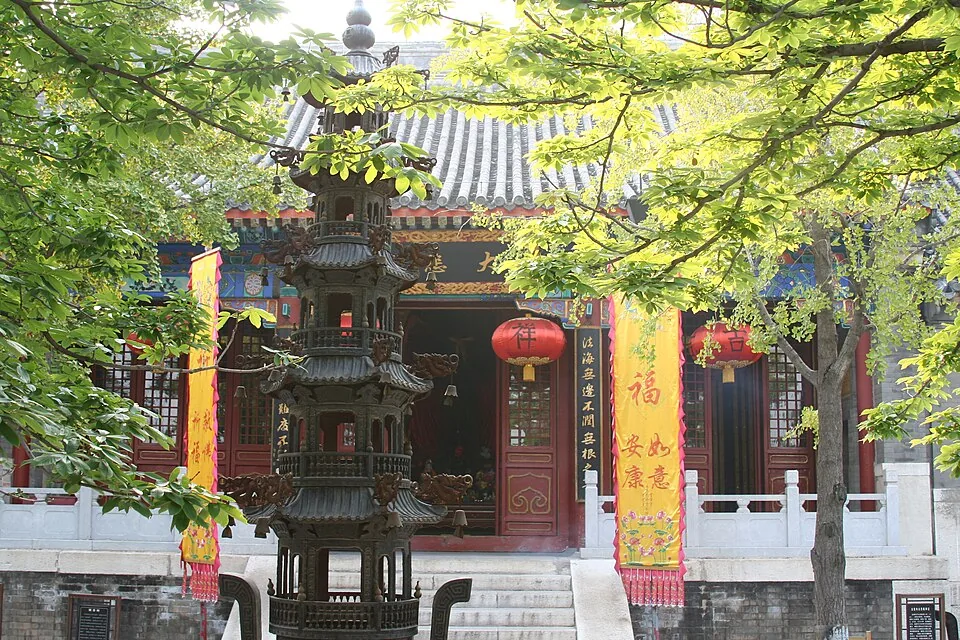
Photo adjustments
Converted to WebP and resized without changing the subject or cropping the source frame.
Explore the region
About Yunju Temple
The project began with the monk Jingwan and continued across many generations, leaving a record that complements the temple’s historic pagodas and other scripture collections. The point of a visit is the relationship between religious practice and the physical preservation of texts. Concentrate on the stone-sutra interpretation and the temple’s pagoda setting, checking separately which repositories, displays, or associated mountain areas are actually accessible.
Construction at the site began during the Northern Qi dynasty (550-570 CE), though the exact founding year is unknown. Around 611 CE the monk Jingwan, seeking to protect Buddhist teachings after earlier anti-Buddhist campaigns under Emperor Taiwu of Northern Wei and Emperor Wu of Northern Zhou, vowed to engrave the entire Buddhist canon onto stone steles; his successors continued the work for more than a thousand years, with the last stele dated to 1691 CE.
During the Tang dynasty, Princess Jinxian persuaded Emperor Xuanzong to donate over 4,000 manuscript scrolls of the Buddhist canon and land to support the engraving, and a pagoda commemorating her stands atop Fangshan mountain; during the Liao dynasty, royal patronage funded completion of unfinished sutras and an attempt to engrave the entire Khitan Tripitaka onto stone. These stone sutras, also known as the Fangshan Stone Sutra, can be used to correct later printed versions of the canon, since the original manuscripts and printed editions they drew on have largely been lost.
Nine caves were excavated at the temple to hold the steles, along with two underground depository rooms; the most notable, Cave No. 5, known as Leiyin Cave (雷音洞), remains open to the public. A significant portion of the temple was destroyed in the early 1940s and has since been substantially restored.
What to look for
- Stone-sutra interpretation: look at how Buddhist texts were engraved and preserved as durable material objects.
- Historic pagodas: compare the temple’s memorial architecture with the scripture-preservation story.
Location & getting there
Getting to Yunju Temple
The Beijing municipal guide locates Yunju Temple in Shuitou Village, Dashiwo Town, Fangshan.
- Use the temple in Shuitou as the arrival destination; an associated mountain cave or repository is a separate access question, not an assumed extension of the entrance ticket.
Combine your visit
Suggested order within this visit:
-
Temple and scripture interpretation
Begin with the purpose of the stone-engraving project.
-
Stone-sutra display areas
Examine the surviving texts where public viewing is provided.
-
Pagoda setting
Finish with the temple’s related historic structures.
This sequence is an editorial suggestion based on the features described in the sources. Access to individual buildings or areas should be checked locally; no travel time or shared admission is implied.
Find Yunju Temple
云居寺 · 房山区
The pin marks the area, not the entrance.
More places nearby
Approximate straight-line distances between map pins, not travel distances.
Shidu 十渡
15 km awayShidu is a limestone-gorge landscape along the Juma River in southwestern Fangshan. Its name means the tenth crossing, recalling a route that once required repeated river fords; the numbered crossings still help identify…
View guide →Zhoukoudian 周口店
17 km awayThe Peking Man Site at Zhoukoudian preserves limestone caves and excavation localities that transformed the study of early humans in Asia. Finds include human and animal fossils, stone tools and evidence associated with the use…
View guide →Shihuadong Cave 石花洞
25 km awayShihuadong is a layered limestone cave in Fangshan, where different movements of water have produced a remarkable variety of mineral deposits. Hanging stalactites, rising stalagmites and broad stone curtains share the cave with…
View guide →Sources & visit information
The sources below support the place-specific description and arrival information. Suggested combinations are editorial planning ideas; confirm current opening, entry arrangements and transport services for your date.
Visitor information adapted and edited from Wikipedia contributors · CC BY-SA 4.0. Source revision 1367598232.
Background paragraphs condensed from Wikipedia contributors, "Yunju Temple", English Wikipedia · CC BY-SA 4.0. Source revision 1367598232.