

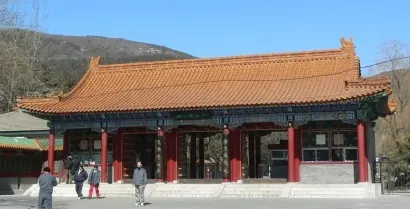
Explore the region
Read the landscape, not just the number eight
“Badachu,” or “Eight Great Sites,” refers to eight historic Buddhist temple sites set across a mountainous park. The traditional sequence is Chang’an Temple, Lingguang Temple, Sanshan Nunnery, Dabei Temple, Longquan Nunnery, Xiangjie Temple, Baozhu Cave and Zhengguo Temple. The complex developed over many centuries: the tourism authority traces its oldest foundations to the Sui–Tang period and describes later rebuilding across successive dynasties. Think of the names as a way to understand the cultural landscape, not a promise that every compound is open on every visit.
This is a temple-and-woodland outing, with uphill paths and stairs linking separate sites. Its appeal lies in the changing relationship between courtyards, old trees and the slopes around them. Autumn foliage is a seasonal draw; spring blossoms and summer shade give the same walk a different character.
Three places to give time to
Lingguang Temple is the most useful first stop for visitors who want one substantial temple visit without committing to the full climb. The park’s tourism profile highlights its Buddha-tooth-relic pagoda, the remains of an earlier Liao-period pagoda, a fish pond, and carved Buddhist text and arhat walls. Look at the tower in relation to the temple courtyards and surrounding wooded slope rather than treating it as an isolated monument.
Dabei Temple rewards a slower look inside its main hall, where the park profile identifies a group of eighteen arhats as a major feature. It makes a useful contrast with Lingguang: one stop is read through its pagoda and surrounding precinct, the other through the hall and its sculptural figures. Follow current signs and access instructions at the compound.
Xiangjie Temple is known for a more ordered, garden-like setting. Below its main hall, two imperial steles have dragon-head forms and tortoise-shaped bases; their inscriptions are associated with the Qing emperors Kangxi, Qianlong and Jiaqing. Higher up, Baozhu Cave and the ridgeline give the walk a more open, elevated finish. These are distinct destinations on a rising route, not adjacent rooms in one complex.
Choose a route that matches your legs
At the main park entrance on Badachu Road, check the day’s map and temple-access notices before choosing an uphill route. For a shorter visit, head to Lingguang Temple and return to the same gate. For a longer walk, continue on signed paths toward Sanshan Nunnery and Dabei Temple; add Xiangjie Temple and the upper sites only if the trail, weather and your group’s energy suit a sustained climb. Use the numbered sequence as orientation, not as proof that each site is open.
Editorial pacing: allow about 2–2.5 hours for an unhurried lower-temple visit and return, or 4–5 hours for a longer uphill temple-and-viewpoint outing with pauses. These are planning estimates, not official durations; stairs, crowds, closures and the return descent can change the day substantially.
The park’s cableway and alpine slide offer alternatives to doing every part of the ascent or descent on foot. A September 2026 report described the upgraded cableway ride uphill as taking under five minutes and the slide as a 1,700-metre forest course with more than 50 bends and a 240-metre vertical drop. Park management announced that the upgraded rides reopened on 16 September, paused for maintenance on 28 September, and resumed on 29 September 2026. Check the park’s latest notice for same-day operation, queues, safety restrictions and separate ride prices; the published notices consulted here do not establish current fares.
Getting there and planning admission
Use Badachu Park / 八大处公园 as the destination in a current map or transit app. The Beijing tourism portal’s visitor listing identifies bus routes 347, 389, 598, 972 and 958 as serving the park stop. Route patterns can change, so confirm the live service for your date rather than relying on a remembered route or station exit.
The same portal listing currently shows park admission at CNY 10 for adults and CNY 5 for concession tickets. It says online real-name tickets are sold through Meituan and visitors enter with a booking QR code. Its seasonal schedule lists a 06:00 opening year-round; from 1 September to 15 November, ticket sales stop at 18:00 and the park closes at 19:00. The published times and ticket arrangements are changeable visitor information, so confirm them on the park’s own current channel before setting out.
Park admission is separate from any cableway or slide charge. The main gate is the practical start and return point for a walking visit; do not assume there is a one-way visitor exit or that a ride will be operating simply because it is listed. The park’s official contact number published by the tourism portal is 010-88964661.
Combine your visit
Suggested order within this visit:
-
Lingguang Temple
Begin with a principal temple and its pagoda setting.
-
Dabei Temple
Add a second compound to compare the architecture and hillside placement.
These are selected sites within Badachu. Follow the signed path and adapt the climb to current access and your group; the sequence does not claim that all eight sites are open or easily linked.
Find Badachu
八大处 · 石景山区
The pin marks the area, not the entrance.
More places nearby
Approximate straight-line distances between map pins, not travel distances.
Fahai Temple (Beijing) 法海寺
2 km awayFahai Temple preserves Ming murals in the Moshikou area of Shijingshan. The paintings reward close attention to faces, garments, and especially the delicate gauze around Water-and-Moon Guanyin. The temple setting also includes a…
View guide →Fragrant Hills 香山
4 km awayFragrant Hills, or Xiangshan, rises at the edge of Beijing’s Western Hills with wooded slopes and the remains of an imperial garden. The park offers two different emphases: the northern area links Spectacles Lake, Jianxin Zhai…
View guide →Beijing Botanical Garden 国家植物园北园
5 km awayThe former Beijing Botanical Garden is now the North Garden of the China National Botanical Garden, below the Western Hills. Its appeal extends beyond flower beds: the conservatory brings tropical vegetation and succulents…
View guide →Sources & visit information
Sources checked on 21 October 2026. Hours, tickets, reservations and transport can change; confirm with the operator before you go.
Image credits & notes (1)
- Badachu · 八大处大门Photo: The original uploader was 用心阁 at Chinese Wikipedia. · CC BY-SA 3.0Resized for the web; the photo itself has not been edited.
