

Explore the region
If this file is altered, note the changes. The share-alike condition applies to an adapted version of the photograph, not automatically to the surrounding article.
A pair with different building histories
These towers were the Yuan-, Ming- and Qing-era capital’s central timekeeping complex. The municipal heritage profile dates their first construction to 1272 and notes rebuilding after fires. Their present fabric belongs to different moments: the Drum Tower was rebuilt in 1420 and repaired in 1539, while the Bell Tower now standing was completed in 1747. The towers served as the north end of the capital’s central axis, a position that made timekeeping part of the city’s public order rather than a palace-only function.
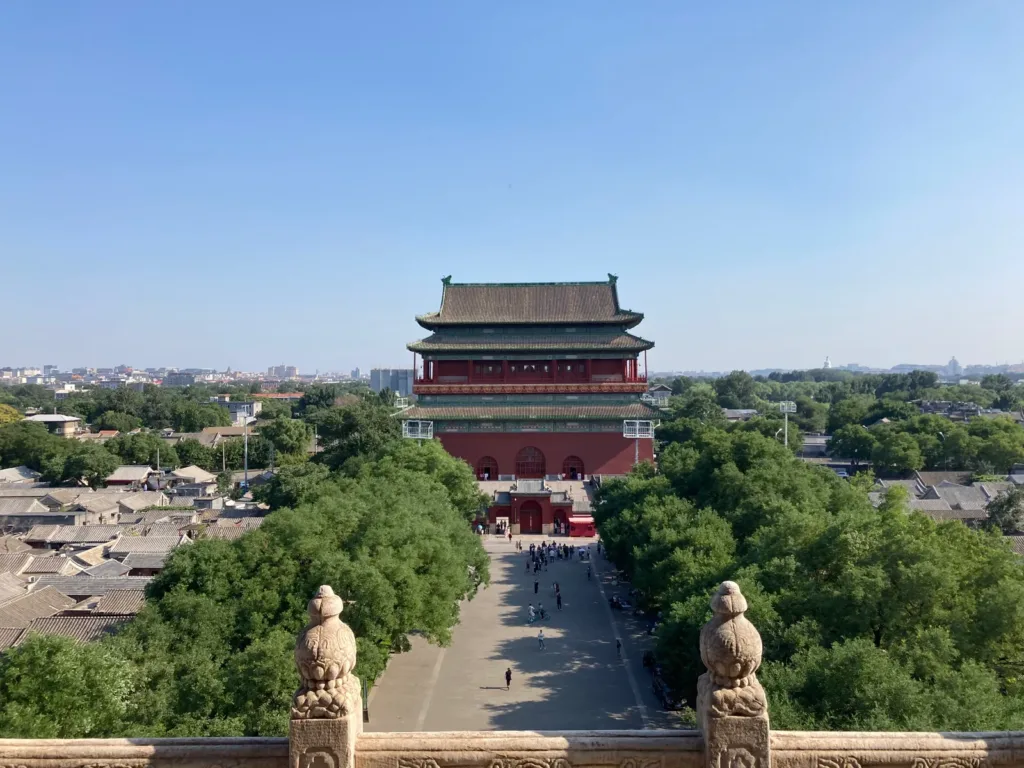
The Drum Tower is 46.7 metres tall. Its large brick-and-timber structure has three tiers of eaves and a grey-tile roof edged in green glazed tiles. On the upper level, look for the surviving historic main drum and the group of 25 replica drums; the replicas help visitors picture the larger timekeeping display without mistaking them for the originals.
The Bell Tower is taller at 47.9 metres. Its masonry base, double-eaved roof, black glazed tiles and green glazed edging give it a noticeably different profile from the red-and-grey Drum Tower. The second level holds a 63-tonne bronze time bell cast in the Yongle reign of the Ming dynasty. The contrast in height, material and roof finish is clearest when the two are viewed together from the open square.
Beijing’s Central Axis was inscribed on UNESCO’s World Heritage List as an urban ensemble. The towers make its northern endpoint legible: the axis is not just a line on a map, but a sequence of city-management, ceremonial and public structures. The official conservation plan describes the Drum and Bell Towers as heritage interpretation sites and specifically calls for timekeeping displays and elevated views to help explain that sequence.
How to explore the two towers
Start by looking at the pair from ground level. The Drum Tower is the southern building and the Bell Tower stands immediately to its north. Visit the Drum Tower first to compare its high timber-framed upper storey with the masonry mass below, then cross the outdoor space to the Bell Tower and look up at the bell’s scale and hanging frame. They are separate buildings, so the transfer between them is outdoors rather than through an indoor connector.
If access to the upper levels is open, use the climb for more than a rooftop photograph: the height makes the low-rise lanes and the north–south alignment easier to read. Displays and access barriers can change. The Bell Tower, which had been closed for reinforcement work on its bell frame, reopened on 27 July 2026; check the operator’s current notice for any later works before setting out.
A compact visit to both towers and the intervening square takes about 1.5–2 hours as an editorial planning estimate, not a venue promise. Allow more time if you want to read the displays, wait for the drum performance or continue walking the Central Axis.
Continue into the lived-in old city
From the towers, continue south along Di’anmen Outer Street for a short section of the Central Axis cultural walking route, or turn into the surrounding historic lanes. The city’s conservation plan treats this northern section as both heritage space and an urban streetscape, linking the towers with the axis and the traditional commercial street. These are lived-in neighbourhoods, not a closed museum set: shops and everyday local activity sit beside protected fabric, so keep residential thresholds clear and follow signs where access is restricted.
The wider route from the towers toward Jingshan and the southern landmarks is a much longer city walk. Treat it as a separate outing rather than assuming that the two towers are a quick stop immediately connected to every central Beijing attraction. The municipal plan describes the route as a series of distinct public spaces and heritage nodes, not one continuous indoor attraction.
Getting there, tickets and current hours
The Beijing Municipal Cultural Heritage Bureau places the site manager in Dongcheng District, at 9 Linzi, Zhonglouwan Hutong. Use that address as a map-area reference for the tower pair; the towers themselves are distinct buildings with separate admission options. A practical rail approach is Line 8 to Shichahai station, followed by a surface walk toward the Drum Tower. Use a live pedestrian map for the final approach rather than relying on an unverified exit letter or a fixed walking time.
The latest 2026 peak-season notice checked for this guide sets public hours at 09:30–17:30. Combined tickets are sold until 16:30; single-tower tickets until 17:00; the last inspection time is 17:20. The notice lists full-fare admission at CNY 30. Adults paying full fare can buy through the official “北京钟鼓楼” WeChat account; concessionary tickets are sold at the Drum Tower ticket window with valid identification.
The same notice lists the Drum Tower’s live drum performances at 10:00, 11:00, 13:00, 14:00, 15:00, 16:00 and 17:00. Its first-floor immersive film is scheduled at 10:30, 11:30, 12:30, 13:30, 14:30, 15:30 and 16:30. Leave enough time to enter before the relevant ticket cutoff; the performance schedule and accessible rooms can change with operating notices.
Combine your visit
Suggested order within this visit:
-
Drum Tower
Start with the southern building and its role in announcing the time.
-
Space between the towers
Compare their alignment and contrasting structures.
-
Bell Tower
Finish at the northern half of the timekeeping pair.
This sequence is an editorial suggestion based on the features described in the sources. Access to individual buildings or areas should be checked locally; no travel time or shared admission is implied.
Find Gulou and Zhonglou
钟鼓楼 · 西城区
The pin marks the area, not the entrance.
More places nearby
Approximate straight-line distances between map pins, not travel distances.
Shichahai 什刹海
Less than 1 km awayShichahai is a historic lake district formed by Qianhai, Houhai, and Xihai, north of Beihai Park. Its waterside paths sit within an old neighborhood of temples, former mansions, and hutongs, recalling the area’s former role in…
View guide →Nanluoguxiang 南锣鼓巷
Less than 1 km awayNanluoguxiang is a north–south hutong in Dongcheng, running between Di’anmen East Street and Gulou East Street. Its older courtyard fabric now sits alongside restaurants, cafes, and souvenir shops, giving the main lane a…
View guide →Prince Gong Mansion 恭王府
Less than 1 km awayPrince Gong Mansion combines a Qing aristocratic residence with a garden behind it in the Shichahai neighborhood. The southern residential portion is arranged through courtyards and substantial buildings; the northern garden…
View guide →Sources & visit information
Visitor details checked on 21 October 2026. Opening and ticket notices can change; check the venue’s official “北京钟鼓楼” account shortly before visiting. Hours, tickets, reservations and transport can change; confirm with the operator before you go.
- Beijing Municipal Government profile of the Bell and Drum Towers ↗
- Conservation and Management Plan for Beijing Central Axis 2022–2035 ↗
- Beijing Bell and Drum Towers peak-season hours and visitor notice ↗
- Bell Tower reopens after reinforcement work ↗
- Beijing Municipal Cultural Heritage Bureau museum listing ↗
- Beijing Central Axis World Heritage listing ↗
- Beijing official map: Bell and Drum Towers information point ↗
- Beijing Bell and Drum Towers visitor guide ↗
Image credits & notes (1)
- The rear of Beijing Drum Tower viewed from the Bell Tower. Photo: ToadspikePhoto: CC BY-SA 4.0