

Explore the region
A residence in the Shichahai neighborhood
The museum stands at 17 Qianhai West Street, Xicheng District, on the southwest side of the Shichahai lake district. This is a neighborhood visit rather than a monument isolated from its surroundings: the mansion’s enclosed courts open onto the hutong-and-water landscape around Qianhai and Houhai. If you plan to continue along the lakeside or through nearby lanes, allow separate time for that walk rather than treating it as part of the mansion route.
The museum’s visitor guide points metro users to Beihai North on Line 6 and maps a pedestrian approach to its Gate 1. Follow the museum’s current map and street instructions from the station; do not navigate only to a generic “Houhai” pin, which may place you at the wrong side of the large neighborhood. The published address is a useful destination for a car or taxi, but access and stopping arrangements on the surrounding streets can change.
Read the residence as a sequence of courts
The site combines the mansion proper and its rear garden. The residence is arranged in eastern, central, and western runs of successive courtyards, with each route oriented from south to north. The central buildings, including Yin’an Hall and Jiale Hall, express the formal status of a prince’s household. The eastern residential courts include Ledao Hall, associated with Prince Gong Yixin’s daily life; the western courts contain Baoguang Room and Xijin Studio, whose carved nanmu screens are among the more intricate interior details to look for where access allows.
This was not a single family home with an unchanged history. The compound began as the residence associated with Heshen in the late Qianlong era, passed through the Qing princely households, and became Prince Gong Yixin’s mansion in the nineteenth century. Its rooms and courtyards therefore preserve changes in status and use across the late Qing, rather than one frozen moment.
At the rear, the Rear Covering Building marks the transition from residence to garden. Rather than focusing on competing published measurements of its length, notice how a long, windowed building forms a boundary between the tightly ordered domestic courts and the more theatrical garden landscape.
Look for the garden’s framed scenes
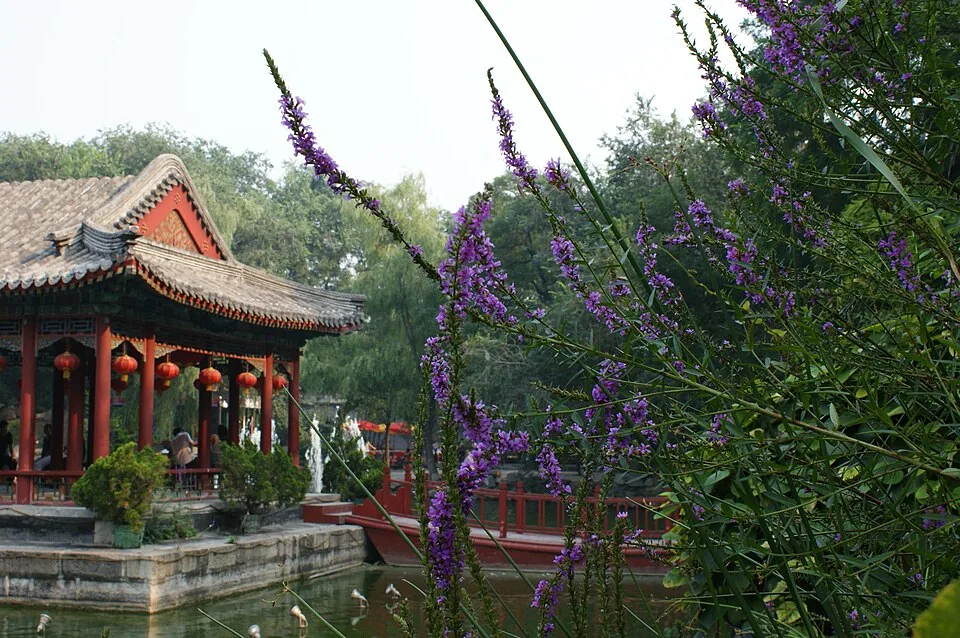
The garden is not simply a patch of greenery behind the house. Its paths use gateways, rock formations, water, and pavilions to reveal a series of framed views. On the central garden route, the white-marble Western-Style Gate makes a conspicuous contrast with the surrounding Chinese timber architecture. Nearby, Dule Peak and Fu Pond establish a sequence of stone and water before the route reaches the garden’s celebrated Fu character stele, set inside Miyun Cave. Bats and the written character for good fortune recur in the garden’s names and ornament, making the motif legible across more than one isolated object.
The Grand Theatre is another reason to slow down. It is an enclosed Qing-era performance hall, rather than an open-air stage. A detailed account describes its painted vine-covered interior and sound-enhancing space beneath the stage; look up at the decoration and notice the compact relationship between stage and audience, while following the museum’s current rules about interior access.
A useful first visit is about 2–3 hours, as an editorial suggestion: begin with the residence’s main courts, notice the transition at the rear building, then spend the remaining time following the garden’s central features and any open side courts. A slower visit can take longer, especially when displays or queues are active. The museum’s map and on-site barriers should decide the exact sequence; individual rooms and features are not guaranteed to be open on every visit.
Tickets, opening hours, and access
The museum’s current official site lists a standard admission price of CNY 40. Its English ticket-information page describes real-name advance booking and use of the same identity document for admission; use the museum’s official online-ticket entry linked from its website and check the live booking screen for availability and current document instructions. The page lists CNY 40 per ticket; do not assume a third-party listing or an old advance-sale window is current.
The published regular schedule is 08:30 opening, 16:00 end of ticket sales, 16:10 end of admission, and 17:00 closing. The museum is normally closed on Mondays except statutory holidays. Its 15 September 2026 notice specifically said it would open on the Mid-Autumn Festival dates of 25–27 September and National Day holiday dates of 1–7 October on the regular 08:30–17:00 schedule. Check the museum’s newest notice for any later holiday, event, or conservation change.
The official address is 17 Qianhai West Street. For arrival, use the museum’s visitor guide and the entry point shown for your ticket; for departure, follow on-site signs rather than assuming the entrance is also the exit. There is no need to add an unsupported station-exit letter, bus number, or travel time to the plan.
Combine your visit
Suggested order within this visit:
-
Southern residential courts
Begin with the domestic and ceremonial part of the mansion.
-
Transition to the garden
Notice the shift from axial buildings to garden scenery.
-
Northern garden
Finish among the ponds, pavilions, and rock formations.
This sequence is an editorial suggestion based on the features described in the sources. Access to individual buildings or areas should be checked locally; no travel time or shared admission is implied.
Find Prince Gong Mansion
恭王府 · 西城区
The pin marks the area, not the entrance.
More places nearby
Approximate straight-line distances between map pins, not travel distances.
Shichahai 什刹海
Less than 1 km awayShichahai is a historic lake district formed by Qianhai, Houhai, and Xihai, north of Beihai Park. Its waterside paths sit within an old neighborhood of temples, former mansions, and hutongs, recalling the area’s former role in…
View guide →Gulou and Zhonglou 钟鼓楼
Less than 1 km awayBeijing’s Drum and Bell Towers stand together at the northern end of the old inner-city central axis. They served the practical task of announcing time through the Yuan, Ming, and Qing periods, giving the surrounding streets a…
View guide →Beihai Park 北海公园
1 km awayBeihai Park is arranged around a large lake northwest of the Forbidden City. Jade Islet rises from the water with the White Dagoba above Yong’an Temple, while the northern shore holds a different group of pavilions, courtyards…
View guide →Sources & visit information
Visitor details checked on 21 October 2026. Hours, tickets, reservations and transport can change; confirm with the operator before you go.
- Prince Gong's Mansion Museum visitor guide ↗
- Beijing municipal profile of Prince Gong's Mansion ↗
- People's Daily account of Prince Gong's Mansion ↗
- Ministry of Culture and Tourism: Prince Gong's Palace Museum ↗
- Prince Kung's Palace Museum ticket information ↗
- 2026 Mid-Autumn and National Day opening notice ↗
- Prince Gong's Palace Museum official website ↗
Image credits & notes (1)
- Prince Gong Mansion · 恭王府. Photo: 2008-08-03.Photo: onion83 · CC BY-SA 2.0Resized for the web; the photo itself has not been edited.
