

Explore the region
Tap any red Chinese text to hear it in Mandarin.
A museum about evolution, not just dinosaurs
The museum is affiliated with the Chinese Academy of Sciences’ Institute of Vertebrate Paleontology and Paleoanthropology. The institute says it established the museum in 1994 as a specialist natural-science museum built around fossils; it opened to the public in December 1995. Its purpose is to make paleontology, ancient environments, human evolution and evolutionary science accessible through objects and interpretation.
The displays are arranged as a broad evolutionary sequence. The museum’s current visitor information describes two sections—the vertebrate museum and the human-evolution museum—with galleries for ancient fish-shaped animals and amphibians, reptiles and birds, mammals, and early humans and Palaeolithic tools. A separate east hall hosts temporary exhibitions, and a 3D screening room is also part of the museum. Temporary displays can change; the museum’s website currently names an exhibition on geological and mineral specimens and early life in the east hall.
The most rewarding way to look around is to follow the sequence rather than treating each skeleton as an isolated photo stop. Start with the early aquatic and amphibian life, then compare the body plans of reptiles, birds and mammals. The point is not a simple ladder in which every group turns into the next: the exhibits use fossils to show changing diversity and relationships across deep time. Finish in the human-evolution and stone-tool galleries, where the story shifts from animal anatomy to evidence of early human life and technology. The museum’s own guide identifies this sequence and those gallery themes.
Several named specimens help anchor the visit. The institute’s museum page highlights the long-necked Mamenchisaurus, the Lufengosaurus often called “China’s first dragon,” a skeleton of the Yellow River elephant, and a replica based on the Peking Man skull before its disappearance. These are not all dinosaurs: the elephant skeleton and human material make clear how much broader the collection is. Look at labels to distinguish fossil material from casts, models and reconstructions; the museum includes all of these forms of display.
How to explore
Allow about two to three hours as a planning estimate, longer if you read labels closely, visit a temporary exhibition or attend a screening. Begin with the main evolutionary galleries in their displayed order, then see what is open in the east-hall special exhibition and whether a 3D programme is running. Follow the museum’s signs for room-to-room transitions, and check on-site notices for temporary displays and screenings.
The museum is at 142 Xizhimen Outer Street, Xicheng District. The institute places it about 300 metres west of Beijing Zoo and 50 metres west of Beijing Planetarium, a useful way to distinguish this address from other museums in the area. Beijing’s tourism listing identifies Beijing Zoo Station on Metro Line 4 and describes a walk west along Xizhimen Outer Street; it quotes about 800 metres from the station. Use live wayfinding for the pedestrian crossing and entrance approach, and do not treat the station’s exit letter in older listings as guaranteed current advice.
Hours, admission and booking
The published visitor schedule is Tuesday to Sunday, 09:00–16:30, with admission ending at 16:00; the museum is closed on Mondays. Beijing’s public-service listing also says that the museum’s ticketing is handled through its official 中国古动物馆票务平台 Zhōngguó Gǔdòngwùguǎn piàowù píngtái WeChat account. Opening arrangements can change for holidays or special events, so confirm the date and booking instructions through the museum’s current official channels before setting out.
The institute’s museum information and Beijing’s tourism listing both list CNY 20 for an adult admission ticket. Because online visitor information may not reflect a changed tariff or current concession rules, verify the live price and eligibility in the official ticketing account; do not assume that an old discount description still applies. The tourism listing gives 20 or 30 yuan for a 3D film, but screening schedules and tickets are separate and should be checked for the day of the visit.
Find Paleozoological Museum of China · Beijing
中国古动物馆 · 西城区
The pin marks the area, not the entrance.
Sources & visit information
Sources checked on 21 October 2026. Hours, tickets, reservations and transport can change; confirm with the operator before you go.
Image credits & notes (1)
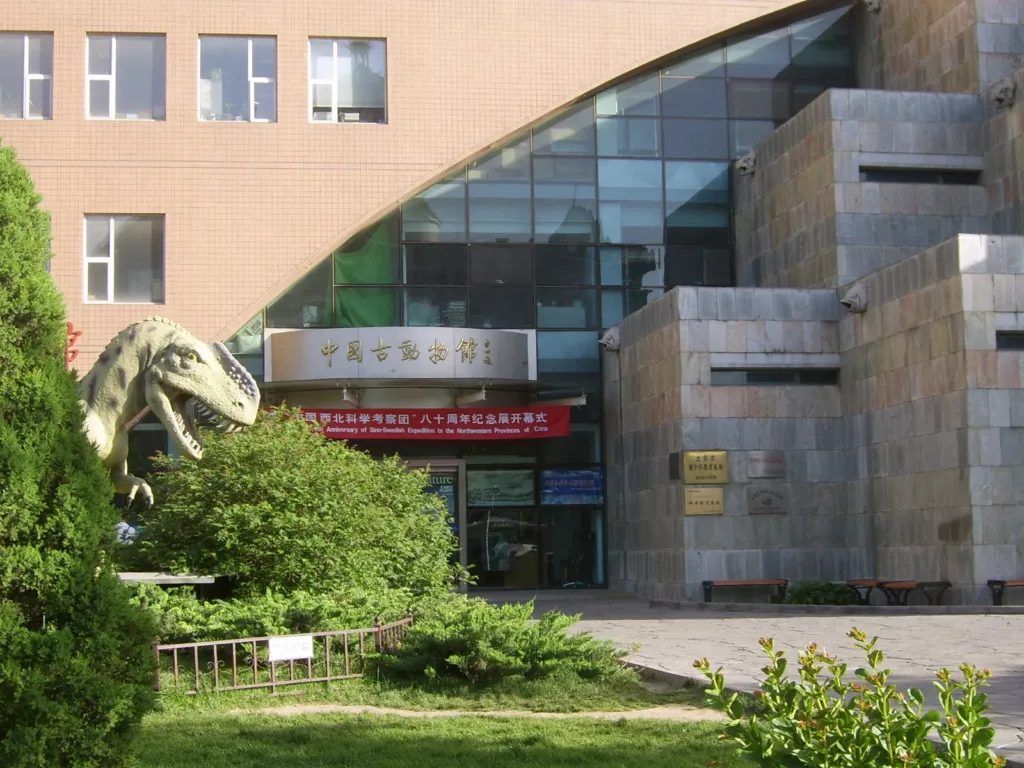
- The museum entrance façade as photographed in 2007. Photo: ShizhaoPhoto: CC BY 3.0