

Explore the region
Why visit
The park was established in 1952 as a historic and cultural garden that brings classical architecture into a modern public landscape. It covers 56.56 hectares, including 16.15 hectares of water, so the lakes and bridges are part of the visit rather than a backdrop to one building.
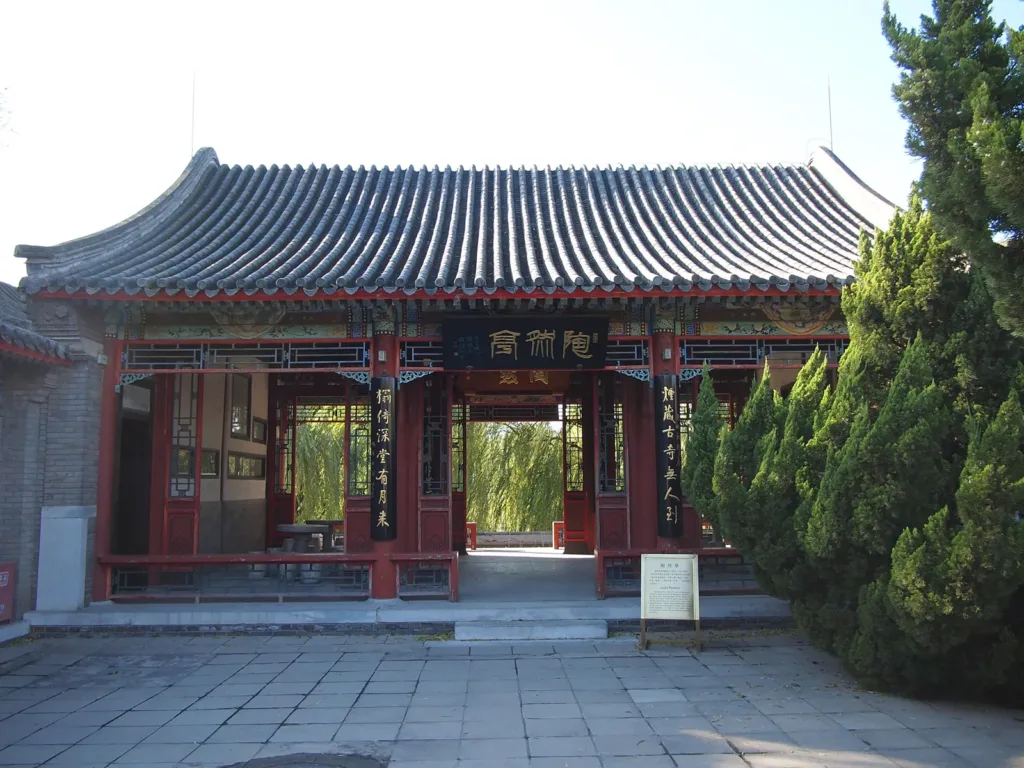
The name comes from Taoran Pavilion, built in 1695 by Jiang Zao within Cibei An. Jiang drew the name from Bai Juyi’s line about waiting until the chrysanthemums turn yellow, then sharing a drink in a carefree mood. The pavilion’s literary associations explain the garden’s name; Cibei An, founded in the Yuan period, preserves an older religious and urban history. The municipal park authority also associates the temple with visits by writers and reform-minded figures including Lin Zexu, Gong Zizhen and Qiu Jin, and with revolutionary activity around the May Fourth period.
Southwest of the central island, the Huaxia Famous Pavilions Garden opened in 1985. Its more than ten selected pavilions represent sites from six provinces and nine cities. Compare their roof shapes, proportions and settings as regional examples rather than treating the garden as a collection of original buildings moved intact to Beijing.
The park’s central island adds a commemorative layer to the waterside walk. The paired memorial markers for early Communist activist Gao Junyu and writer Shi Pingmei stand among the island’s wooded slopes; the park authority identifies them as a notable site within the park. A stroll around the island is as much about changing views across the lake as about reaching a particular monument.
A walk through the park
For a first visit, allow about 1.5–2 hours as an editorial estimate. A longer stop makes sense if you want to pause at the pavilions, read the memorial context or sit by the water; walking conditions, crowds and access to individual buildings vary.
If you want to start with the wider pavilion collection, use the south or west side of the park for the southwest garden, then make your way toward the central island. Finish with Taoran Pavilion and the Cibei An setting, and choose an open north- or east-side gate if it suits your onward journey. The Beijing government visitor guide names east, south and north gates and directs visitors to the southwest pavilion garden from the south or west side; follow the park’s current map and local signs for the exact open route.
If literary history is your priority, reverse the emphasis: head first to the Taoran Pavilion–Cibei An area, continue over the island paths toward the memorial markers, then loop back along the water or cross to the Huaxia garden. The sequence is a practical suggestion, not an official route, and it does not assume that every historic interior is open. Check the park’s notices before making a building interior the purpose of your visit.
Tickets, hours and entry
The seasonal schedule published by the Beijing government lists daily hours of 06:00–22:00 from 1 April through 31 October, with last entry at 21:00, and 06:00–21:30 from 1 November through 31 March, also with last entry at 21:00. The park’s entry-level schedule is distinct from the opening hours of Cibei An or other individual buildings. Check current notices for holiday or event changes.
On the fact-check date, the park’s fourth Chrysanthemum Culture Event was scheduled to run 23 September–29 October 2026. The operator’s notice sets a temporary admission price of CNY 10 full / CNY 5 concession during the event, with standard CNY 2 / CNY 1 prices restored during the statutory National Day holidays. The notice says existing Beijing park annual, seasonal and monthly passes remain valid. Outside the event, the city’s visitor guide lists the standard CNY 2 full ticket and CNY 1 half ticket. Prices and eligibility can change, so check the operator’s latest notice for your visit date.
The Beijing government’s English visitor guide instructs foreign visitors to reserve by telephone at least one day ahead, giving their name, nationality and passport or other ID number; it says unreserved foreign visitors cannot buy at the gate. The guide gives +86 10 6351 1596 and booking hours of 09:00–16:00 daily. Because entry procedures can be revised, confirm this instruction with the park before travelling.
Getting there
Address: No. 19, Taipingjie, Xicheng District, Beijing.
Use Taoranting Station on Metro Line 4 as the subway starting point. The Beijing government visitor guide identifies Exit C; from street level, follow a live map or park signs to the gate that best matches your route. The Line 4 operator’s station page confirms the station and lists its available facilities, but does not make the park’s gates interchangeable with metro exits.
The park has separate east, south and north gate approaches in the municipal visitor guide, and the southwest pavilion garden is most directly approached from the south or west side. If you plan to finish at a different gate, check the park map before entering so that your return trip does not require an unnecessary walk around the perimeter.
Combine your visit
Suggested order within this visit:
-
Taoran Pavilion
Start with the building behind the park’s name.
-
Cibei An setting
Connect the pavilion with the site’s older temple history.
-
Lakeside pavilion walk
Finish with the water and garden landscape around the historic core.
This sequence is an editorial suggestion based on the features described in the sources. Access to individual buildings or areas should be checked locally; no travel time or shared admission is implied.
Find Taoranting Park
陶然亭公园 · 西城区
The pin marks the area, not the entrance.
More places nearby
Approximate straight-line distances between map pins, not travel distances.
Temple of Heaven 天坛
3 km awayThe Temple of Heaven combines imperial ritual architecture with a large wooded park southeast of Beijing’s old central axis. Its main sequence links the Hall of Prayer for Good Harvests with the Imperial Vault of Heaven and the…
View guide →Qianmen 前门
3 km awayQianmen is the familiar name for Zhengyangmen, the historic gateway south of Tiananmen Square on Beijing’s central axis. Its gatehouse and separate archery tower preserve the scale of the former inner-city defenses, although the…
View guide →National Centre for the Performing Arts 国家大剧院
4 km awayThe National Centre for the Performing Arts brings opera, concerts, drama and smaller performances together immediately west of the Tiananmen area. Its operator identifies four principal auditoriums: the Opera House, Concert…
View guide →Sources & visit information
Visitor details checked on 21 October 2026. Seasonal hours and the temporary chrysanthemum-event ticket price are time-sensitive. Route durations below are editorial planning estimates, not park guarantees. Hours, tickets, reservations and transport can change; confirm with the operator before you go.
- Taoranting Park official website ↗
- Taoranting Park — Beijing Municipal Forestry and Parks Bureau ↗
- Taoranting Park — Beijing Municipal Government visitor guide ↗
- Notice on 2026 Taoranting Park Chrysanthemum Culture Event admission prices ↗
- Taoranting Park — Beijing Municipal Bureau of Culture and Tourism ↗
- Taoranting Park lake-island visitor guide ↗
- Taoranting Station — Beijing Subway operator ↗
Image credits & notes (1)
- Taoran Pavilion, identified by the plaque above its central doors, in a photograph taken on 19 November 2011. Photo: rheinsPhoto: CC BY 3.0