

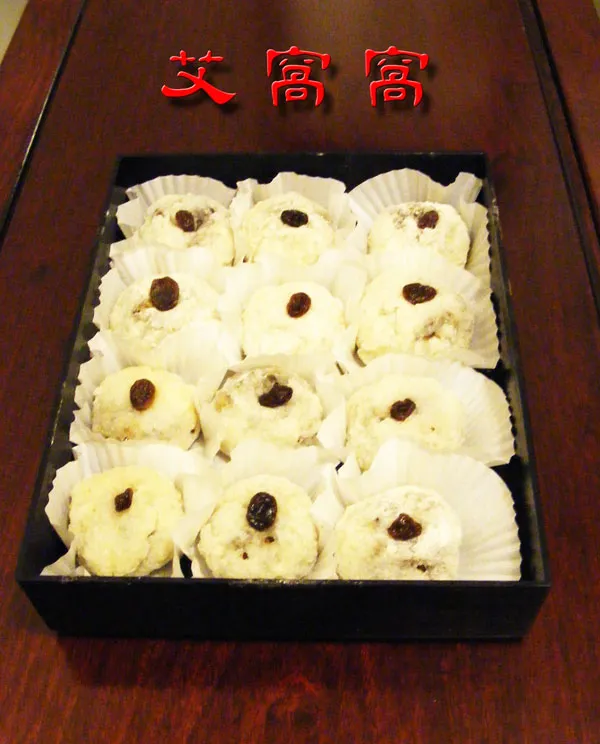
Aiwowo rice balls 艾窝窝
Aiwowo (艾窝窝) is a Beijing traditional sweet made with a tender, chewy glutinous-rice wrapper around a sweet filling. Nuts and seeds, sugar, and fruit or hawthorn cake can make the center fragrant, crunchy, or pleasantly tart; recipes and finishes vary by maker.
Tap any red Chinese text to hear it in Mandarin.
What it is
Aiwowo is a small, white Beijing snack cake, usually rounded after filling. The Beijing municipal government includes it among the traditional sweets sold in the Huguosi snack tradition, while a Beijing cultural-food demonstration documents a practitioner making it as a local snack. These sources establish a Beijing association, not a claim that no similar rice sweets exist elsewhere.
The name is commonly romanized Aiwowo; showing 艾窝窝 Àiwōwo is useful when ordering. “Rice balls” is a convenient English gloss, but the finished piece is more like a soft, filled rice cake than a ball of rice in soup.
Wrapper, filling, and texture
The wrapper’s characteristic base is glutinous rice. One Beijing pastry-maker’s method steams the rice, works it until it binds while leaving some grain-like texture, portions it, then presses each piece flat enough to enclose the center. Other documented descriptions use rice flour and wheat flour in the outer layer, or dust the worked rice with cooked flour to make shaping less sticky. A Hui culinary family’s filmed demonstration instead finishes its filled cakes with coconut. These are documented approaches, not one mandatory recipe.
Fillings are sweet and can combine walnuts, sesame, melon seeds, sugar, yam paste, or preserved fruit such as hawthorn cake and green plum. In one practitioner demonstration, toasted, crushed sesame is mixed into red-bean paste before it is wrapped. The exact mixture, sweetness, and coating depend on the shop or household.
Look for a snow-white to off-white exterior that feels soft, supple, and distinctly sticky-chewy rather than crisp. The rice itself is mild; the center supplies most of the sweetness. Sesame and walnuts bring a toasted, nutty note and a little crunch, while sweet-sour hawthorn or preserved fruit can cut through the sugar. Toppings such as a piece of fruit or a coconut coating belong to particular presentations, not every Aiwowo.
How to choose and eat it
Aiwowo is sold as a ready-to-eat small sweet rather than a soup dumpling. Choose by the filling that appeals to you, and ask what is inside if the shop has several kinds. A modest first piece is a useful way to gauge the sweetness and the chewy texture before choosing more; there is no single required sauce or accompaniment.
The rice is glutinous, and some versions use wheat flour in or around the wrapper. Common fillings may contain sesame, walnuts, other seeds, or preserved fruit. If any of these ingredients matter to you, ask about the specific batch rather than assuming all shops use the same filling.
Image licence
This image may be reused under CC BY-SA 3.0 with attribution, a link to the licence, and an indication of changes. It is unmodified here. If adapted, the adapted image must be shared under the same or a compatible licence; that requirement applies to the image adaptation, not automatically to this article.
Where to eat it
You can find Aiwowo all over Beijing, so there is no need to seek out one particular restaurant. To find one near you, search for “艾窝窝” in Meituan (美团) or Amap (高德地图) and check recent reviews, distance and opening hours.
More dishes to compare
Explore related local specialties and compare their names, preparation notes and ordering guidance.
Soybean-dusted rice rolls 驴打滚 →
Sticky-rice dough is steamed, rolled around sweet bean paste and coated in toasted soybean powder before being sliced. The powder also helps keep the sticky surface manageable. Each piece combines a soft, elastic wrapper, smooth filling and dry, nutty coating.
Pea-flour pudding 豌豆黄 →
Peeled peas are cooked until soft, worked into a smooth sweetened paste and set before being cut into neat yellow pieces. The texture depends on careful cooking and straining rather than a heavy pastry crust. Each square is tender, fine-textured and gently sweet, with a recognizable pea flavor. It should feel smooth rather than sticky like a glutinous-rice cake.
Sources & reading
Recipes and servings vary between kitchens.
Image credits & notes (1)
- A tray of Aiwowo at a shop. The cakes are pale, soft-looking rounds with a small dark topping; this photograph shows one maker’s presentation, not a fixed shape or garnish. Photo: Wiki Elven FanPhoto: CC BY-SA 3.0