

Chongming rice cake 崇明糕
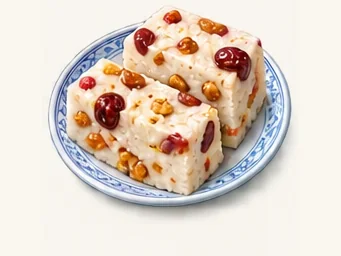
Chongming cake is a steamed rice pastry from Shanghai’s Chongming District, made with glutinous and non-glutinous rice, sugar and variable additions such as dates, beans, nuts or seeds. It is fragrant and gently sweet, with soft and firmer versions.
Tap any red Chinese text to hear it in Mandarin.
A Chongming pastry, not one fixed recipe
Chongming gāo (崇明糕) is a traditional steamed cake associated with Chongming District, Shanghai. Local government and cultural sources describe it as a festival food, especially for Lunar New Year. The saying niánnián gāo (年年糕, a play on “year after year” and “higher”) links the cake with New Year wishes. Its traditional making technique is included in Shanghai’s intangible cultural heritage program.
The usual base combines glutinous rice with japonica or other non-glutinous rice and sugar. Depending on the maker, additions may include red beans, red dates, walnuts, pine nuts, melon seeds, candied fruit or other dried fruit. Some documented recipes also use pork fat. These are variations, not a mandatory checklist: ingredients and proportions differ by maker.
How it is made and what to expect
The rice is selected and blended, soaked, ground, then steamed. In a documented traditional method, the prepared rice mixture is added gradually to a steaming basket as steam rises through it; judging when to add each layer takes experience. This is a steamed pastry, not a baked loaf or a chewy glutinous-rice dumpling.
Expect a pale rice-coloured cake, often dotted with darker red-brown dates or beans and whichever nuts, seeds or fruit the maker uses. Sources describe a gentle rice fragrance and a soft, sweet texture that is sticky without being greasy. The fruit and nuts give some bites a denser, chewy or crunchy contrast. The precise appearance and texture depend on the additions and the balance of rice varieties.
Local descriptions distinguish soft and hard styles. Shanghai’s English-language municipal guide pairs the soft style with warm serving and the firmer style with cool serving; treat that as a useful local distinction rather than a rule every shop follows. Ask which kind is available and whether the seller recommends it warm or cool.
Ordering and dietary notes
Show 崇明糕 or say Chóngmíng gāo. If the display offers more than one kind, ask 这是松糕还是硬糕? (Zhè shì sōnggāo háishi yìnggāo? — Is this the soft or firm style?) You can also ask 今天的糕里加了什么? (Jīntiān de gāo lǐ jiā le shénme? — What has been added to today’s cake?) and 这个适合热着吃还是冷着吃? (Zhège shìhé rèzhe chī háishi lěngzhe chī? — Is this better eaten warm or cool?) Recipe and serving practice vary, so follow the maker’s advice rather than assuming every cake should be reheated.
The rice base is joined by changing additions, and some documented versions include pork fat. If you avoid meat, ask about the specific batch, including the use of pork fat. If you have a nut allergy, ask whether walnuts, pine nuts or other nuts are present and about possible contact during preparation; the listed additions vary by maker.
More dishes to compare
Explore related local specialties and compare their names, preparation notes and ordering guidance.
Bar-shaped rice cakes 条头糕 →
Glutinous-rice dough is shaped into slender bars, commonly around sweet bean paste, and cooked until soft. Some versions carry a light osmanthus fragrance or finishing syrup. The wrapper is chewy and supple, contrasting with the smoother, denser filling. Its sweetness and sticky texture make a small piece quite satisfying.
Eight-treasure sticky rice 八宝饭 →
Sticky rice is steamed with a sweet filling, often bean paste, and arranged with dried fruit or nuts before being turned onto a serving plate. Additional syrup or fat may enrich the rice. The dessert is dense, glossy and chewy, with concentrated sweetness and contrasting bits of fruit or nuts.
Sources & reading
Recipes and servings vary between kitchens.