

Diebu Juema Pig 迭部蕨麻猪
Diebu Juema Pig (迭部蕨麻猪) is a small highland Tibetan pig associated with Diebu County; visitors encounter its pork in fresh or preserved preparations, so search the Chinese name locally rather than treating it as a single restaurant dish.
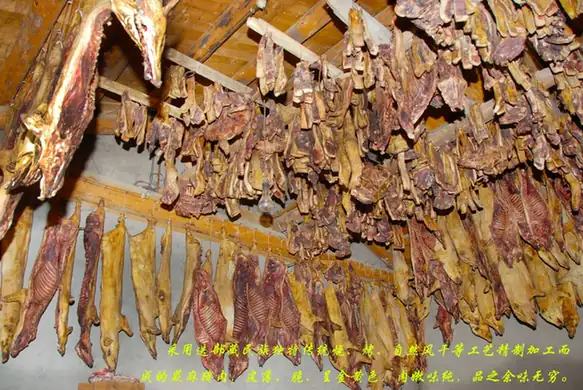
Image notes
Resized for the web; the photo itself has not been edited.
Tap any red Chinese text to hear it in Mandarin.
What the name refers to
Diebu Juema Pig is a local pig and meat product, not the name of one fixed recipe. A Gansu agriculture department profile describes it as a small, distinctive local Tibetan pig raised in an outdoor grazing environment. The same profile records the pig as a national-level protected livestock genetic resource in 2006 and Diebu Juema pork as a geographical-indication protected product in 2017.
The name is locally explained through juema (蕨麻): a Gannan government food guide says that pigs traditionally foraged for juema on the grassland, which gave the animal its name. The label therefore connects the product to both an animal and the highland food landscape; it does not mean that every serving contains juema root.
Why it belongs to Diebu
The pig is associated with the river valleys and lower grassland areas of Gannan rather than with a single shop in a tourist centre. A local government description places the breed in high, cold parts of Gannan where grazing is important, and specifically notes a small distribution along both banks of the Bailong River in Diebu County. A 2025 agricultural-university account describes the main distribution as Diebu and the usual system as grazing supplemented by housing, while also noting the breed’s hardiness and ability to use coarse feed.
Do not turn “free-range” into a single promise about every producer. Recent reporting from Diebu describes one modern base where pigs graze in summer and are kept in sheltered facilities in winter, with seasonal feed changing accordingly. That is a documented local variation, not a universal specification for all Diebu Juema pork.
How it appears on the table
Diebu’s county food record describes a traditional preserved-pork route. Pieces are divided and hung under the eaves to smoke and air-dry; they may later be boiled in large pieces for festivals or guests, or cut into smaller pieces and cooked with potatoes, cabbage or bracken. The same account says that a plate of local Juema pork is customary at Diebu banquets. These are useful preparations to look for, but they are not a claim that every restaurant uses the same method.
A Gannan government food guide describes cooked Juema pork as tender and fragrant, with crisp skin and relatively little fat. Treat that as a regional description rather than a guarantee for every cut, producer or cooking style. Ask whether the serving is fresh, cured or wind-dried, and whether it is being served plain, boiled or with vegetables.
Finding it without inventing a restaurant
Use the exact Chinese name 迭部蕨麻猪肉 Diébù Juémá Zhūròu when you want the meat or a cooked dish. 迭部蕨麻猪 Diébù Juémázhū is useful when a listing refers to the animal, a local product or a packaged meat item. Search for “迭部蕨麻猪肉” or “迭部蕨麻猪” on Meituan (美团) or Amap / Gaode Maps (高德地图) near your current location. Check the menu, recent reviews, opening information and today’s availability before choosing. A map result or a product label is not, by itself, proof of a particular farm, preparation method or quality.
This is a regional food product rather than a fixed attraction. It has no single visitor entrance, station, final-mile approach or return route to list, and this entry does not nominate a restaurant, address or shop as the one place to eat it. Once you choose a current venue, use that venue’s Chinese address and current map information for the last leg and the return journey. Do not navigate to a named farm unless the venue itself has confirmed that it receives visitors.
Because the item is pork, it is not a vegetarian dish. If you need halal food, avoid assumptions based on the name and ask the venue about certification, cooking equipment and other ingredients. Availability, preparation and opening status are venue-specific and should be checked on the day.
More dishes to compare
Explore related local specialties and compare their names, preparation notes and ordering guidance.
Hong Men Zang Xiang Jue Ma Zhu 红焖藏香蕨麻猪 →
Another listing for pork from the juema pig breed, under a different local name.