

Tsampa 糌粑
In Gannan, tsampa is a Tibetan staple made from roasted, ground highland barley and mixed by hand with butter tea; local versions may add cheese curds, sugar or salt.
Tap any red Chinese text to hear it in Mandarin.
Tsampa is best understood as a foodway rather than a fixed restaurant recipe. Local-government food pages in Gannan describe it as a Tibetan staple eaten every day and as a dish offered to guests, while Xiahe County presents it under local Tibetan foods.
What makes it tsampa?
The base is highland barley, or qingke (青稞). A Xiahe County description says the grain is dried, roasted and finely ground; it stresses that the local process roasts before grinding and does not remove the outer layer or sift the flour. A Hezuo account gives the sequence as washing, drying, roasting and grinding. That roast-first process is why a menu translation such as “roasted barley flour” is more useful than treating tsampa as an ordinary steamed or boiled barley dish.
English-language food writing normally uses tsampa for ground roasted barley flour, but notes that other grains can appear in versions outside the core barley tradition. On a Gannan menu, therefore, ask what grain and additions are used rather than assuming one universal formula.
How it is mixed and eaten
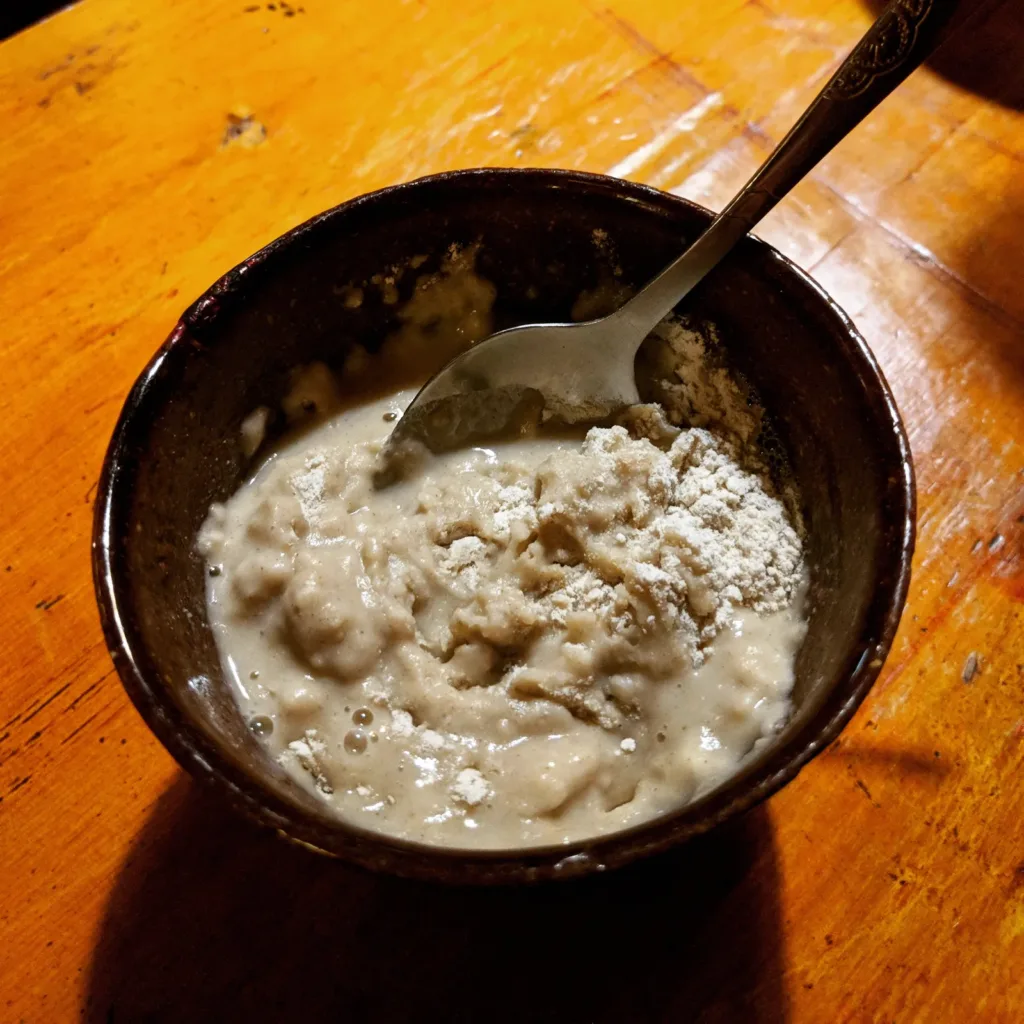
A common Gannan serving starts with butter in a bowl. Hot tea or tea water is added to soften it, followed by tsampa and a little qūlā (曲拉, dried cheese curds) and sugar. The mixture is worked by hand until it holds together in small, compact bites. Local descriptions differ in the finger-by-finger details, but agree on the basic sequence: mix, adjust the tea and flour, then shape it rather than eating the powder dry.
The balance is not always sweet. A Diebu account says sugar may be left out and a little salt used instead. It also notes that if the mixture is too dry, more tea can be added; if it is too wet, more roasted flour can bring it back together. That small adjustment is part of the texture: the finished bite should hold its shape without becoming a wet porridge.
If you are served tsampa in a home or pastoral setting, follow the host’s lead. A recent Hezuo description treats spilling as poor table manners and says the bowl is normally left clean after eating. This is a practical reason to mix gradually, keep the bowl close, and ask before adding more tea or sugar.
Gannan versions and the travel context
There is no need to turn one county’s method into a statewide recipe. In Hezuo’s account, the usual table may include tsampa, butter tea, butter, qūlā and sugar. In Upper Diebu, described by the prefectural agriculture bureau as a colder, more pastoral area, tsampa was traditionally eaten in the morning and evening. The same account calls butter and tsampa a convenient food for a journey: a traveller could carry flour, butter, tea and a pot and prepare it where water and fuel were available.
That last description is a foodway record, not a promise that a scenic area permits fires or sells a picnic kit. For a visitor, the more realistic encounter is a prepared bowl in a Tibetan restaurant, guesthouse or home meal, with the exact dairy, salt and sugar balance varying by cook.
Finding it as a traveller
Tsampa is a dish, not a single address, so there is no fixed entrance, station or return route to list. Search for 糌粑 Zānbā or 酥油糌粑 Sūyóu Zānbā on Meituan (美团) or Amap / Gaode Maps (高德地图) after setting the town or county where you are staying. Open the actual menu and recent reviews, check current opening information, and confirm that it is available today before choosing. Search results are leads, not proof of quality or authenticity.
When ordering, ask whether the bowl contains butter, butter tea, qūlā, milk or sugar, and whether the kitchen can make a savoury version with salt. If you avoid dairy, have an allergy, or simply do not want a sweet bowl, say so before the flour is mixed. Because recipes vary and some places may list the name without serving it at that moment, this quick check matters more than a generic “must-try” label.
Sources & reading
Image credits & notes (1)
- A bowl of tsampa being blended with yak butter tea; the source page does not specify a Gannan location, so this is an illustrative foodway image. Photo: JpatokalPhoto: CC BY-SA 4.0