

Zhuoni Tibetan Steamed Buns 卓尼藏包
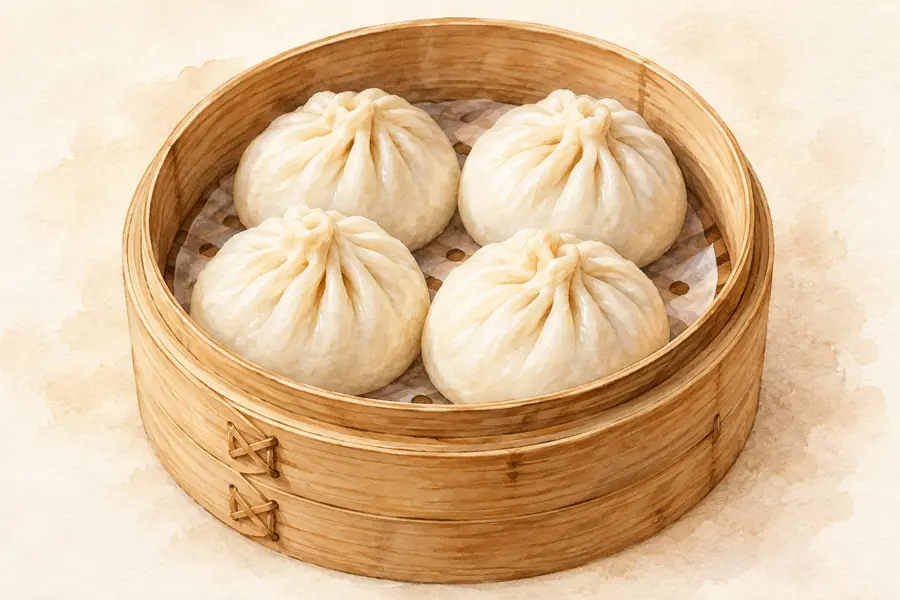
Zhuoni Tibetan Steamed Buns (卓尼藏包) are Gannan-style soup-filled buns made with an unleavened wrapper and seasoned beef, mutton, or yak filling. In Zhuoni, look for them in village dining settings around Niba Village rather than treating them as a single restaurant or fixed recipe.
Tap any red Chinese text to hear it in Mandarin.
Tibetan steamed buns are one of Gannan’s meat-based staples. The “Zhuoni” label is useful for travelers because Niba Village in Niba Town, Zhuoni County, is an official food-and-village stop where Tibetan buns are listed alongside butter tea, tsampa and other local foods; the prefecture-wide recipe itself is not presented as a Zhuoni-only invention.
What you are eating
The dough is simian (“dead dough”): flour mixed into a non-fermented wrapper rather than a yeasted bun. Public descriptions differ slightly by kitchen. One Gannan food account describes fatty yak meat chopped with scallion and ginger while water is worked in; a Hezuo government guide gives beef or mutton with scallion, salt, Sichuan pepper, cooking oil and meat broth. Together, these accounts explain why the bun is juicy rather than dry, but they do not establish one mandatory filling or seasoning.
The wrapper is rolled thin, filled, and gathered at the top, with a small opening where the pleats meet before steaming. The finished bun is described as lotus-like or vase-shaped, with a generous amount of savory broth inside. Eat it carefully while hot: break the skin first and let the juice settle rather than biting straight through. Beef, mutton and yak are not interchangeable allergy or dietary information, so ask which meat and stock were used.
How to find it in Zhuoni
For a Zhuoni-specific food stop, use 尼巴村 (Niba Village) in 尼巴镇 (Niba Town). The county government describes the village’s Tibetan settlement and lists Tibetan buns among dishes visitors can eat there; it also notes that the village is a living community, not merely a display. The Ministry of Culture and Tourism includes the village in a “百年藏寨” route and likewise lists 藏包 among its local foods.
This is not a fixed-address dish. Search 卓尼藏包 Zhuóní Zàngbāo first, and if results are sparse search “藏包” + “卓尼” on Meituan (美团) or Amap/Gaode Maps (高德地图). Before choosing, check the menu, recent reviews, opening information, and whether buns are available today. A map result or ranking is not proof that a restaurant is the most authentic, and a village kitchen may serve the dish only when it has prepared a batch.
Getting there and back
Niba Village is reached from G248; the Ministry of Culture and Tourism’s route page also lists a special passenger service to the village. That page gives reference figures of 91 km from Hezuo and 89 km from Zhuoni County seat, with journey times of about two hours, but it does not publish a current return timetable. Confirm the current public-transport departure and return before setting out. If you drive, keep 尼巴村 Níbā Cūn and 尼巴镇 Níbā Zhèn as the Chinese destination names, follow the signed village access rather than assuming a restaurant pin is the village entrance, and arrange your return before moving on. The bun has no separate ticket, gate or universal opening schedule; its availability follows the kitchen serving it.
A local context worth making time for
If you reach Niba for the food, allow time to look at the settlement as well. The county government describes its more than 200-year-old traditional “shanzi” houses, built on the slope with wooden ladders and raised walkways; G248 passes south of the village. The food makes more sense here as part of a living Tibetan village meal than as a packaged snack detached from place. Be respectful in shared courtyards and do not photograph residents or kitchens without permission.