

Dong sour-cured pork 侗家腌肉
Dong sour-cured pork, or 侗家腌肉 (Dòngjiā yānròu), is a Qiandongnan Dong-style fermented pork made with salt, glutinous-rice ingredients, chilli and spices. Its winter curing season and barrel fermentation connect a practical preserving method with the Dong preference for sour foods.
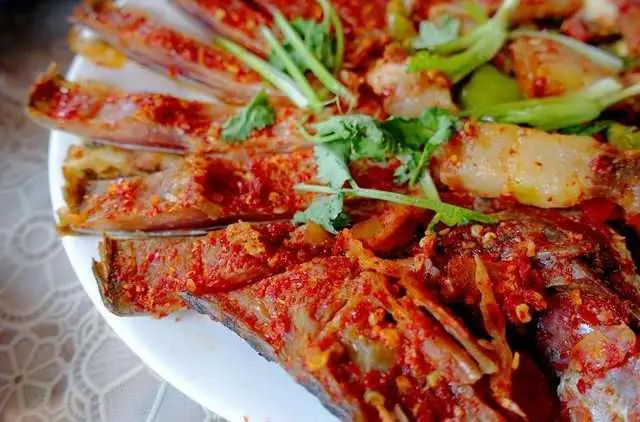
Image notes
Resized for the web; the photo itself has not been edited.
Tap any red Chinese text to hear it in Mandarin.
What this dish is
Keep the Chinese name 侗家腌肉 Dòng Jiā Yānròu ready when searching or asking. It is not simply smoked bacon (腊肉), and it is not Dong pickled fish (侗家腌鱼). A 2022 regional product standard defines 腌肉 Yānròu as a fermented meat product made from pork with ingredients such as chilli powder, cooked glutinous rice or sweet-rice-wine lees, white liquor, salt and spices, using salting and fermentation. The standard is for production, sale and inspection in Qiandongnan; household recipes can be less uniform.
The dish belongs to a wider Dong food culture in which sour preservation is normal rather than unusual. A Liping County government introduction lists pickled pork, fish and vegetables among the foods associated with the saying “eat without leaving sourness” (吃不离酸). A food feature in Science and Technology Daily likewise notes that pork, beef, chicken and duck can all be made into fermented “meat sours” in Dong communities. These sources explain the cultural setting without claiming that every Dong household uses one fixed recipe.
How the flavour is built
The traditional description published by Qiandongnan News gives the clearest sequence for the pork version. The skin is first seared on a red-hot iron plate, scraped and washed, then rinsed with rice-washing water. The meat is cut into pieces or strips and salted for three or four days. It is then packed into a wooden curing barrel with cooked, cooled glutinous rice mixed with chilli powder, Sichuan pepper and salt; a sweeter version uses sweet rice wine made from glutinous rice. Meat and rice are layered, weighted with a stone and sealed with oiled paper.
The preferred traditional period is the eleventh lunar month through the first lunar month, with the work completed roughly ten days before Lichun, the Beginning of Spring. Treat that as a seasonal food tradition, not a promise that a restaurant has a current batch. The regional standard describes the finished product as block-shaped, with chilli or other seasonings attached, an intended sour-spicy and mellow aroma, and lean meat that may be red with white or slightly pink fat.
Expect variation in saltiness, tang, sweetness from rice wine and the balance between lean and fatty pieces. A kitchen may serve it as a cooked dish or offer it as a packaged local product; ask how that particular batch is prepared rather than assuming that a photograph or a shelf item is ready to eat. Do not treat one household or restaurant method as the only authentic version.
How to look for it without choosing a shop for you
Search the exact Chinese name 侗家腌肉 Dòng Jiā Yānròu in Amap/Gaode Maps (高德地图) or Meituan (美团) after setting your location to the Qiandongnan town or village where you are staying. Use the results only as leads, not as a ranking of quality. For each nearby listing, check that the menu text or a recent menu photo actually names 侗家腌肉 or 腌肉, rather than only 腊肉, 腌鱼 or a generic “local pork” dish. Read recent reviews for a dated mention of this dish, check the current opening status and hours, and ask by phone or in person whether it is being served today. Because the curing season is traditional and supply is batch-dependent, an old review does not prove present availability.
Before ordering, tell the server that you are looking for pork fermented with glutinous-rice ingredients and chilli, and ask whether the batch contains sweet rice wine or white liquor. It is a pork dish, not vegetarian; the rice, chilli, salt and possible alcohol matter for dietary restrictions. If you are unsure about unfamiliar fermented flavours, order a small portion or ask to see the serving style first. No particular shop, brand, address or platform ranking is endorsed here.
Where it fits in a Qiandongnan trip
This is a regional food rather than a dish tied to one ticketed attraction. A Qiandongnan government-published Dong-village route through Liping and Congjiang lists 腌肉 among the foods to taste and buy as a local product, alongside pickled fish and other Dong foods. That is useful context for the dish’s place in the Zhaoxing–Liping–Congjiang food landscape, but it is not a current guarantee of a menu, opening time or retail stock at any stop.
Because 侗家腌肉 has no single venue, there is no honest single address, ticket, reservation rule, railway stop or last-mile route to give. Once a current venue is found through the checks above, follow that venue’s live Amap or Meituan listing and confirm the return plan locally. The dish entry therefore carries no venue-specific transport directions.