

Heyang xuemian noodles 合阳踅面
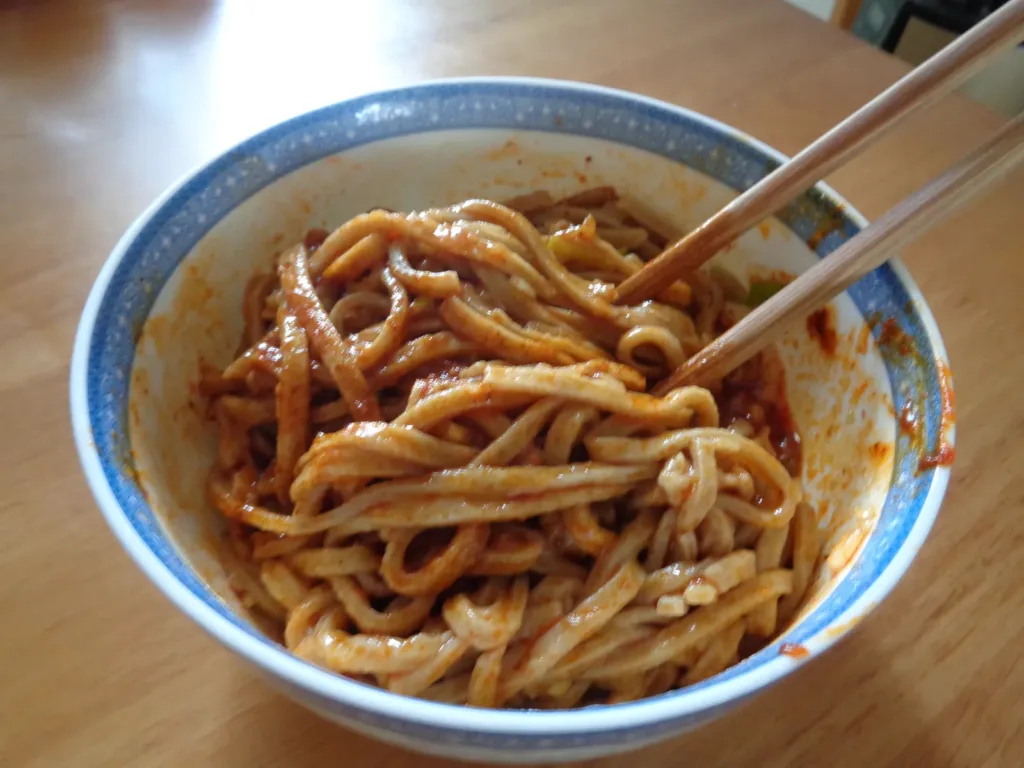
Heyang xuemian is a local noodle dish from Heyang County in Weinan, eastern Shaanxi: a buckwheat-and-wheat batter is spread into sheets, partially baked, cut into strips, and revived in boiling water before being dressed with local seasonings. Its soft, cohesive bite and the rare Chinese character 踅 make it a food to order by its Chinese name rather than by an assumed English translation.
Tap any red Chinese text to hear it in Mandarin.
Why try it
Heyang xuemian is not made by pulling a fresh rope of dough. A flour batter is spread into thin sheets on a hot iron griddle, partially baked, cooled, and cut into strips. The rare character 踅 is pronounced xué; you may also see 旋面 or 页面, but showing 合阳踅面 Héyáng Xuémiàn is the safest way to order.
Local stories link the food to Han Xin’s army at the Xiayang Ferry in the early Western Han, and the dish is often called an “ancient instant noodle.” Treat that as local tradition, not a securely dated origin: the evidence here describes a remembered story rather than archaeological proof. What is not in doubt is the dish’s practical design—sheets that can be stored for a time and revived quickly in boiling water.
Watch the sheet-making
If you find a kitchen or market stall where preparation is visible, watch for the circular motion behind the name. A maker spreads batter from the centre outward and back towards the centre with a half-moon wooden tool on a heavy iron griddle. A recent Shaanxi Daily report describes a griddle about 90 cm across, sheets around 2 mm thick, a second griddle for finishing, then cooling and air-drying before cutting. The maker folds the cooled sheets and cuts even strips; “four edges visible” is a local way to describe neat work.
This is an observation opportunity, not a guaranteed visitor demonstration. The method gives the noodles a cohesive, soft-chewy bite rather than the springy pull of hand-stretched wheat noodles. A current report uses equal parts buckwheat and wheat flour for one maker, while older local writing describes a 70:30 buckwheat-to-wheat blend. Treat the ratio as a maker-level variation, not a fixed rule. Either way, buckwheat association does not make the dish wheat-free.
How it is served
Xuemian may be served dry-tossed or with soup. Local accounts describe lard or another cooking fat, chilli oil, salt, vinegar, spring onion or chive blossom, and a small serving of 鱼儿粉 Yú’ér Fěn (a starchy “fish” garnish); the starch may be mung bean, sweet potato, wheat or corn depending on the kitchen. Some dressings may include meat or meat-based fat, so ask before ordering.
Try a small bite before adding extra chilli or vinegar, then adjust. If you prefer a lighter bowl, ask for less oil and confirm the broth or topping. If you have coeliac disease, a wheat allergy, a buckwheat allergy, or follow a vegetarian or vegan diet, explain it in Chinese and ask about both the noodle blend and the dressing; do not infer safety from the word “buckwheat.” A real local variation is stir-fried xuemian, but recipes and vegetables vary—order it as a variation, not as a single canonical recipe.
Finding a bowl without turning this into a shop endorsement
The dish is sold across Heyang County, including town markets and restaurants, so it is not a fixed-address attraction. Search 合阳踅面 Héyáng Xuémiàn on Meituan (美团) or Amap/Gaode Maps (高德地图) from your current location; if you are heading towards Fang Town, try 坊镇踅面 Fāngzhèn Xuémiàn as an additional query. Open the current listing, menu photos, recent reviews, opening status and today’s availability before choosing. Map ranking is not proof of quality or authenticity, and this guide does not endorse a named shop.
Getting there and back
Plan this as a Heyang County food stop, not as a ticketed attraction with one gate. Public timetable pages read on 2 November 2026 list 合阳北站 (Heyang North Railway Station) on the Xi’an–Heyang North–Hancheng corridor, with trains shown in both directions. Confirm the day’s service and tickets through 12306 or your booking channel before setting out; timetable pages can change.
There is no honest single last-mile instruction because the dish is spread across the county. From 合阳北站, choose a currently open listing in Amap or Meituan and use the live local taxi, ride-hailing or transit option for that specific address; the exact bus number, exit and travel minutes are not established here. Before eating, check a 合阳北站 → 西安 Héyáng Běi Zhàn → Xī’ān or 合阳北站 → 韩城 Héyáng Běi Zhàn → Hánchéng return departure and leave enough time to get back to the station. The cited timetable pages do not establish a guaranteed last train.
More dishes to compare
Explore related local specialties and compare their names, preparation notes and ordering guidance.
Biangbiang noodles biángbiáng面 →
Wheat dough is stretched and slapped into very broad, thick ribbons, then boiled and dressed. Hot oil over chili and aromatics is familiar, while meat and vegetable toppings vary. The noodles have a strong, springy chew and a wide surface that carries the seasoning. Their thickness makes the texture central to the dish.
Wuqi chopped buckwheat noodles 吴起剁荞面 →
Buckwheat dough is worked into a firm sheet or block and chopped into noodle strips before cooking. A wheat blend may be used, and the accompanying broth or sauce varies. The noodles have an earthy grain flavor and a more compact bite than stretchy hand-pulled wheat noodles.
Sources & reading
Recipes and servings vary between kitchens.
Image credits & notes (1)
- A bowl of Heyang xuemian noodles, showing the broad, sauce-coated strips and chopsticks. Photo: LiuxingyPhoto: CC BY-SA 4.0