

Huangpi bean-and-rice noodles 黄陂豆丝
Huangpi dousi is a Wuhan-area staple made from a rice-and-bean batter cooked into thin sheets and cut into strips. It is especially associated with Huangpi’s New Year food traditions, and its soft, springy texture is unlike wheat noodles.
Tap any red Chinese text to hear it in Mandarin.
In Huangpi District, a northern district of Wuhan, dousi is counted among the area’s three traditional snacks and is closely tied to the run-up to Spring Festival. Families traditionally make it as a New Year provision, while local producers now also combine hand methods with modern production.
What it is
Despite the English word “noodles”, 黄陂豆丝 starts as a thin sheet. Rice is combined with mung beans or soybeans, soaked and ground into a batter, then spread on a hot pan and sliced after cooling. The result is a grain-and-bean food with a springy bite, not a wheat-noodle dish or a pressed tofu sheet.
How it is made
A traditional account describes soaking the rice and beans before grinding them into a pale batter. It notes that early-rice varieties are valued for their lower stickiness, while a small amount of soybean can help keep the finished sheet tender; proportions vary between makers. The batter is spread into a thin round on a pan, allowed to set, cooled, and cut.
The pan-spreading stage is the part that most clearly shows the craft. In a 2024 account from Huangpi, one person managed the heat while another rotated a tool around the pan to spread the batter evenly. That coordination affects the sheet’s appearance and texture.
How to eat it
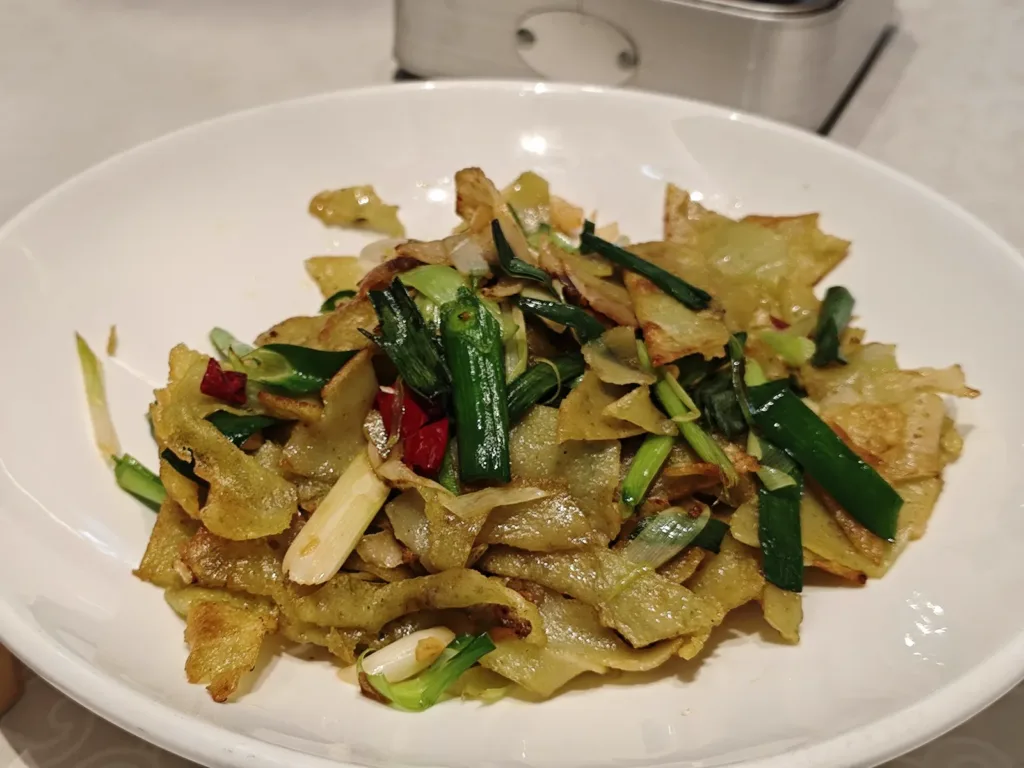
Local sources describe three straightforward preparations: pan-frying, stir-frying, and boiling. Choose a browned, savoury version if you want more pan aroma, or a boiled preparation if you want the strips to carry more of the surrounding broth. Freshly made sheets and dried products can behave differently, so ask how the kitchen prepares its version.
The base is a rice-and-bean batter, but a finished dish can still have added vegetables, meat, stock, or other seasonings. If you have an allergy or avoid particular ingredients, show the name 黄陂豆丝 Huángpí Dòusī and ask what is in both the strips and the seasoning before ordering. Recipes and serving styles are not a single fixed formula.
Huangpi, Wuhan, and nearby names
Huangpi dousi is the Huangpi-associated version within Wuhan’s wider food culture. An official Ministry of Culture and Tourism route for rural Wuhan lists 黄陂豆丝 Huángpí Dòusī and 蔡甸豆丝 Càidiàn Dòusī as separate specialties. Treat the district name as part of the order rather than assuming that every “豆丝” on a Wuhan menu is the same local version.
Where to eat it
You can find Huangpi bean-and-rice noodles all over Hubei, so there is no need to seek out one particular restaurant. To find one near you, search for “黄陂豆丝” in Meituan (美团) or Amap (高德地图) and check recent reviews, distance and opening hours.
More dishes to compare
Explore related local specialties and compare their names, preparation notes and ordering guidance.
Three-delicacy doupi 三鲜豆皮 →
A thin crepe-like skin is cooked, filled with sticky rice and finely diced savory ingredients, then folded and browned. Portions are cut from the larger pan preparation. A crisp, lightly eggy surface contrasts with dense, chewy rice and juicy diced filling. The portion is more substantial than its thin exterior suggests.
Xiaogan sweet fermented rice 孝感米酒 →
Glutinous rice is fermented until the grains soften and produce a sweet, aromatic liquid. It is served spoonable, sometimes warmed or combined with egg and other additions. The grains are soft and lightly chewy, with sweetness balanced by a gentle fermented aroma and possible acidity.
Sources & reading
Recipes and servings vary between kitchens.
Image credits & notes (1)
- A plate of Hubei-style stir-fried dousi, shown as a regional preparation illustration rather than a named Huangpi vendor. Photo: LiuxingyPhoto: CC BY-SA 4.0