

Rice Wine 米酒
Yanbian’s 米酒 is a Korean-ethnic rice drink shaped by village brewing traditions, with grain-based and fruit-flavoured versions; look for it by its Chinese name rather than treating one shop as the definitive address.
Tap any red Chinese text to hear it in Mandarin.
A regional drink, not one fixed restaurant dish
In Yanbian, 米酒 is best understood as a regional drink in Korean-ethnic food and living-culture settings. The documented picture runs from traditional village brewing in Xintun, Antu County, to a visitor-facing tasting courtyard inside China Korean Folk Village in Yanji. It is therefore more useful to think of 米酒 as a local tradition with different expressions than as one city-exclusive formula or one definitive shop.
How the drink is made and changed
At Xintun village, brewer Li Dechun is identified as a practitioner of the village’s Korean-style traditional rice-wine craft. A report describes the sequence as making the starter, fermentation and brewing, and says the village developed grain wines using five-grain and six-grain mixtures. Those details belong to the documented Xintun production line; they should not be treated as a universal recipe for every 米酒 served across Yanbian.
In Yanji’s folk-culture park, An Zhenjin is described as the fourth-generation inheritor of the Ailing rice-wine-making technique. She has adapted the traditional practice for visitors and introduced mulberry and blueberry versions. These fruit flavours are real local variations, but they are not proof that every seller uses the same base, sweetness or fermentation method.
What to notice in the glass
A report from the park describes the drink as cool, fragrant and sweet. At the Ailing family rice-wine courtyard, the surrounding scene includes traditional buildings and rice-wine starter drying in the sun, so the point of the visit is partly to see the craft in a lived setting rather than only to buy a bottle.
Ask what you are being served: a plain grain version, a fruit-flavoured version, or another house variation. The sources read for this guide do not state a standard alcohol percentage. Sweetness is not the same as being alcohol-free, so visitors avoiding alcohol should confirm the preparation or skip it. Do not assume that a particular version is vegan, gluten-free or free of other allergens simply because it looks pale or sweet.
Finding a serving without choosing a “best” shop
Search for 米酒 Mǐjiǔ or 朝鲜族米酒 Cháoxiǎnzú Mǐjiǔ on Meituan (美团) or Amap / Gaode Maps (高德地图). Add 延吉 Yánjí or 安图 Āntú if the results are too broad. Before choosing, check the current menu, recent reviews, opening information and whether the drink is available that day. Map ranking is not evidence of authenticity or quality, and this guide does not name a single restaurant as the official address for the dish.
The best-documented visitor setting is China Korean Folk Village in Yanji. A local report places the park at Yanji’s 延南路 area and describes north and south gate scenes; Amap lists the destination as 中国朝鲜族民俗园 Zhōngguó Cháoxiǎnzú Mínsúyuán, at 延边朝鲜族自治州延吉市延南路与延龙路交叉口东150米. If the park is part of your plan, use that Chinese destination in a taxi or ride-hailing app, enter through the gate open on the day, and follow on-site signs for 爱玲家米酒小院 Àilíng Jiā Mǐjiǔ Xiǎoyuàn only if it is operating. The reports document the courtyard, but they do not guarantee current opening, a tasting, a fixed menu or same-day supply.
Amap’s public transport record lists a stop named 中国朝鲜族民俗园(公交站) and shows routes 1, 21, 32, 41, 43, 46 and B16. It also mentions a park-area shuttle connection toward Mao’er Mountain, without giving a timetable. Check the live route and operating direction before setting out. For the return, use the same named stop or a live ride-hailing pickup point after leaving the park; 米酒 itself has no dedicated address or return route.
Xintun is important for the village-origin story, but the source reviewed here does not establish a regular walk-in workshop schedule, public entrance procedure or a guaranteed tasting service. Treat a visit there as a separate, pre-confirmed stop rather than assuming that a production story equals an open attraction.
Sources & reading
Image credits & notes (1)
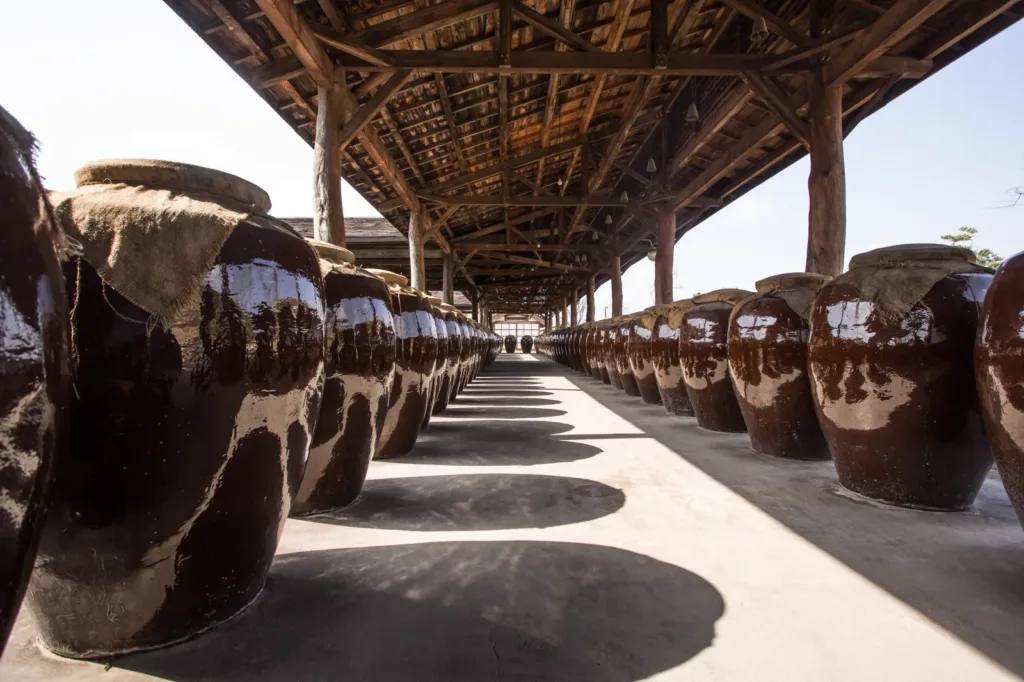
- Rows of earthenware jars associated with makgeolli brewing; an illustrative brewing-scene reference, not a photograph of Yanbian’s Xintun village. Photo: russik ryoo (Pixabay user russik-7521298)Photo: CC0 1.0