

Lanzhou oil-fried bean jelly 兰州油炒粉
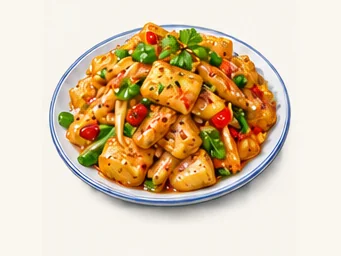
Lanzhou oil-fried bean jelly (兰州油炒粉) is a hot local snack made by stir-frying set liangfen pieces with lard, sugar, scallion, garlic shoots, salt and soy sauce, then serving them with optional chili oil, sesame paste, vinegar and garlic juice. Expect a hot, seasoned piece of jelly rather than a noodle dish; recipes and toppings vary by stall.
Why it is worth trying
Oil-fried bean jelly is a Lanzhou-associated street snack, not a dish that needs a single landmark or a fixed restaurant to explain it. A Gansu provincial information site describes it as a local Lanzhou specialty and notes the close relationship with niangpi sellers: places selling niangpi commonly also sell oil-fried bean jelly. The point of trying it is the transformation of a cool, set liangfen into a hot wok dish, with a browned, seasoned exterior and a soft jelly centre.
That everyday setting still exists. A 2025 report on Lanzhou morning markets described an oil-fried-bean-jelly stall beside other market foods on Zhengning Road, where its version was blanched in penghui water and dressed with garlic and chili. That is a report of one current stall’s variation, not a city-wide recipe or a promise that every market serves it.
How it is made and eaten
The documented traditional method starts with liangfen cut into roughly mahjong-tile-sized cubes. The pieces are added in batches to a flat iron pan containing heated lǔzhūyóu, a seasoned rendered pork fat, then stir-fried with sugar, scallion, garlic shoots, salt and soy sauce until golden and hot. The bowl is finished according to taste with chili oil, sesame paste, aged vinegar, garlic juice and sometimes more salt.
This sequence explains the dish better than a list of flavour adjectives: hot fat colours the exposed faces, while the set jelly remains soft enough to eat with chopsticks. The proportions and finishing sauces are not a universal formula, so look at whether the stall is cooking a fresh batch and add vinegar or chili gradually if the bowl is already dressed. The practical aim is to eat it hot, rather than treating it like a cold liangfen salad.
In the wider Gansu food region, cold niangpi and hot oil-fried powder are also presented as a deliberate contrast. A 2024 CCTV report from Lintao describes diners ordering “a bowl of niangpi” and “a bowl of fried oil powder” as a cold-and-hot pairing. It is useful regional context, but it should not be read as proof that every Lanzhou serving follows the same pairing.
Season and local context
The season is not a strict rule. A Gansu cultural-travel report lists oil-fried bean jelly among Lanzhou’s summer street foods, while another Gansu report says that hot oil-fried bean jelly is especially fitting in winter and spring and that liangfen itself is eaten year-round. In practice, a stall may change what it prepares with the weather and its daily trade, so check current availability instead of assuming a particular month guarantees it.
Search for “兰州油炒粉” on Meituan (美团) or Amap / Gaode Maps (高德地图) to find nearby places serving this dish. Check menus, recent reviews, opening information and today’s availability before choosing. Search ranking does not establish quality or authenticity, and a listing does not prove that a stall still has a portion when you arrive.
Dietary notes
The documented method uses lǔzhūyóu, or seasoned rendered pork fat, and commonly lists soy sauce, sesame paste, garlic, chili and vinegar among the seasonings. Do not assume that a bowl is vegetarian or free of a particular allergen from its appearance. If you avoid pork, soy, sesame, garlic, strong chili or other ingredients, ask what the stall uses that day; recipes and sauces vary, and the name alone is not an ingredient guarantee.
More dishes to compare
Explore related local specialties and compare their names, preparation notes and ordering guidance.
Niangpi noodle sheets 酿皮 →
A flour or starch batter is steamed into sheets, cooled and sliced, then dressed with savory condiments. Wheat-based versions may be served with separate pieces of gluten, but ingredients vary. The sheets are smooth and elastic, with the dressing contributing sourness, chili heat and aromatic richness. Gluten adds a spongier bite when included.
Lanzhou sweet grey-pea soup 兰州灰豆子 →
The peas are soaked and simmered until their skins split and the liquid becomes thick. Dates and sweetness round out the flavour. The mixture is cooked to a soft consistency rather than left as separate firm peas in a clear syrup. Expect an earthy pea flavour, gentle date sweetness and a soft, almost sandy texture. Its muted colour is normal for the ingredients, while the amount of added sugar varies between shops.
Sources & reading
Recipes and servings vary between kitchens.