

Oyster omelet 海蛎煎
Small oysters, egg and sweet-potato starch meet on a hot pan in this Southern Fujian snack. The starch sets into a tender, slightly elastic center with browned edges; garlic, greens and the sauce vary by cook.
Tap any red Chinese text to hear it in Mandarin.
City-card summary: Small oysters, egg and sweet-potato starch meet on a hot pan in this Southern Fujian snack. The starch sets into a tender, slightly elastic center with browned edges; garlic, greens and the sauce vary by cook.
What it is
海蛎煎 (hǎilìjiān), literally “oyster fry,” is a familiar Xiamen food, but it belongs to the wider Southern Fujian coastal repertoire rather than to one uniquely fixed Xiamen recipe. Fujian’s provincial account describes oyster omelet as a specialty snack and traces its development to southern Fujian. A Xiamen-focused account calls it one of the city’s locally rooted foods.
From oyster to crisp edge
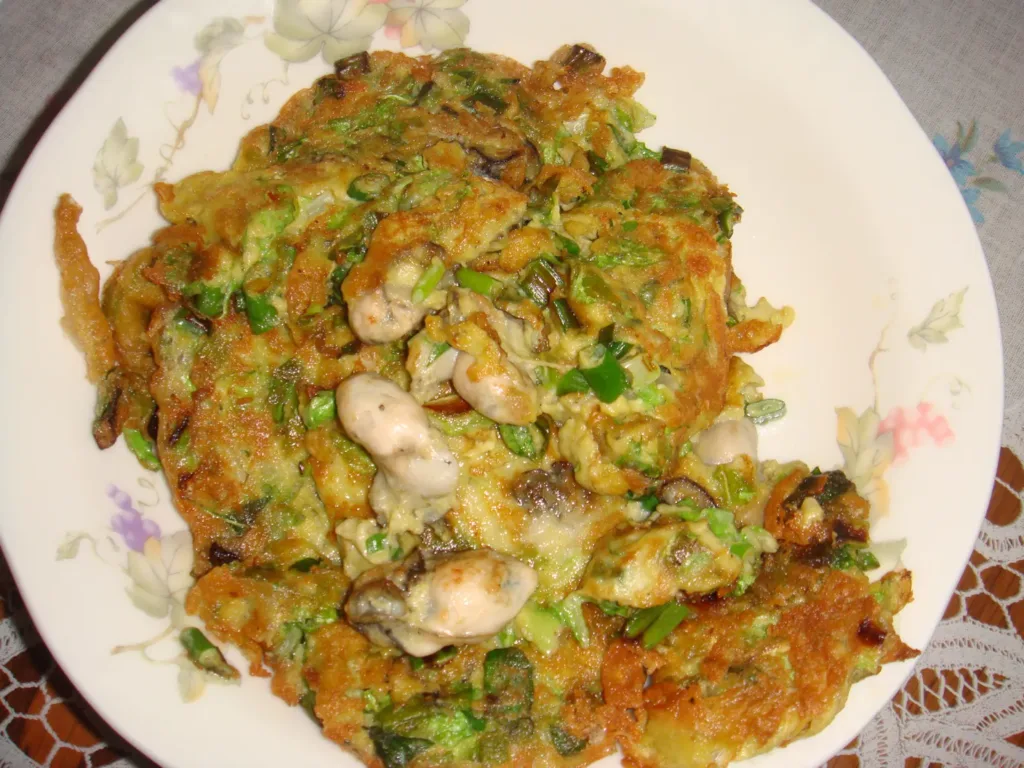
A common base is small oysters, egg and sweet-potato starch. The starch batter binds the seafood and, as it cooks, becomes set and faintly elastic; the egg and direct contact with the pan help the surface brown, sometimes into a crisp edge. The result is neither a plain egg omelet nor a firm flour pancake: oyster juices and brine stay in the soft middle. Recipes differ. Xiamen descriptions emphasize sweet-potato starch and chopped garlic or green garlic, while other Southern Fujian versions may add scallion or vegetables.
Cooks may fry the oysters with the starch mixture before adding egg, or arrange the oysters over batter and fold or turn it as the egg sets. Oil, greens and seasoning are not uniform. Garlic-chili, sweet-sour or other dipping sauces may be served separately, so ask what accompanies the plate rather than assuming one standard sauce. The dish is best eaten hot, while the contrast between its browned edge and yielding center remains.
Ordering and dietary checks
Show 海蛎煎 Hǎilì Jiān when ordering; pronunciation and English menu wording can differ. Oysters and egg are central to the usual preparation, and recipes may use sweet-potato starch, other starches, garlic, greens and cooking oil or pork fat. It is not vegetarian, and the appearance alone cannot establish whether a version is free of other allergens or animal ingredients. If that matters, ask the individual kitchen about its batter, cooking fat, sauce and shared cooking surface.
Where to eat it
You can find Oyster omelet all over Fujian, so there is no need to seek out one particular restaurant. To find one near you, search for “海蛎煎” in Meituan (美团) or Amap (高德地图) and check recent reviews, distance and opening hours.
More dishes to compare
Explore related local specialties and compare their names, preparation notes and ordering guidance.
Lychee pork 荔枝肉 →
Pork is cut so it curls during frying, then coated with a sweet-and-sour sauce. The resulting rounded pieces resemble lychees; potatoes may also appear in some versions. The pork is crisp at first, with tender meat beneath and a glossy tangy-sweet coating. It is a savory meat dish even though its name is fruity.
Rouyan dumpling soup 肉燕 →
Pork is worked with starch into a very thin wrapper, which encloses a savory filling and is cooked in soup. The meat-containing wrapper is the defining difference from an ordinary wheat wonton. The skin is delicate but resilient, with a subtle meatiness around the juicy center and light broth.
Sources & reading
Recipes and servings vary between kitchens.
Image credits & notes (1)
- A plate of oyster omelette (蚵仔煎), photographed in 2010. The source does not document a Xiamen location, so this is a dish illustration rather than a photograph of a specific Xiamen restaurant or a claim about one standard local recipe. Photo: YUCHIA CHUNG (credited on Wikimedia Commons as YUCHIA CHUNG from Irvine, USA)Photo: CC BY 2.0