

Rouyan dumpling soup 肉燕
Rouyan (肉燕), often rendered as “meat swallow,” is a Fuzhou-style dumpling soup whose wrapper is made by pounding lean pork with sweet-potato starch, rather than using an ordinary wheat wrapper. Its thin, resilient skin, savory filling, and hot broth make it a useful dish for tasting how Fuzhou treats texture and soup.
Tap any red Chinese text to hear it in Mandarin.
What makes it different
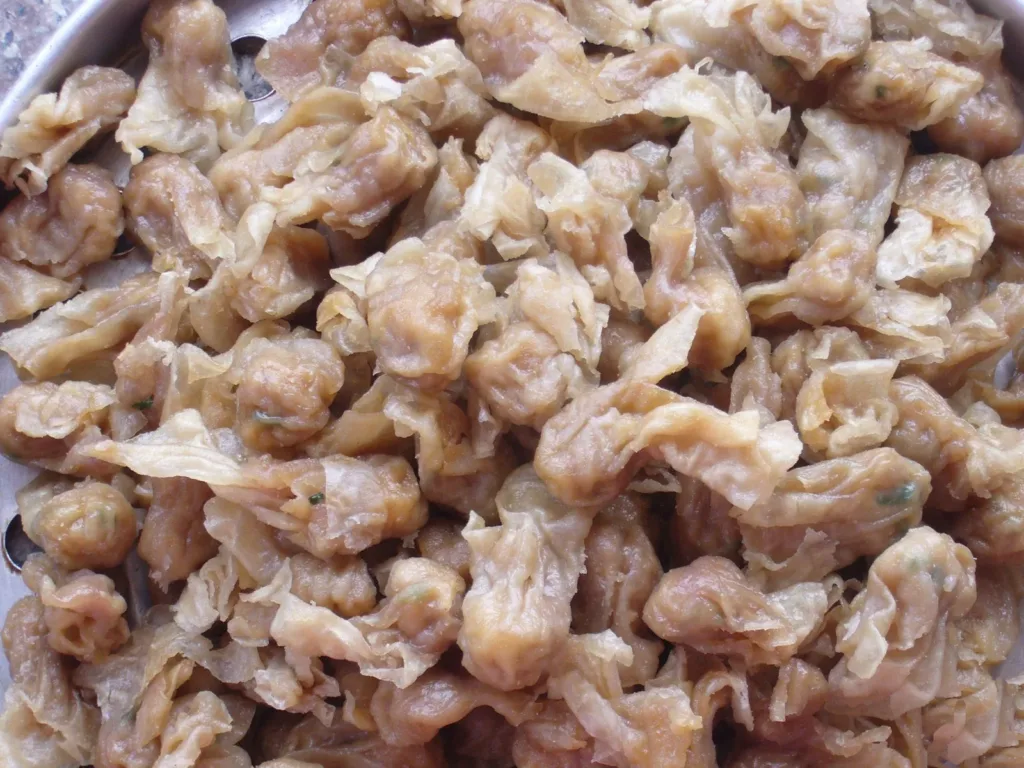
The wrapper is the point. Traditional accounts describe lean pork from the leg being pounded into a paste, combined with sweet-potato starch, and rolled or pressed into a sheet thin enough to look almost like paper. A local craft account stresses that the pounding and temperature control affect the meat’s adhesiveness, while a teaching demonstration describes the finished pieces as thin square wrappers. These are descriptions of a labor-intensive method, not a promise that every modern kitchen follows one identical formula.
The cooked skin is delicate but resilient: it should hold its filling while turning glossy and lightly translucent in hot water. The center is usually savory and meat-based, and the broth keeps the bowl simple enough for the wrapper’s texture to stand out. Pork is not only a possible filling here; it is part of the wrapper itself. Fish, shrimp, egg, seasonings, and other ingredients may appear in particular fillings or kitchens, so the menu and the kitchen’s answer matter more than a generic photograph.
Rouyan is associated strongly with Fuzhou, but local histories place its earliest story in Pucheng and describe the craft as later flourishing in Fuzhou. That distinction is useful: the dish is a Fuzhou food tradition without needing a claim that the city invented every form of it. In Fuzhou, rouyan also appears in banquet and festival customs. When it is cooked with duck eggs, it is called Taipingyan, a name linked to wishes for peace; do not assume a plain bowl of rouyan includes an egg unless the menu says so.
How to taste it and compare related forms
Start with the skin rather than the garnish. Notice whether it stays intact around the filling, how quickly it softens in the broth, and whether the bite is slippery, springy, or firmer than a wheat wonton skin. Then taste the filling and broth separately. This is a better way to recognize rouyan than judging by the swallow-like shape alone.
Menus may also use related names. Yansi refers to dried rouyan skin cut into strips and cooked in soup; Yanwan uses strips of the skin around a meat mixture to make balls. These are related preparations, not proof that a vendor’s “rouyan” is one fixed recipe. Taipingyan is the duck-egg version associated with banquets and festive meals.
Ordering and practical access
Show the Chinese name 肉燕 Ròuyàn when ordering. If a menu uses another label, try 扁肉燕 Biǎnròu Yàn as well. Ask whether the wrapper is pork-based and what is in the filling: “燕皮是猪肉做的吗?馅里有猪肉、虾、鱼或鸡蛋吗?” Rouyan is not vegetarian, and people avoiding pork or seafood should confirm the whole bowl rather than relying on the name or appearance.
Rouyan is a dish, not a fixed attraction with one entrance or address. Search for 肉燕 Ròuyàn or 扁肉燕 Biǎnròu Yàn on Meituan (美团) or Amap/Gaode Maps (高德地图) to find nearby current listings. Check the menu, recent reviews, opening information, and that day’s availability before choosing. After selecting a venue, use the app’s current route from your actual starting point; the last mile, nearest stop, and return route depend on that venue. There is therefore no honest dish-specific station, exit number, walking time, fare, or fixed return line to give here. Return by the same city transport or a taxi/ride-hailing service shown for the chosen venue.
More dishes to compare
Explore related local specialties and compare their names, preparation notes and ordering guidance.
Mingxi dried pork jerky 明溪肉脯干 →
Pork is cut or shaped into thin sheets, seasoned and dried or roasted until concentrated and ready for storage. Individual makers determine how sweet, smoky or spicy the result becomes. The texture is firm and fibrous, with a savory-sweet meat flavor that grows as it is chewed. Thinner pieces are easier to tear.
Lychee pork 荔枝肉 →
Pork is cut so it curls during frying, then coated with a sweet-and-sour sauce. The resulting rounded pieces resemble lychees; potatoes may also appear in some versions. The pork is crisp at first, with tender meat beneath and a glossy tangy-sweet coating. It is a savory meat dish even though its name is fruity.
Sources & reading
Recipes and servings vary between kitchens.
Image credits & notes (1)
- A tray of rouyan dumplings from Danyang town in Lianjiang County, Fujian, photographed in 2009; a regional example of the pork-based wrapper rather than a named Fuzhou restaurant or a served bowl of soup. Photo: LianxxPhoto: CC BY 3.0