

Tibetan Butter Tea 酥油茶
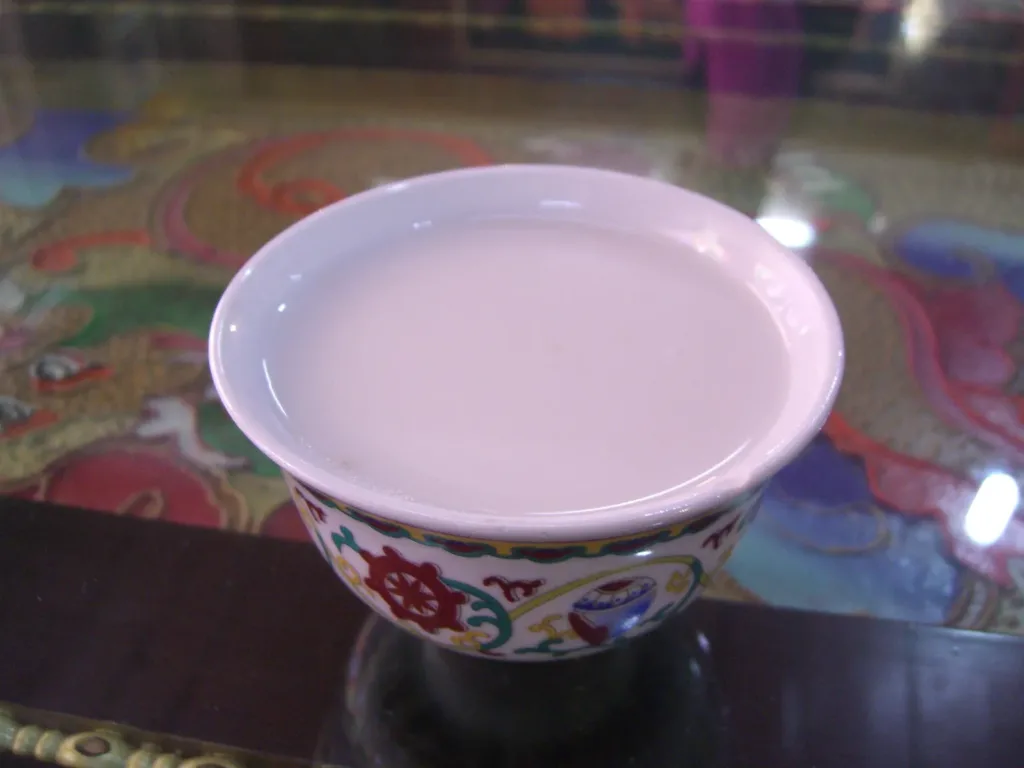
Tibetan Butter Tea (酥油茶, Suyou Cha) is a savory, emulsified drink made from strongly brewed brick tea, butter and salt. In Aba's Tibetan communities it belongs to an everyday and guest-hosting food tradition, and it is especially worth trying with tsampa when a local host or food venue offers it.
Tap any red Chinese text to hear it in Mandarin.
What it is
In Aba, 酥油茶 is a regional Tibetan drink, not a sweet milk tea and not a dish claimed as a one-town invention. The Aba local gazetteer notes that the strong border tea called 雅茶 (also called 马茶 or 边茶) is used for butter tea because its flavor can stand up to butter and milk. The same source describes tsampa as a staple eaten with butter and tea water, which explains why the drink is often encountered as part of a larger Tibetan meal rather than alone.
Official Aba visitor information for Ruoergai lists 酥油茶 among local Tibetan foods that visitors can taste.
How it is made
The base is strong tea, often brick tea or the robust border tea used in Aba. The tea is boiled, then butter and salt are added. In the traditional method, the mixture is worked in a tall wooden churn with a stick until the fat and tea form a cloudy emulsion. Government cultural accounts also note that electric mixers are now used in some homes, so the visible preparation may differ from the old hand-churned version.
The result is usually warm, savory and tea-forward, with a buttery or dairy aroma and a thin sheen of fat. It is not meant to taste like sweet milk tea. Strength, saltiness and the balance of tea and butter vary between households and venues, so a first sip is a better guide than a fixed recipe.
How to drink it
Aba sources place butter tea alongside tsampa: roasted barley flour can be mixed with butter and tea water, forming a simple, filling food. If you are offered both, taste the tea on its own first, then try the tsampa preparation if your host shows you how.
In a hosted setting, the bowl may be refilled as you talk. Local etiquette accounts describe taking small sips rather than draining the bowl at once, and leaving a little when you are finished. These are hospitality customs, not a rigid rule for every commercial venue; follow the host’s lead, and say politely if you do not want another refill.
Practical tips
Use the Chinese name 酥油茶 Sūyóu Chá when asking. Confirm that it is available before ordering.
Because the drink is made with butter, it is not automatically vegan, dairy-free or low-salt. Ask about the ingredients if you have an allergy, dietary restriction or a preference for less salt; do not infer a recipe from its color alone.
Where to eat it
You can find Tibetan Butter Tea all over Sichuan, so there is no need to seek out one particular restaurant. To find one near you, search for “酥油茶” in Meituan (美团) or Amap (高德地图) and check recent reviews, distance and opening hours.
Sources & reading
Image credits & notes (1)
- A cup of yak butter tea photographed at Shuzheng Tibetan Village in Jiuzhaigou, Ngawa Tibetan and Qiang Autonomous Prefecture, Sichuan; a regional example rather than proof of a current vendor. Photo: Alpha (Flickr username avlxyz)Photo: CC BY-SA 2.0