

Dried Cheese Curds 奶渣
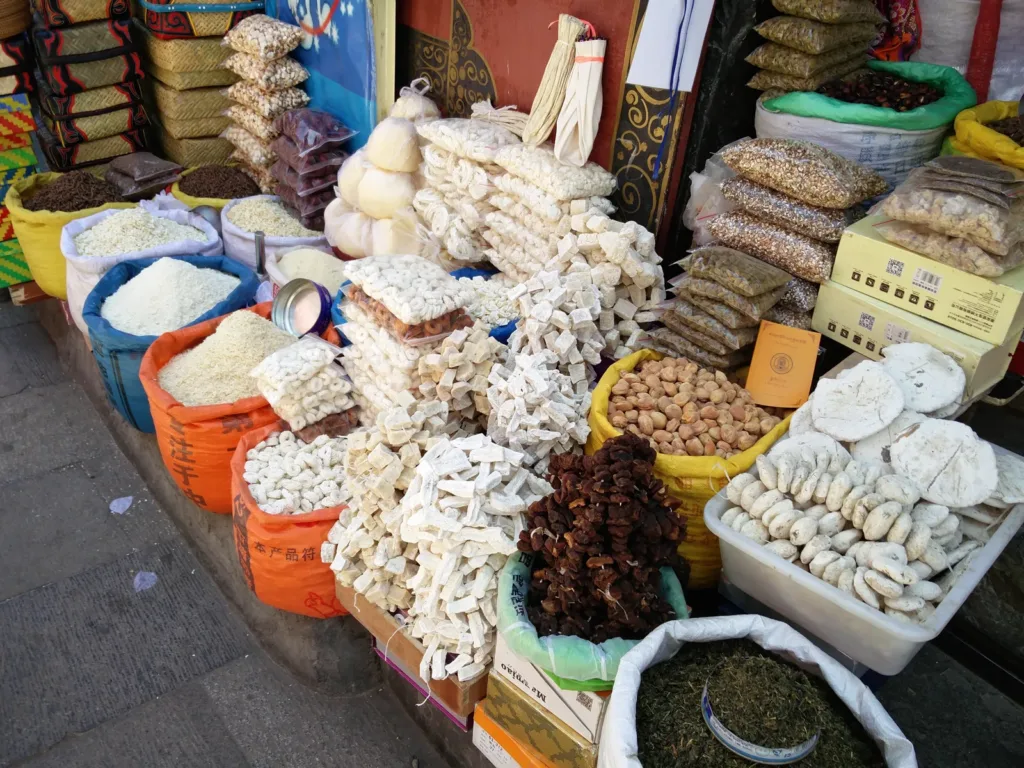
Dried Cheese Curds (奶渣, naizha) are a traditional Tibetan dairy food made by separating curds from milk after butter-making or souring, then draining and drying them. In Lhasa they may appear as hard pieces or rings to eat on their own, or as an ingredient with tea, tsampa, porridge, and soup.
What it is
奶渣 is not one factory-standard cheese. A local Lhasa report describes a herder from Damxung County making it from the liquid left after churning butter from yak milk: the liquid is boiled, cooled until sour, strained through bamboo, and the retained curds are dried. The report also places home-made curds in Lhasa street selling, rather than tying the food to one restaurant.
The wider term qula is used for milk dregs in technical writing. A review of yak-milk products says it can be made from skim milk left after ghee-making or directly from raw yak milk; fermentation helps the casein set before the curd is dried. This is why two sellers may offer different shapes, colors, or levels of firmness without either being an invented “official” version.
Flavour and texture
The Lhasa account describes hollow white rings that are hard to chew, with a milky aroma and a sweet-and-sour note from fermentation. Expect a firm, dry chew rather than the softness of yogurt. A FAO account of related Chinese highland milk residue notes that skim-milk curds tend to dry white and hard, while whole-milk curds can be more yellow and brittle. The exact texture therefore depends on the milk, the amount of fat left after butter-making, fermentation, and drying time.
How to eat it
Dried curds can be nibbled as a snack, crumbled into porridge or soup, or added to butter tea for a stronger dairy taste. Fresh, undried curd can be used as a filling for 奶渣包子 (curd buns). Related milk-curd preparations are also mixed with butter, sugar, or tsampa. The FAO account records fresh residue with milk tea and dried residue mixed with butter and zanba; a Tibetan government language-and-culture page describes curd, butter, and sugar pressed into snack cakes.
Do not assume that every product labelled 奶渣 is plain dried curd. Tibet’s tourism department lists milk-curd sweets, curd cakes, curd strips, and other dairy snacks, while a Lhasa food report describes modern curd pastries as a separate processed variation. Ask whether you are buying plain dried curd, a sweetened cake, or a packaged pastry, and check for added sugar, butter, wheat, dried fruit, or other ingredients.
This is a milk product and is not vegan. Fermentation and drying do not remove dairy-allergy concerns. Prepared versions may add butter, sugar, or flour, so visitors with allergies or strict dietary requirements should ask in Chinese: “这是纯奶渣吗?里面有没有酥油、面粉或糖?” (“Is this plain milk curd? Does it contain butter, flour, or sugar?”)
Where to eat it
You can find Dried Cheese Curds all over Tibet (Xizang), so there is no need to seek out one particular restaurant. To find one near you, search for “奶渣” in Meituan (美团) or Amap (高德地图) and check recent reviews, distance and opening hours.
Sources & reading
Image credits & notes (1)
- A Lhasa market display of Tibetan cheese and dried dairy products, including white ring- and block-shaped curds, photographed in June 2019. Photo: LinasDPhoto: CC BY-SA 4.0