

Highland Barley Wine 青稞酒
A low-alcohol fermented highland-barley drink called chang, with a strong Shigatse association through Farmers’ New Year and household hospitality; look for it by the Chinese name 青稞酒 rather than a single restaurant.
Tap any red Chinese text to hear it in Mandarin.
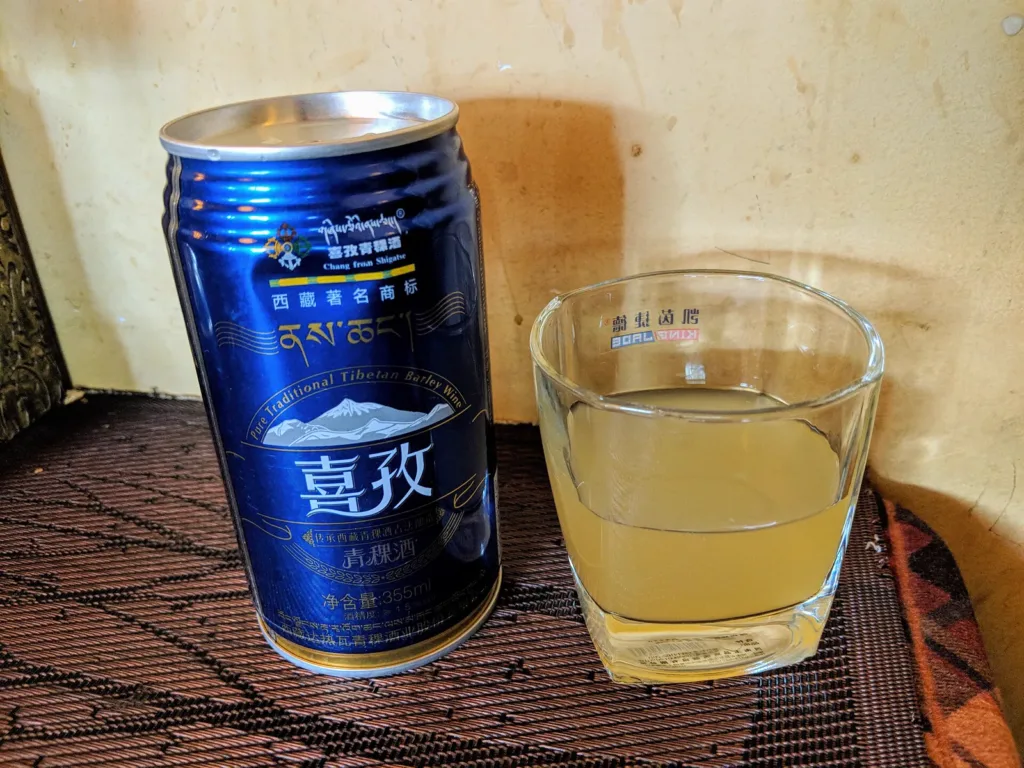
Shigatse’s 青稞酒 is best understood as a drink tied to farming households and seasonal hospitality, not as a single branded product. The drink is usually called chang (羌) in Tibetan and is made by fermenting highland barley. A 2026 report from Namling County records families pouring 青稞酒 alongside chema, festive food, butter tea, and music on Shigatse’s Farmers’ New Year, observed on the first day of the twelfth Tibetan month. That is a documented Shigatse setting; it does not mean every cup outside the festival follows one recipe.
What to taste
The basic household process is to wash and cook the barley, cool it to a warm—not hot—temperature, mix in fermentation starter (酒曲), seal it in a vessel, and let it ferment. Water is added after fermentation. Traditional descriptions call this a compound, repeated-fermentation method and note that the exact timing and handling vary with household and season. A shorter description from China Tibet Online similarly gives a two- or three-day fermentation followed by water and another rest, and describes the result as pale yellow, sweet-and-sour, low in alcohol, and beer-like. Treat “low alcohol” as a flavor and strength description, not as alcohol-free.
The first pour from a fermented batch is usually the fullest and strongest. Later additions of water create second, third, or fourth pours that become lighter and more acidic; households may blend pours to suit the desired strength. In some households, the fermented grain is held before water is added: zla-chang (达羌, “monthly wine”) is aged for a month or more, while lo-chang (洛羌, “year wine”) is held for a year or longer. These are real variants, not a single universal standard.
At the table, expect a drink that can move from sweet grain aroma to a mild sour edge. A reported Farmers’ New Year meal in Shigatse places it with family dishes and toasts, while older local descriptions distinguish the stronger first pour for honored guests from lighter pours used more casually. Customs are household-specific, so watch the host and accept only what you can safely drink. Qingke jiu is also not the same as distilled Tibetan white liquor (藏白酒): both may start with barley, but the distilled spirit is a separate, stronger category.
How to look for it
Use the Chinese name 青稞酒 Qīngkējiǔ (and, if useful, 羌酒 Qiāngjiǔ) when asking or searching. Search for “青稞酒” on Meituan (美团) or Amap / Gaode Maps (高德地图) to find nearby places that may serve it. Check the current menu, recent reviews, opening information, and whether the listing means fermented chang or a bottled or distilled barley spirit. Ask about the day’s availability and ingredients before ordering; recipes and strength vary, and this drink is not automatically alcohol-free or suitable for every dietary or medical need.
This is a dish entry, not a venue recommendation. Qingke jiu has no single visitor entrance, address, last-mile route, station, or return line that can be stated without inventing a restaurant. Once you select a current listing, verify that venue’s exact entrance and local transport separately, and keep the same listing in view for the return journey. No fixed taxi fare, travel time, or station is asserted here.
Nothing in this dish entry establishes the current Tibet entry requirements for foreign visitors, or any route and extra permit for border areas. Those are separate trip conditions to check before travel. This page does not turn a food search into a border or high-altitude itinerary.
A note on the Shigatse connection
The evidence supports a strong local association with Shigatse’s agricultural calendar and family hospitality, especially around Farmers’ New Year. It does not support calling 青稞酒 a Shigatse-only invention: the sources describe it as a well-known Tibetan beverage with regionally varied methods. If you are visiting outside the festival season, treat a current local listing or a host’s invitation as the practical evidence that it is available that day.
Sources & reading
Image credits & notes (1)
- A can of commercially produced chang from Shigatse alongside a glass of the pale-yellow barley wine. Photo: JpatokalPhoto: CC BY-SA 4.0