

Wuhan savoury rice-batter rings 武汉面窝
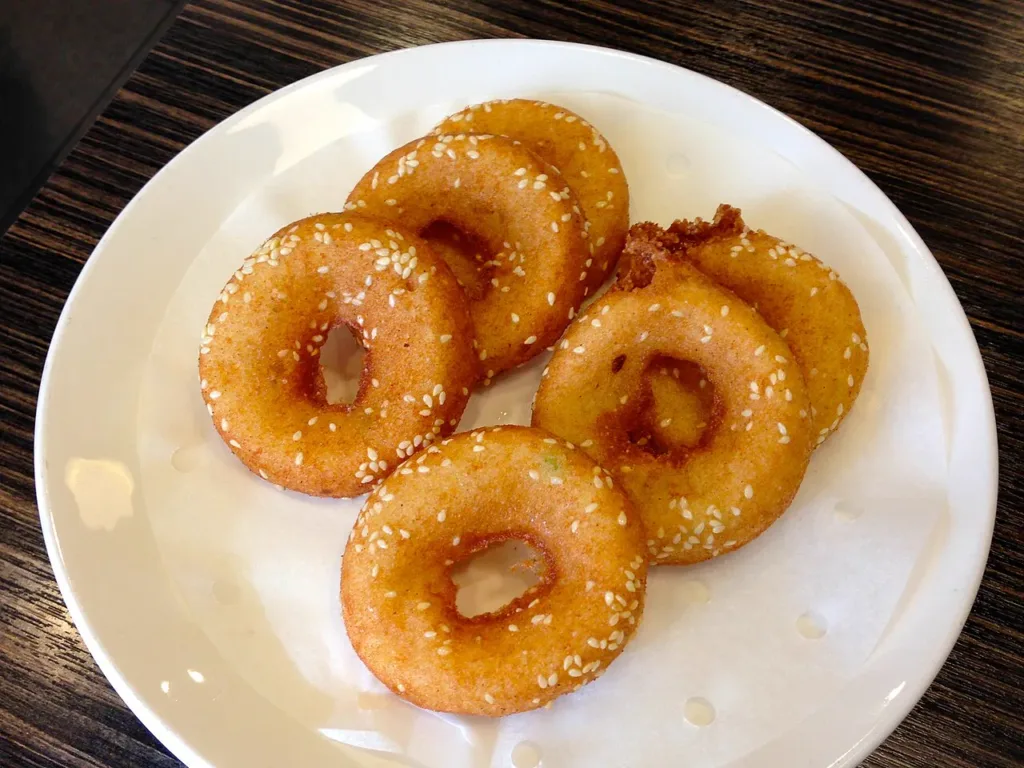
Wuhan mianwo is a savoury, deep-fried rice-and-soy breakfast ring. Its special appeal is the contrast between a crisp, thin centre and a softer, thicker rim, shaped in a raised-centre iron spoon and eaten as part of Wuhan’s morning “guozao” tradition.
Tap any red Chinese text to hear it in Mandarin.
What it is
Mianwo (面窝) is a Wuhan breakfast snack, not a sweet doughnut. A traditional description uses polished round-grain rice and soybean batter seasoned with scallion and fine salt; ginger and sesame are also common in local descriptions. The name contains 面, but the familiar preparation is not based on wheat flour.
The shape comes from the way the batter sits in the frying tool: a round piece with a thick outer edge and a thin centre, often opened into a hole. The bite changes across that small ring. The thin sections crackle, while the fuller rim stays softer inside. Its flavour is savoury and lightly aromatic from the scallion, ginger and sesame rather than sugary.
How the ring is made
Rice and soybeans are soaked and ground into a batter, then seasoned. A vendor spreads the mixture in a shallow iron spoon with concave edges and a raised centre. A second spoon helps scoop and press the batter so that the middle stays thin or opens. The spoon then goes into hot oil until the ring turns golden. This simple-looking tool is what gives mianwo its irregular ring and its two textures.
Recipes vary between stalls. One official description mentions a rice-and-glutinous-rice mix as a Wuhan variation, while another traditional account describes round-grain rice with soy. Treat these as recipe differences, not a single compulsory formula.
How to order and eat it
Show 面窝 Miànwō or 武汉面窝 Wǔhàn Miànwō when ordering. It is normally bought from a breakfast stall and eaten while hot. A small piece works well alongside hot dry noodles, rice noodles, sweet soybean milk or rice-wine egg soup; the combination is part of Wuhan’s “过早” culture rather than a formal multi-course meal.
Ask whether the stall is serving the standard rice-and-soy version or another type. The sources mention pea-based versions and shao mianwo (苕面窝), made with sweet potato and usually without the central hole. A skilled vendor may also make a version with little or no crisp centre, described as easier for older diners to eat.
Local roots and practical notes
Mianwo is associated with Wuhan’s street-side breakfast culture, but its origin is not securely documented. A frequently repeated story places its invention near Jijiazui on Hanzheng Street in Hankou during the Guangxu period and names a vendor, Chang Zhiren. The official account labels this an oral story without surviving written records, so it is best treated as local tradition rather than a proven founding date.
You are more likely to encounter mianwo in the morning than as an all-day restaurant dish.
The traditional descriptions are rice-and-soy based, but recipes and shared fryers vary. If you avoid soy, sesame, wheat, or cross-contact, ask what is in the batter and whether the oil is shared. Do not assume a particular variation is vegetarian or allergen-free from its appearance alone.
Where to eat it
You can find Wuhan savoury rice-batter rings all over Hubei, so there is no need to seek out one particular restaurant. To find one near you, search for “武汉面窝” in Meituan (美团) or Amap (高德地图) and check recent reviews, distance and opening hours.
More dishes to compare
Explore related local specialties and compare their names, preparation notes and ordering guidance.
Three-delicacy doupi 三鲜豆皮 →
A thin crepe-like skin is cooked, filled with sticky rice and finely diced savory ingredients, then folded and browned. Portions are cut from the larger pan preparation. A crisp, lightly eggy surface contrasts with dense, chewy rice and juicy diced filling. The portion is more substantial than its thin exterior suggests.
Fried flatbread with sticky-rice dumplings 油饼包烧梅 →
Savory sticky-rice shaomai are placed inside a freshly fried flatbread and folded together as a handheld breakfast. The dumpling filling can include mushrooms, pork and other seasonings. The combination layers crisp bread, soft wrappers and dense sticky rice, making it richer and more filling than its size suggests.
Sources & reading
Recipes and servings vary between kitchens.
Image credits & notes (1)
- A plate of Wuhan mianwo (savoury rice-batter rings), showing the sesame-speckled ring shape. Photo: ZhengZhouPhoto: CC BY-SA 4.0