

Bole-Style Roast Lamb 博乐风味烤羊肉
Bole-Style Roast Lamb is featured among the local specialties of Xinjiang.
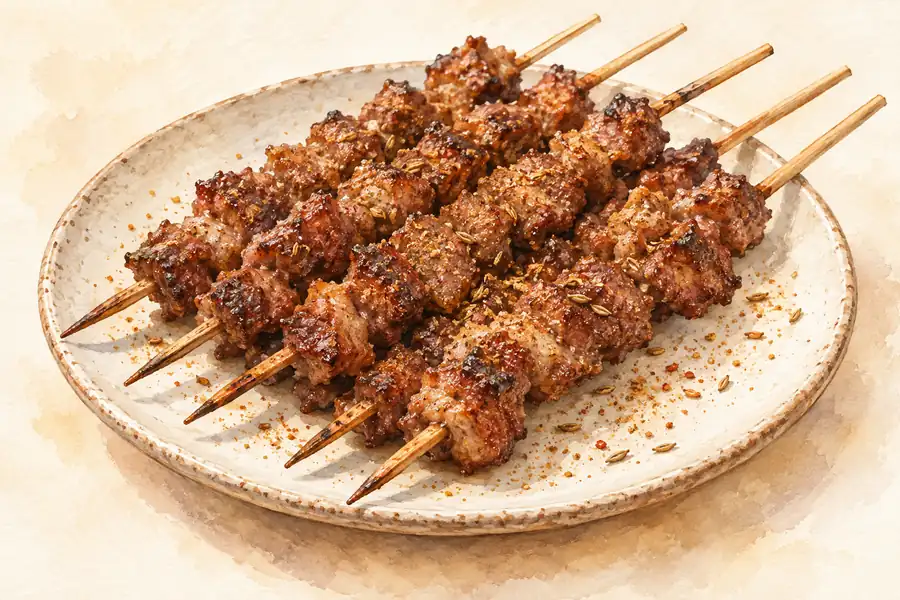
Bole-Style Roast Lamb (博乐风味烤羊肉) is the seasoned reading of Bole roast lamb, where 风味 in the name promises a local style rather than plain meat.
What a marinade does over direct heat
The words 风味, meaning local flavour, usually signal a marinade or a rub rather than a different animal. Roasting over direct heat is fast: the outside browns while the inside is still pink, and the coating decides whether the surface burns before the meat is done. Sugar in a marinade speeds up browning, salt applied too early draws water to the surface, and a dry rub behaves differently from a wet one.
Seasoning on the outside
Expect a stronger, more spiced surface than a plain skewer, with cumin, chilli and sometimes onion or a yoghurt-based coating doing the work. Fat still carries most of the flavour, so a trimmed piece tastes flatter than a fattier cut. Because the meat is roasted rather than braised, it is firmer than a boiled lamb plate and the seasoning stays where it was applied.
Why the town claims a flavour
Bole is in Bortala Mongol Autonomous Prefecture in northern Xinjiang, near the Kazakh border, and lamb roasted over heat is the standard street food of the whole region. The 风味 in this name is the menu's way of claiming a local seasoning, which is why the same dish cooked elsewhere is more likely to be listed with the town name alone.
Ingredients and what to ask
Lamb, salt, cumin and chilli are the usual base, with onion, garlic, yoghurt or a little vinegar in the marinade depending on the kitchen. Whether the meat is on skewers, on a rack or on a whole spit changes the cooking time more than the seasoning does. Ask 是什么部位 (which cut), 辣不辣 (how spicy) and 腌过没有 (is it marinated) before ordering.
How to order it
Order by weight or by the skewer, since 一斤 (half a kilo) and 一串 (one skewer) are very different units, and ask for 拼盘 if you want a mixed plate. Ask 要等多久 (how long is the wait), because roasting to order takes time and a busy grill will not rush for one table. If you want the fat left on, say so, because some kitchens trim by default.
Serving and eating it
Eat it straight off the heat, while the fat is still liquid and the surface crisp, with bread and raw onion alongside. Cumin and chilli build up as you eat, so tea or a plain yoghurt drink between mouthfuls does more than a sweet drink. It is street food rather than a banquet dish, so it is better ordered in small rounds than as one large pile.
More dishes to compare
Explore related local specialties and compare their names, preparation notes and ordering guidance.
Bole Roast Lamb 博乐烤羊肉 →
Bole Roast Lamb (博乐烤羊肉) is the same town and the same cooking method without 风味 in the name, so the seasoning is the only thing the words add. Reading them together is a quick lesson in how much a Xinjiang menu can leave unsaid: one name promises a local treatment, the other simply states that lamb is roasted.
Questions before you order
What does 风味 add to the name?
It signals a local seasoning or marinade rather than a different animal, so ask 腌过没有 and 辣不辣 to find out what it means at that grill.
Is it a dry or a wet rub?
It varies. A wet marinade gives a softer surface and a dry rub a firmer crust, so ask the cook rather than assuming from the name.
Sources & reading
The supplied food list supports this name and regional association. The culinary terms below are explained as menu vocabulary; a local recipe, origin story and venue availability have not been independently verified.