

Xinjiang Spicy Fried Rice Noodles 新疆炒米粉
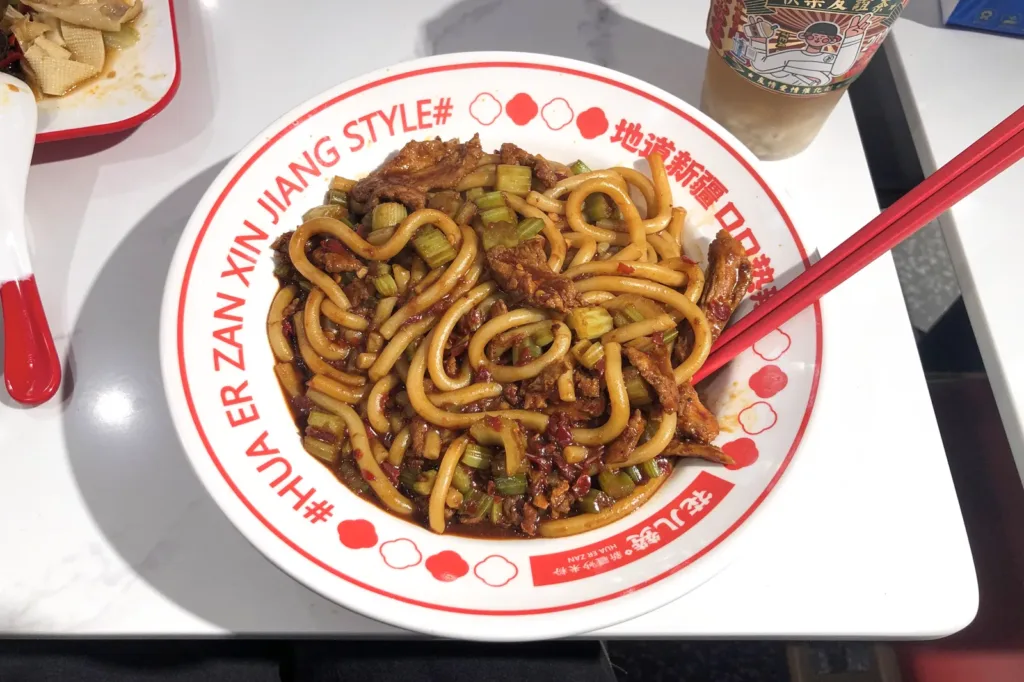
A thick-rice-noodle stir-fry associated with Xinjiang’s modern food culture: chewy noodles in a concentrated chilli sauce, usually with chicken or beef and crisp vegetables; ask for a mild level first.
Tap any red Chinese text to hear it in Mandarin.
A Xinjiang dish with a cross-regional beginning
Xinjiang spicy fried rice noodles, written 新疆炒米粉 Xīnjiāng Chǎo Mǐ Fěn and commonly called Xinjiang chao mifen, are a modern Xinjiang specialty rather than an ancient, fixed recipe. Accounts differ in how they tell the origin, but reporting places the dish’s development in Ürümqi in the 1980s. A Xinjiang Daily account says Guizhou workers at the former Xinjiang October Tractor Factory combined Guizhou rice noodles with local stir-fried-noodle habits in 1982; it records a dedicated “Southern Rice Noodle House” opening on Ürümqi’s Renmin Road around 1986. China News likewise dates the dish’s history to the 1980s.
The useful way to understand that story is as a cross-regional beginning, not as a claim that Ürümqi invented every bowl served today. The same government account says rice-noodle shops and versions spread across Xinjiang, while an official Xinjiang tourism page lists 新疆炒米粉 among the region’s specialty foods.
What to expect in the bowl
The usual structure is a thick rice noodle stir-fried with a dense, red, chilli-rich sauce and a chosen meat, most often chicken or beef. China News describes rice as the main raw material and the texture as a meeting point between the fine slipperiness associated with southern rice noodles and the firmer, chewier bite preferred in northern-style eating. A detailed food explainer likewise describes unusually thick, elastic noodles and identifies celery as a familiar partner.
That thickness is not just visual. The noodles are softened before they go into the wok, then cooked with the sauce and toppings; a common preparation described for home cooking soaks the dry noodles first so they soften without breaking during frying. The result should be a noodle that still has resistance while carrying a heavy coating, rather than a light soup noodle. Celery or another crisp vegetable can cut through the sauce with a fresher, crunchier bite.
Do not expect one universal recipe. Chicken-fried and beef-fried versions are common. Some kitchens add crisp Sichuan-style pickled cabbage, mushrooms, or pieces of nang; these are documented variations, not ingredients that every restaurant must use. Sauce bases and the balance of chilli, savoury seasoning, tomato, and vegetables also differ from kitchen to kitchen.
Spice, ordering, and dietary questions
Spice is part of the dish’s identity, but “辣” is not a single standard across Ürümqi. China News describes menus or cooks using levels from lightly spicy through mild and medium to extra hot, with the exact scale left to the individual kitchen. For a first bowl, choose the lowest listed level and ask what that level means there; do not assume “mild” means chilli-free. Keep the Chinese name 新疆炒米粉 Xīnjiāng Chǎo Mǐ Fěn ready to show when ordering, and confirm whether you want chicken or beef and which add-ons are included.
The colour or regional label cannot prove that a bowl is halal, vegetarian, or free of an allergen. Ask about the meat, stock or sauce, cooking oil, and possible cross-contact before ordering. If you avoid celery, pickled vegetables, chilli, or wheat-containing additions such as nang, ask specifically rather than relying on the appearance of the finished dish.
Finding a current serving in Ürümqi
This is a dish, not a fixed attraction or a single venue, so it has no dish-specific address, ticket, entrance, public-transport route, or citywide opening schedule. In Meituan (美团) or Amap/Gaode Maps (高德地图), search the exact Chinese name 新疆炒米粉 Xīnjiāng Chǎo Mǐ Fěn near where you are staying. Open the current menu instead of relying on a platform ranking or food photograph; then check recent reviews, the venue’s current opening status, and whether the dish is available today. If the listing is unclear, ask in Chinese about the meat, spice level, add-ons, and same-day supply. This method helps you find a nearby serving without endorsing any particular restaurant or brand.
More dishes to compare
Explore related local specialties and compare their names, preparation notes and ordering guidance.
Xinjiang diced stir-fried noodles 新疆丁丁炒面 →
Noodle dough is formed into strands or strips, cut into small pieces and cooked, then tossed with the chopped toppings. Matching the size of the noodles and vegetables helps distribute flavour through the plate. Expect a chewy wheat bite with juicy tomato and savoury meat. It is generally less slippery than long laghman strands, while the vegetables add moisture and contrasting texture.
Polo rice 抓饭 →
Rice is cooked together with meat, carrots and oil so the grains absorb the flavored liquid. Lamb is common, while raisins and other additions depend on the kitchen. The rice is rich and separate-grained, with sweet carrot, savory meat and occasional fruit sweetness rather than a sticky porridge texture.
Sources & reading
Recipes and servings vary between kitchens.
Image credits & notes (1)
- Example of Xinjiang-style spicy fried rice noodles with chicken, photographed at Xidan in Beijing; shown as a cross-region dish example, not as a photo taken in Ürümqi. Photo: N509FZPhoto: CC BY-SA 4.0