

Bamboo Tube Rice 竹筒饭
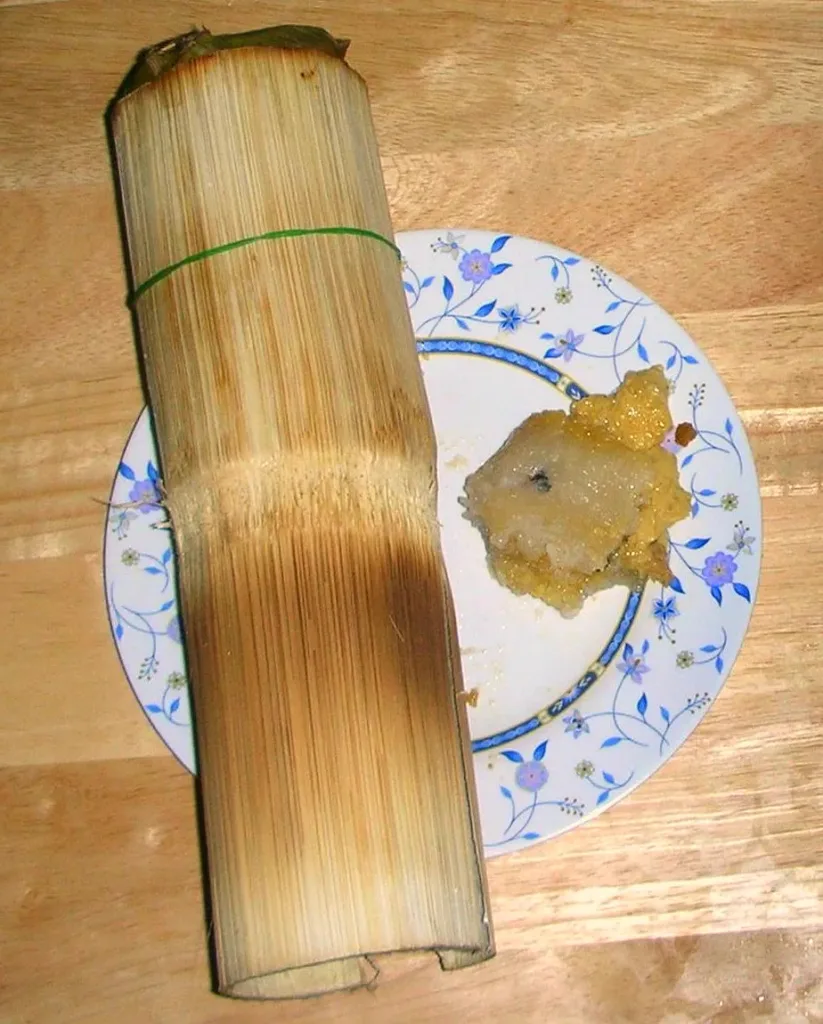
Bamboo Tube Rice (竹筒饭, zhútǒng fàn) is a Xishuangbanna Dai rice food made by slowly roasting soaked glutinous rice—sometimes purple glutinous rice—in fragrant bamboo. The tube lends a clean bamboo aroma to the soft, sticky rice; the point is the bamboo cooking vessel as much as the rice itself.
Tap any red Chinese text to hear it in Mandarin.
What it is
In Xishuangbanna, glutinous rice is part of Dai everyday food culture, and local botanical and food sources describe bamboo-tube rice as a food associated with Dai communities in the prefecture. The regional character is the pairing of sticky rice with fragrant bamboo, not a claim that bamboo rice exists nowhere else.
The fragrant style is often associated with Cephalostachyum pergracile, called 香糯竹, 糯竹 or 香竹 in Chinese. The Chinese Academy of Sciences’ Xishuangbanna Tropical Botanical Garden describes this bamboo as widely grown in the prefecture and explains that its scent transfers to rice cooked inside the tube.
How it is made and eaten
A documented local method cuts bamboo at a node, leaves one end as a base, fills it with washed and soaked glutinous or purple glutinous rice plus some water, and seals the opening with banana or bamboo leaf. The tube is roasted first upright and then laid flat, turning slowly over low heat until the rice is cooked.
Once the rice is ready, the tube is gently tapped with the back of a knife so the rice releases from the bamboo wall. Shallow slits in the tube make peeling easier. What appears is a compact cylinder of sticky rice wrapped in a thin inner bamboo membrane.
Flavour and variations
The expected taste is the soft, sticky bite of glutinous rice with fresh bamboo fragrance. Local food coverage describes sweet-leaning versions eaten with honey or sugar and notes that fillings or added vegetables and meat can vary. Treat these as vendor or occasion variations, not as one fixed recipe.
Ask how a batch is served before buying. Plain rice, purple rice, a sweet accompaniment or added fillings can lead to a different experience. If you have an allergy or dietary restriction, ask about the ingredients directly; the appearance of a bamboo tube does not establish that a serving is vegetarian or free of a particular allergen.
Practical tips
Use the Chinese name 竹筒饭 Zhútǒng Fàn when asking at a market.
Bamboo can remain hot after roasting. Let the seller open the tube, or wait until it is safe to handle before peeling it yourself. Eat it while the rice is warm, when the contrast between the bamboo aroma and the soft rice is easiest to notice.
Where to eat it
You can find Bamboo Tube Rice all over Yunnan, so there is no need to seek out one particular restaurant. To find one near you, search for “竹筒饭” in Meituan (美团) or Amap (高德地图) and check recent reviews, distance and opening hours.
Sources & reading
Image credits & notes (1)
- Regional example from Thailand: khao lam, sticky rice with sugar and coconut cream cooked in a prepared bamboo section. This is a related bamboo-rice preparation, not a photograph of Xishuangbanna bamboo-tube rice. Photo: XufancPhoto: CC BY-SA 3.0