

Explore the region
Tap any red Chinese text to hear it in Mandarin.
Founded under botanist Cai Xitao in 1959, the garden now combines research, plant conservation and public education. The official introduction lists about 1,125 hectares, more than 14,000 living-plant taxa, 39 specialist plant areas and about 250 hectares of original tropical rainforest. It is also a national 5A scenic area.
What to look for
Start in the western visitor area, where the collections are arranged as distinct gardens rather than one undifferentiated forest walk. The Palm Garden, aquatic-plant collection and Banyan Garden let you compare upright trunks, floating leaves, aerial roots and spreading canopies at close range. The giant water lily, or Wanglian (王莲), is a seasonal highlight; the official visitor page gives July–August as its best viewing period, so do not treat it as a year-round guarantee.
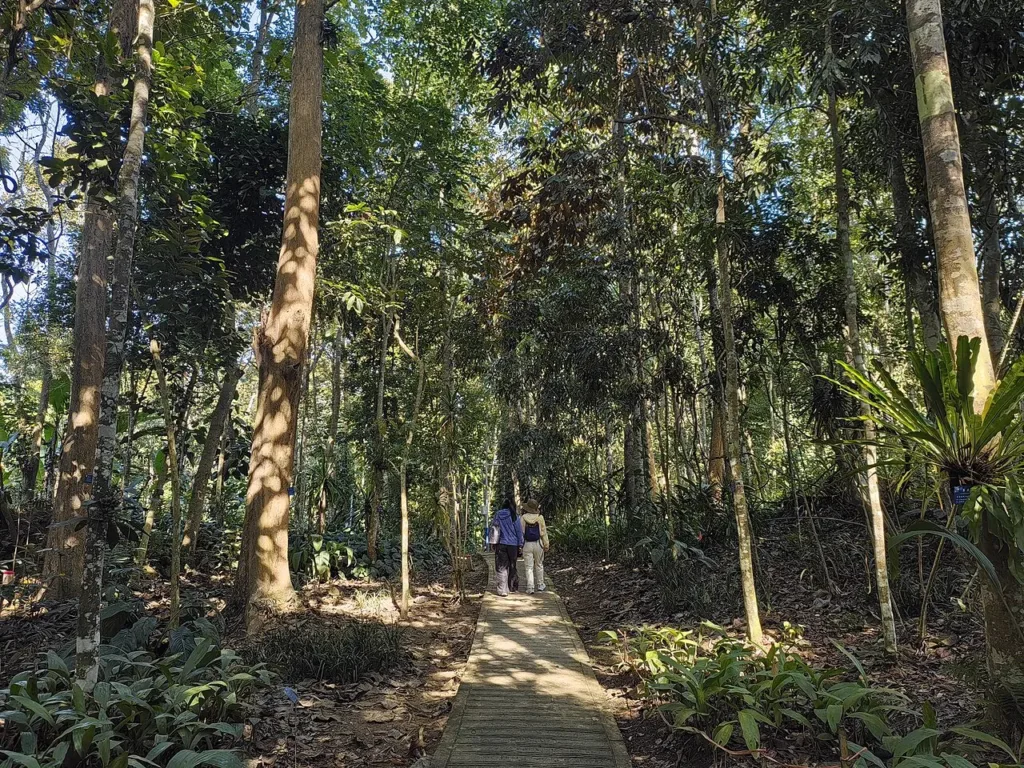
The eastern visitor area has a different character. Green Stone Forest and the tropical rainforest are less about manicured display and more about walking through forest and limestone scenery. The official route notes that vehicles stop near the eastern attractions and that visitors continue on foot. Allow a full half-day if you want both west and east; the operator’s current guidance estimates roughly 2.5 hours for each area and 4–5 hours for the whole garden.
Visiting the garden
The official visitor notice says the garden is open year-round. For ordinary sightseeing, use the West Gate or the Suspension Bridge entrance: the published hours are 08:00–18:00 at the West Gate and 07:30–18:30 at the Suspension Bridge. The East Gate is described as a work channel, with vehicle access for hotel guests, rather than a general visitor entrance.
The current official ticket page lists an adult admission ticket at CNY 80 and a half-price ticket at CNY 40. It directs visitors to the garden’s official WeChat mini-program or named partner platforms for real-name booking. The same page says admission inspection requires the original second-generation Chinese identity card. Because it does not explain a passport procedure, international visitors should contact the garden before relying on online booking or same-day inspection; do not infer passport acceptance from the domestic ticket rules.
A garden ticket and the internal vehicle ticket are separate products. The official page lists CNY 50 for the western area, CNY 50 for the eastern area and CNY 100 for the whole garden, with vehicles operating 08:00–18:00. The named western route links the West Gate, Shade Garden, aquatic-plant garden and Wanglian pond, Palm Garden, Banyan Garden, the tree collections and the vine garden; the eastern route serves Green Stone Forest and the tropical rainforest. Routes can be adjusted during peak periods, so keep time for queues and walking.
This is a protected research and visitor landscape, not a place to collect specimens. The garden’s rules prohibit smoking and open flames, picking flowers or fruit, climbing vines or trees, entering ponds, and catching animals. Stay on managed routes and follow staff instructions, especially in rainforest areas.
Getting there and back
The garden’s address is 中国科学院西双版纳热带植物园, 云南省勐腊县勐仑镇. It sits on Hulu Island, surrounded by the Luosuo River, about 60 km from Jinghong according to the operator’s transport guide. The official route names Xishuangbanna Gasa International Airport and Xishuangbanna Station as the main gateways into the area, but both still require a road transfer to Menglun and the garden entrance.
From Jinghong, the operator describes two practical onward options: take a taxi or road transfer to the garden, or go to Jinghong’s Banna Passenger Station and take a coach to Menglun. For the return, use Menglun Passenger Station for a coach back toward Jinghong. The garden’s route page carrying these coach details was published in 2021, so check the current departure point, timetable and fare before setting out rather than treating its older figures as fixed.
China Railway’s October 2026 operating report confirms that passenger services on the China–Laos Railway continue through Xishuangbanna, but the railway is only the regional gateway; it does not replace the last road leg to the garden.
For a first visit, search the Chinese destination name 中国科学院西双版纳热带植物园 Zhōngguó Kēxuéyuàn Xīshuāngbǎnnà Rèdài Zhíwùyuán and specify 勐腊县勐仑镇 Měnglà Xiàn Měnglún Zhèn. Plan the outward and return road legs before entering: the garden is much larger than the western collection area, and the eastern forest route is not a quick add-on at the end of a day.
Combine your visit
Suggested order for the visit:
-
Aquatic plants and Palm Garden
Start with the concentrated western collections.
-
Banyan Garden
Compare trunks, aerial roots and spreading canopies.
-
Eastern rainforest or Green Stone Forest
Add an eastern-area visit only with time for its walking route.
This is an editorial sequence of named spaces or places. It does not imply a verified walking connection or promise opening, ticket availability or a journey time.
Find Xishuangbanna Tropical Botanical Garden
西双版纳热带植物园 · 勐腊县
The pin marks the area, not the entrance.
More places nearby
Approximate straight-line distances between map pins, not travel distances.
Manting Park 曼听公园
47 km awayManting Garden places Dai-style visitor architecture among shaded planting and water in Jinghong. The royal-palace building, Zhangha Pavilion and octagonal covered bridge give the grounds distinct architectural landmarks, while…
View guide →Wild Elephant Valley 野象谷
49 km awayWild Elephant Valley occupies the Sanchahe forest area north of Jinghong. Elevated viewing walkways provide a way to observe the valley without entering elephant habitat, while the Asian Elephant Museum explains the animals’…
View guide →Sources & visit information
Sources checked on 24 October 2026. Hours, tickets, reservations and transport can change; confirm with the operator before you go.
Image credits & notes (1)
- A managed tropical-rainforest path inside Xishuangbanna Tropical Botanical Garden, photographed on 25 December 2025. Photo: YumetoPhoto: CC BY-SA 4.0