

Zhangye beef tiny-noodle soup 张掖牛肉小饭
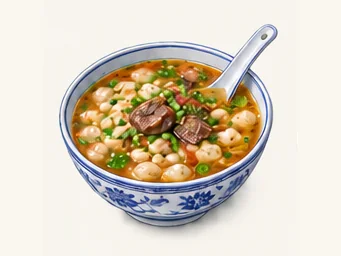
Zhangye beef tiny-noodle soup (张掖牛肉小饭, Zhangye niurou xiaofan) is a Zhangye breakfast of rice-sized wheat-dough pieces in beef-bone broth, commonly served with sliced beef, potato vermicelli and tofu. Its appeal is the contrast between spoonable, savoury soup and small dough pieces that stay springy rather than turning into rice.
Tap any red Chinese text to hear it in Mandarin.
The name is easy to misunderstand. “Xiaofan” sounds like “small rice”, but the “rice” in the bowl is wheat dough cut into very small pieces. People’s Daily’s description explains the name through the small size of the dough, meat, tofu and vegetables, while an English-language Zhangye food guide likewise treats the pieces as flour dough rather than grains.
This is a morning food of Zhangye’s urban 甘州 (Ganzhou) setting, not a single restaurant or a dish tied to the 七彩丹霞 scenic area. Zhangye’s government describes it as a local breakfast eaten in the city’s everyday street life, and CCTV’s 2026 food programme calls it one of the breakfasts local people most like. The most useful way to try it is to look for a current breakfast shop in the city, then order by its Chinese name.
How the bowl is made
A maker rolls a wheat-flour dough into an even sheet and cuts it into rice-sized pieces. People’s Daily notes that machine-pressed dough is now common, although the underlying idea remains the same. The pieces may be left to dry under a soft cloth before they are boiled. After cooking, they are cooled in water, which helps them keep a distinct, lightly springy bite instead of becoming a mass of soft noodles.
The soup is built around beef bones. A typical description combines the broth with sliced beef, locally made potato vermicelli and tofu; scallions and coriander are common finishing touches. Accounts of individual kitchens differ: some describe chicken stock alongside beef-bone stock, pepper and ginger seasoning, or a little starch to give the soup more body. Treat those as variations, not a single fixed recipe for every bowl.
Flavour and texture
Expect a hot, savoury bowl in which the broth does most of the work. The small dough pieces are spoon-sized and more substantial than rice, with a soft centre and a little chew. Beef brings the main savoury depth, while vermicelli and tofu change the texture from bite to bite. Depending on the shop, the soup may be clearer or slightly thickened, and the garnish may include fresh herbs or chopped chilli.
Ordering and dietary notes
Show 张掖牛肉小饭 Zhāngyè Niúròu Xiǎofàn when ordering. It is reasonable to ask whether that day’s bowl includes sliced beef, potato vermicelli and tofu, because recipes and additions vary between kitchens. Beef and wheat are central to the dish, so it is not vegetarian; ask about the stock, seasoning and additions if you avoid wheat, beef, soy or particular spices. Do not assume a bowl is free from an ingredient merely because it is not visible on top.
Where to eat it
You can find Zhangye beef tiny-noodle soup all over Gansu, so there is no need to seek out one particular restaurant. To find one near you, search for “张掖牛肉小饭” in Meituan (美团) or Amap (高德地图) and check recent reviews, distance and opening hours.
More dishes to compare
Explore related local specialties and compare their names, preparation notes and ordering guidance.
Lanzhou beef noodles 兰州牛肉面 →
Fresh wheat dough is hand-pulled to the chosen width and cooked in a clear beef broth with radish, herbs and optional chili oil. Sliced beef may be included in modest amounts or ordered separately. The noodles are resilient, while the broth balances meaty depth with clean aromatics. Width changes the bite significantly even when the soup is identical.
Dunhuang sand-chive beef pie 沙葱牛肉饼 →
Minced beef is mixed with chopped shacong, an aromatic desert allium, enclosed in dough and pan-fried into small pies. The filling cooks in its own juices while the shell browns. Crisp pastry surrounds moist beef with a distinctive onion-like green aroma, often stronger than an ordinary vegetable garnish.
Sources & reading
Recipes and servings vary between kitchens.