

Explore the region
Tap any red Chinese text to hear it in Mandarin.
Why Guling is distinctive
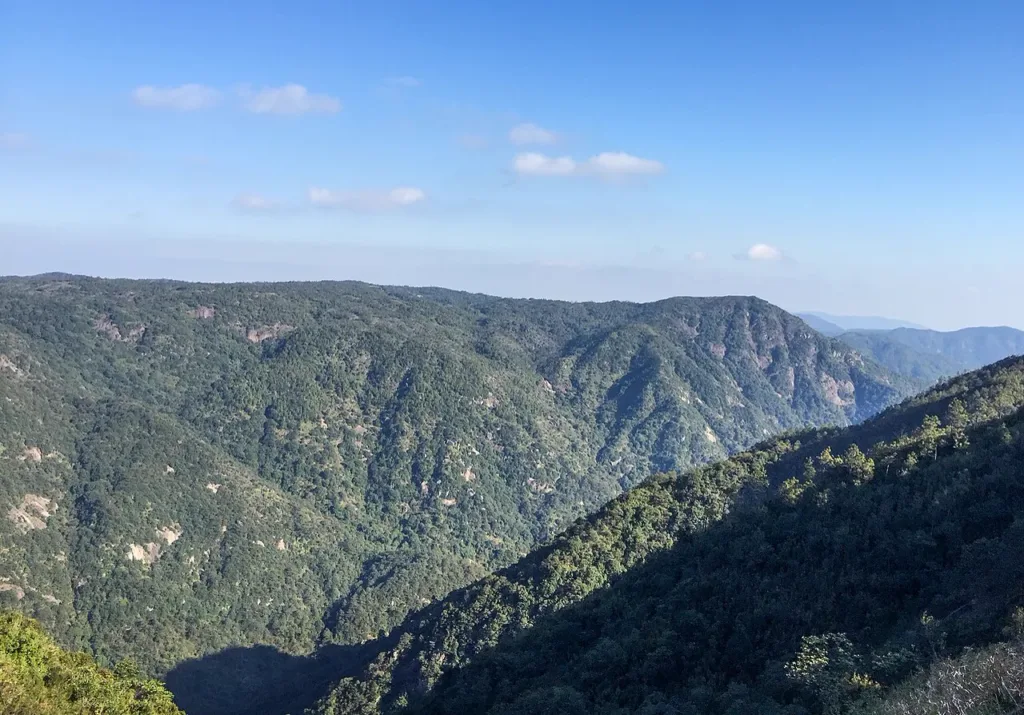
Guling lies in Fuzhou’s Jin’an District, in the Shuanggu mountain range east of the city. The district government describes an average elevation of about 750–800 metres and a highest point of 998 metres, with four landscape areas and more than 30 named sights. That scale matters: Guling is a mountain resort spread across villages, roads and forest, not a single gate followed by one short loop.
Foreign residents began using the mountain as a summer retreat in the nineteenth century. By the early twentieth century, villas, social facilities and seasonal services had formed a community shared by foreign residents and local people. The surviving stone cottages and public buildings are most valuable when read together: they show how a cool mountain refuge became a lived-in settlement rather than a collection of isolated “old houses”.
What to look for
Start around Yixia Village (宜夏村), the historic centre of the resort. Move slowly along the village lanes and look for the practical details of mountain construction: thick stone walls, covered verandas, drainage arrangements and small buildings set among tall trees. The point is not to photograph every façade as if it were a museum object. Notice which structures remain whole, which are ruins or later restorations, and how the road connects them. Published local visitor information lists Yixia Villa, the Guling Post Office and the International Club as separate points of interest, so check signs on the day rather than assuming every interior is open.
The International Club (万国公益社) is a useful place to understand the resort’s social history. The building served as a community centre in the early twentieth century, with space for gatherings and information exchange. Observe the varied stonework and the public scale of the building against the smaller cottages. When the exhibition or interior is open, treat it as an interpretation site; do not enter a closed room or photograph people without permission.
At the Gardner Exhibition (加德纳展示馆), look for the domestic side of the “Kuliang story”: old furniture, a piano, Western household objects and media that explain Milton Gardner’s childhood in Fuzhou and the later family connection with Guling. This is a place for comparing personal memory with the resort’s wider history, not for reducing the site to a single friendship anecdote. The exhibition’s opening and access conditions are not stated in the sources used here, so confirm them locally.
Finish at Liushanwang Park (柳杉王公园) if the route and weather allow. Its landmark is a very large ancient Japanese cedar, and the surrounding trees help explain why Guling was valued as a cool retreat. Look up through the canopy, then back toward the roads and cottages: the forest is part of the historical setting, not merely a backdrop for the buildings.
Getting there and getting back
The practical public-transport approach is to reach Gushan Bus Terminal (鼓山公交总站) and take the Guling Tourist Area special bus (鼓岭旅游度假区公交专线) to Liushanwang Park (鼓岭柳杉王公园). A municipal notice lists the stops as Gushan Bus Terminal, Buxing Village, Shaxi Station, Guling Ancient Trail (East), Guling Ancient Trail (West), Guolun Village, Dayangping, Xia Guai, Sanchalu and Liushanwang Park; the return follows the same route.
The resort’s transport page identifies Fuzhou Metro Line 2, Gushan Station (鼓山站) as the metro access point for the Gushan entrance area. It does not establish a current exit number or a reliable walking time from the station to the bus terminal, so confirm the last transfer in Amap or another current local map rather than guessing.
The latest municipal notice located for this guide lists seasonal operating windows for the mountain bus. From November through April it gives Gushan Bus Terminal departures from 08:00 to 16:00 and Liushanwang Park departures from 09:00 to 17:00; from May through October it gives 07:30–16:00 and 08:30–18:30 respectively. The same notice also records that older Guling area shuttle services were terminated when this arrangement began. Because mountain transport changes, check the official notice or the stop display on the day you travel, and start back from Liushanwang Park before the final listed departure.
A taxi or ride-hailing car should use the exact Chinese destination 鼓岭柳杉王公园 Gǔlǐng Liǔshānwáng Gōngyuán for the bus terminus, or 宜夏村 Yíxià Cūn if you have confirmed that your planned walk begins there. Do not treat “Guling Scenic Area” as one precise roadside entrance. The area reopened to visitors on 4 September 2026, with the management committee advising visitors to watch weather conditions; that warning is especially relevant on a forested mountain road.
Before you go
The sources read for this guide do not establish a current ticket price, reservation process or universal opening time for every building. Confirm those details, along with the availability of the Gardner Exhibition, International Club and any interior displays, immediately before departure. Wear shoes suited to uneven and sloping ground, allow time for the return bus, and keep to signed roads and paths. Guling rewards close observation of a settlement’s details more than a rushed checklist of viewpoints.
Find Guling Scenic Area
鼓岭 · 晋安区
The pin marks the area, not the entrance.
Sources & visit information
Sources checked on 2 November 2026. Hours, tickets, reservations and transport can change; confirm with the operator before you go.
Image credits & notes (1)
- A forested mountain panorama in Guling, showing the steep ridges and ravines that shape the highland resort. Photo: N509FZPhoto: CC BY-SA 4.0