

Explore the region
Why this place is worth the climb
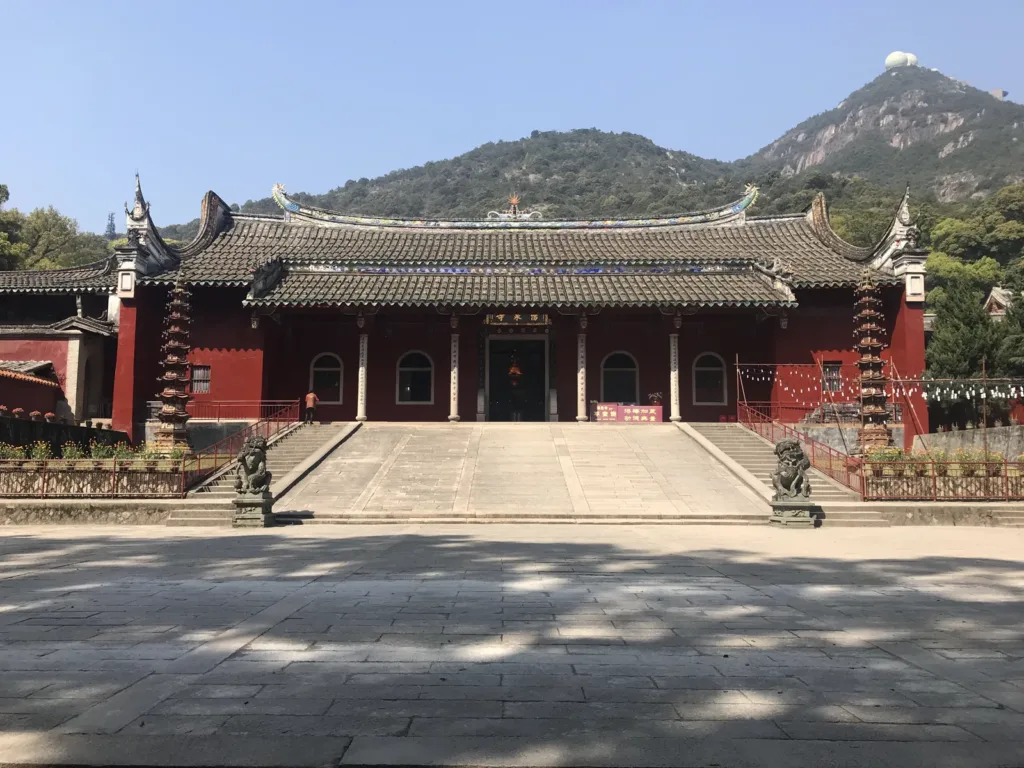
Yongquan Temple is a Buddhist monastery on Drum Mountain (鼓山) in Jin’an District, not a detached monument in the city centre. Its buildings rise in terraces with the slope, so the visit works best as a sequence: approach through the mountain, enter the courtyards, then look outward to the inscriptions and rock scenery. Most of the surviving temple complex follows a Ming–Qing arrangement, with about 25 halls and the bell and drum towers forming part of the stepped composition.
The temple’s history has more than one useful date. The site is associated with an earlier Huayan temple founded in 783; it was rebuilt in the late Tang–Five Dynasties period, and the name Yongquan Temple was established in the Ming period. That layered history is why the temple is better read as a living religious and publishing tradition than as a single preserved construction date.
What to look at
Start with the two pottery Thousand-Buddha Pagodas (千佛陶塔) in front of the temple. They were fired in 1082, are 6.83 metres high, and each is an octagonal, nine-storey tower carrying 1,038 sculpted Buddha figures. The pair, together with the Gushan cliff inscriptions, was announced as a national-level key cultural relic in 2001. Look first at the towers as a pair, then move closer to compare the repeated small figures, the layered body and the roof silhouette. Do not touch the surfaces or lean on the protective boundary.
Inside, follow the open courtyards rather than trying to turn the monastery into a checklist of halls. Notice how the Mahavira Hall, Dharma Hall, bell and drum towers, and the release-animal pond fit into the slope. Some rooms are active religious spaces; give worshippers and residents the right of way, keep voices low, and obey current photography and closed-door signs.
Allow time for Gushan’s nearby cliff inscriptions if the signed route is open. At Lingyuan Cave, read a few inscriptions closely instead of hunting for every famous name. The large “寿” character associated with Zhu Xi is a good study point: compare its scale, brush-like structure and placement against the rock face, then read the label for the date and attribution. The inscription landscape records successive visits and literary exchange; it is not a backdrop for climbing onto the rock.
Getting there and getting back
The clearest public-transport approach is Fuzhou Metro Line 2 to Gushan Station (鼓山站). A local visitor guide places the cableway’s lower station about 180 metres from Exit A, but cableway operation is weather- and maintenance-sensitive, so check the notice at the station or scenic-area entrance before relying on it. The guide does not establish a fixed late return service; keep the last practical descent in mind before extending the walk.
For a walking-led visit, go to Gushan Lower Court (鼓山下院) and take the historic登山古道 toward the temple. The local guide describes a route of about 2,000 metres with 2,633 steps and seven rest pavilions. Pace yourself and turn around conservatively in rain: the stone steps can be slippery, and the route is a mountain ascent rather than a short walk from the metro platform.
The scenic-area shuttle is a more direct assisted option. The listed Gushan Line runs Gushan Lower Court (鼓山解院) → Shibajing Scenic Area (十八景区) → Yongquan Temple (涌泉寺), with the same stops in the opposite direction for the return; the listed fare is CNY 10. This is a scenic-area service, not a city bus, and the page does not provide a current frequency or final departure time. Confirm the day’s signboard and retain enough time for the reverse journey.
A 2024 local guide lists Yongquan Temple as open 06:30–17:30 and the temple admission as CNY 40, while also warning that cableway operation can change for inspection or rain and typhoon conditions. Treat these as planning references rather than a guarantee of today’s opening, ticket exemptions or cableway schedule. Confirm the current ticket channel, active-hall access and final descent on arrival. No official source reviewed here explained a passport-specific ticket or reservation procedure, so international visitors should carry their passport and ask at the ticket point instead of assuming that a domestic online booking route applies.
Visiting with care
This remains a place of worship. Observe ceremonies from the edge, do not photograph people without consent, and avoid blocking the ceremonial axis or altar areas. The most rewarding pace is slower than a viewpoint stop: compare the pagodas, read a small number of inscriptions, and let the changing courtyards explain how a mountain monastery occupies its slope.
Find Gushan Yongquan Temple
鼓山涌泉寺 · 晋安区
The pin marks the area, not the entrance.
Sources & visit information
Sources checked on 2 November 2026. Hours, tickets, reservations and transport can change; confirm with the operator before you go.
Image credits & notes (1)
- A main temple hall at Gushan Yongquan Temple, with Drum Mountain rising behind it. Photo: ZhangzhugangPhoto: CC BY-SA 4.0