

Explore the region
In brief: Luoxing Pagoda is a seven-storey, octagonal granite tower on Luoxing Hill in Mawei, where the lower Min River meets the port approaches. Its importance is not just its silhouette: it is a surviving Ming reconstruction, a maritime landmark once known internationally as “Pagoda Anchorage,” and a useful place to read Fuzhou’s river, port and shipbuilding history together.
Read the tower in its setting
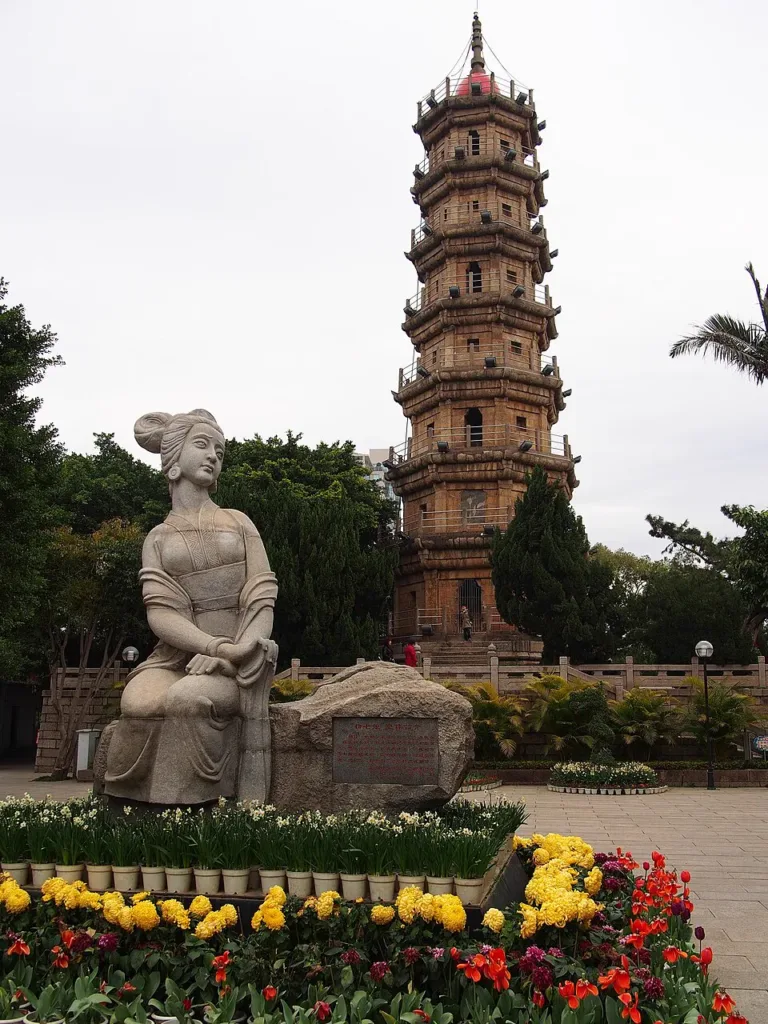
The present tower was rebuilt in 1624, during the Tianqi era of the Ming dynasty, after the earlier tower had been destroyed in the Wanli period. It rises about 30–31.5 metres from an 8.6-metre-diameter base. Look closely at the granite, the eight-sided plan, the arched openings and the stone stairs: this is a pavilion-style stone pagoda rather than a freestanding modern monument. The tower is a national-level protected cultural relic, listed in 2013.
Stand below it and then turn toward the Min River. The tower’s location at the lower river and the Mawei port explains its double identity as a religious monument and a navigation mark. Government heritage material describes it as a marker of the Min River gateway and a maritime-Silk-Road site; a Fujian transport-history account connects the landmark with ships entering and leaving Fuzhou and with the historical port’s “Pagoda Anchorage” name. Treat “China Tower” as a historical nickname, not a claim that the tower was built for modern tourism.
What to look for in Luoxing Park
Use the park as a slow approach rather than photographing only the tower. From the hillside and river edge, look for the relationship between the pagoda, the port channel and the old maritime infrastructure. The park preserves inscriptions and traces associated with the Min River’s military and shipbuilding history, including relics connected with the 1884 Sino-French conflict; not every relic or interior space is guaranteed to be open on the day.
The front couplet is a small but rewarding detail. “朝朝朝朝朝朝夕,长长长长长长消” is meant to be read through the multiple pronunciations of the characters, evoking the river’s daily tides—潮来潮往 and the rise and fall of the water. Read it as a piece of river culture, not as a decorative slogan detached from the site.
Getting there and getting back
The visitor-facing address is 福州市马尾区港口路83号, the address for Luoxing Pagoda Park. For a taxi or ride-hailing car, show “罗星塔公园” rather than only “罗星塔”; the park address identifies the public approach, but the precise gate-side drop-off is not confirmed in the sources.
For buses, a public park listing names routes 73, 116, 131 and 180 to the “Luoxing Pagoda” stop. Check the live route, direction and stop position in Amap / Gaode before boarding; the source does not establish a walking-minute figure from the stop to the tower. For return, use the opposite-direction stop only after confirming the signage, or ask the driver to collect you at 罗星塔公园.
Do not plan around a metro stop named 罗星塔站 yet. A public construction summary describes it as part of Fuzhou Metro Line 2’s eastern extension, with opening expected in 2026, rather than as a confirmed operating station on this research date.
Before you go
Opening hours, ticketing and current entry arrangements are not treated as confirmed here: public listings are not a current official notice. Confirm them with the park or venue on your travel date. The park listing notes that the internal stairs may be narrow and steep and that climbing can be restricted; do not assume that reaching the park guarantees access to the tower interior.
Combine your visit
A suggested sequence through the named features described in the source.
-
Luoxing Hill approach
Examine Luoxing Hill approach as a separate part of Luo Xing Ta.
-
Pagoda and river-facing setting
The Ming-period stone pagoda rises above the river.
The order is an editorial suggestion. Internal opening arrangements and transfers between sectors need checking; no walking duration or access entitlement is implied.
Find Luoxing Pagoda
罗星塔 · 福州市
The pin marks the area, not the entrance.
More places nearby
Approximate straight-line distances between map pins, not travel distances.
Mount Gu (Fujian) 鼓山
10 km awayMount Gu rises in eastern Fuzhou with the Min River to the south and Guling to the north. Yongquan Temple forms a major cultural focus on its slopes.
View guide →Yantai Mountain 福州烟台山
16 km awayYantai Mountain rises from the north end of Nantai Island, on the south bank of Fuzhou’s Min River. Its streets retain the churches, schools and former consular buildings of the city’s foreign-trade period. The rough stone walls…
View guide →Yu Mountain 于山
18 km awayYu Mountain is a small hill in central Fuzhou with a concentration of temples, inscriptions and memorial buildings. The White Pagoda marks its lower approach, while Qi Gong Shrine connects the site with the memory of the Ming…
View guide →Sources & visit information
Sources checked on 2 November 2026. Hours, tickets, reservations and transport can change; confirm with the operator before you go.
Image credits & notes (1)
- Luoxing Pagoda with the Li Qiuniang statue in Luoxing Park, Mawei, Fuzhou, photographed in February 2014. Photo: rheinsPhoto: CC BY 3.0