

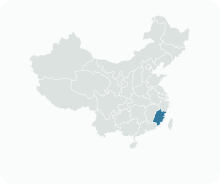
Get to know Wuping County
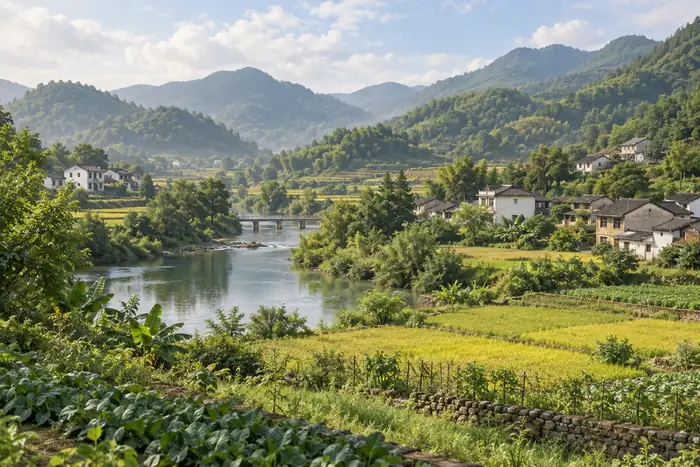
- Administrative area
- County · 县
- Part of
- Longyan
- Chinese name
- 武平县
- Local areas
- County guide
Area & population
- Area in the source
- 2,637.00 km²
- Population · 2020
- 278,238
Source: cited geographic source, as of the dates shown.
Setting and landscape
Shanghang County (上杭县) lies to the east and Changting County (长汀县) to the north. To the south are Jiaoling (蕉岭县) and Pingyuan (平远县) counties of Meizhou (梅州) in Guangdong, and to the west Xunwu (寻乌县) and Huichang (会昌县) counties of Ganzhou (赣州) in Jiangxi. The county contains the Liangyeshan National Nature Reserve (梁野山国家级自然保护区), the Liangyeshan national forest trail (梁野山国家森林步道) and the Zhongshanhe National Wetland Park (中山河国家湿地公园).
History
Excavated finds show people living here about 6,000 years ago, and in the early Western Han the area held the capital of the Nanhai kingdom (南海国). After Tingzhou (汀州) was founded in 736 under the Tang, two towns were set up in its south-west: Nan'an, now Pingchuan, and Wuping, now Zhongshan. They were merged as Wuping Chang (武平场) in 946 under the Southern Tang and raised to a county in 994 under the Song. In the Ming and Qing it was one of the eight Hakka counties of Tingzhou prefecture.
A county soviet government was formed in October 1929, and Mao Zedong and other leaders came to Wuping three times. Minzhu Township's Gaoshu village (民主乡高书村) is known as the first village the Red Fourth Army entered in Fujian. The county produced one general and four major generals; the general, Liu Yalou (刘亚楼), was the first commander of the air force of the People's Republic. Troops of the Fourth Field Army retook Wuping on 17 October 1949.
What to see
Zhongshan Town (中山镇) is a national historic and cultural town known as the "town of a hundred surnames" (百姓镇), home to 102 family names. Yanqian Town (岩前镇) is where the Dingguang Buddha (定光佛), protector deity of Hakka people on both sides of the Taiwan Strait, settled; its Dingguang culture park is designated a cross-Strait exchange base.
Food and local products
Wuping green tea (武平绿茶) is a Chinese geographical indication product.
Getting oriented
Two expressways leave the province from Wuping, the Yongwu (永武) and Zhangwu (漳武) routes, and the Longyan–Longchuan high-speed railway has a Wuping station.
Highlights
- Zhongshan Town 中山镇: National historic and cultural town with 102 family surnames.
- Yanqian Town 岩前镇: Where the Dingguang Buddha, protector deity of Hakka people on both sides of the Taiwan Strait, settled.
- Liangyeshan National Nature Reserve 梁野山国家级自然保护区: National nature reserve in the county, listed alongside the Liangyeshan national forest trail.
- Wuping green tea 武平绿茶: Chinese geographical indication product.
Sources for this guide
建制沿革-武平县人民政府 · Wuping County People's Government
武平县情概况-武平县人民政府 · Wuping County People's Government
县情概况-武平县人民政府 · Wuping County People's Government
武平县 - 维基百科,自由的百科全书 · Wikipedia (Chinese) · CC BY-SA 4.0
Original English written from the listed sources and checked sentence by sentence against quoted extracts by a separate reviewer. Updated 2026-09-23.
Explore Wuping County
Core places to explore, with English and Chinese names.
Wuping County 武平县
Plan your visit
Getting there
Wuping County is about 90 km in a straight line from central Longyan. Search for 武平县 in a map app to find stations and your accommodation.
Where to stay →More in Longyan
Sources & geographic information
Administrative names and parent areas: Official geographic directory · Reference date 2026-09-06.
Some facts checked against 武平县 — Wikipedia contributors, CC BY-SA 4.0.
Map data © OpenStreetMap contributors. Pins mark approximate centres, not entrances or boundaries.