

Explore the region
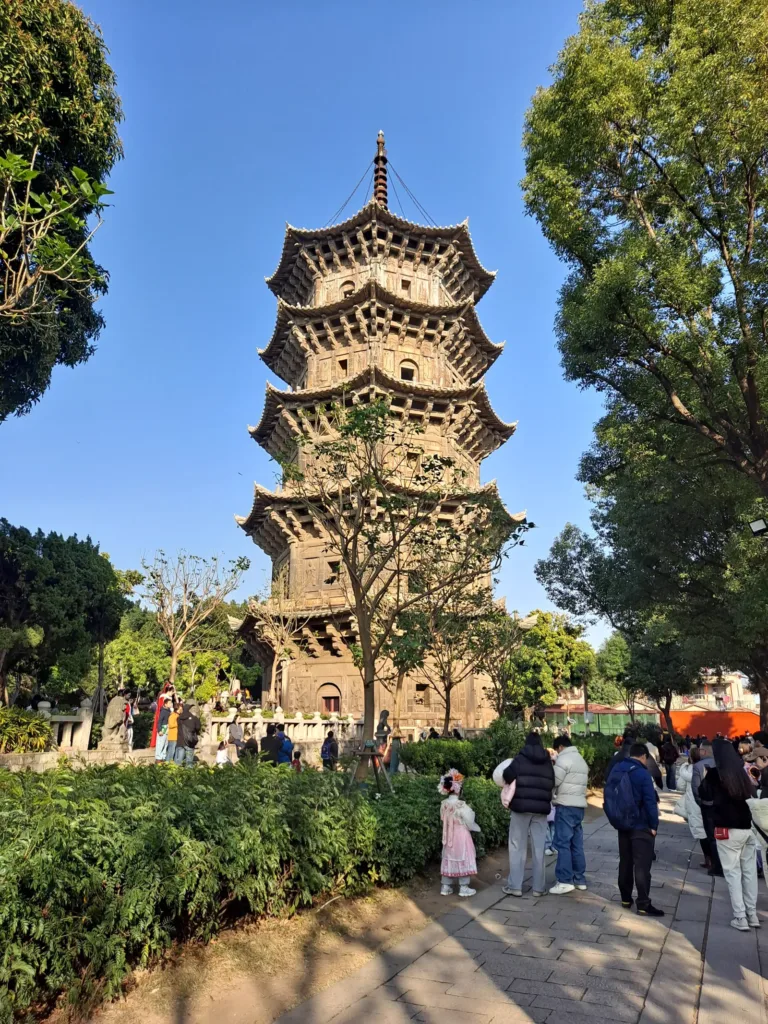
Quanzhou is easiest to understand as a city shaped by the meeting of river, sea and inland routes, not as a single fenced heritage park. In the old city, West Street and Tumen Street place the twin pagodas of Kaiyuan Temple, Qingjing Mosque’s stone gateway, Tonghuai Guan-Yue Temple and Tianhou Temple within living streets. UNESCO describes the World Heritage property as a connected maritime system: religious buildings stand alongside bridges, docks, inscriptions, production sites and the transport links that once joined the port to its hinterland.
That history still has an audible local register. Nanyin is a slow, elegant musical tradition of southern Fujian, performed with instruments including the dongxiao flute and horizontally played pipa. Its songs are sung in the Quanzhou dialect, and UNESCO records it in courtyards, markets, streets, ceremonies, weddings and funerals. If you come across a rehearsal or performance, listen as a guest in a living community rather than treating residents or worshippers as a show.
The city becomes more spacious once you leave the old core. A bridge or cliff inscription in the surrounding prefecture is not a quick add-on to a West Street walk; it is an outer excursion with its own return journey. Anxi’s tea country, Dehua’s porcelain tradition and the coastal fishing communities add the working hinterland that made the historic port possible.
See Quanzhou as a set of clusters
For a first visit, begin in the historic core and give it time on foot. Kaiyuan Temple and its two stone pagodas make a strong western anchor. Tumen Street brings Qingjing Mosque and Tonghuai Guan-Yue Temple into the same urban conversation, while Tianhou Temple, near the southern edge of the old city, keeps the seafaring and Mazu traditions in view. These are separate religious sites in ordinary city streets, not rooms inside one combined attraction.
Choose one outer theme rather than trying to cover the whole prefecture in a day. Luoyang Bridge and Anping Bridge show how crossings and tidal waters belonged to the port’s infrastructure. Jiuri Mountain adds cliff inscriptions connected with wind-prayer rites for sea voyages. Xunpu and other coastal places shift the emphasis towards fishing communities and everyday Minnan material culture. The UNESCO listing is a serial property spread across component sites, so it does not create one universal entrance, one city-wide ticket or one all-in-one route. Confirm the arrangements for each individual place.
The city’s scale
Quanzhou is a prefecture-level city in southeastern Fujian. Its old urban core is mainly experienced through Licheng, Fengze and Luojiang, while the wider municipal area includes Quangang, the county-level cities of Jinjiang, Shishi and Nan’an, and the mainland counties of Hui’an, Anxi, Yongchun and Dehua. The distances matter: a district or county name on a map does not mean that its heritage site is within walking range of the old city.
The official city profile lists Jinmen separately as “待统一” and excludes it from the stated land area. It should not be folded into an ordinary mainland Quanzhou day route; check the relevant entry and transport rules separately if it is part of your plans.
Food, tea and making
Quanzhou’s food is a family of southern Fujian tastes rather than one fixed recipe. In the city’s own guide, noodle paste (mianxian hu 面线糊), runbing (runbing cai 润饼菜), beef thick soup (niu rou geng 牛肉羹) and Honglai chicken feet (洪濑鸡爪) sit alongside seafood and snacks associated with particular towns. Menus and methods vary between kitchens, so ask what is in the broth, filling or seasoning if you have an allergy or dietary restriction; a dish’s appearance is not a guarantee that it is vegetarian or free of a particular ingredient.
The wider city explains the material side of the port as well. Anxi Tieguanyin belongs to the tea country in the western hills, while Dehua is associated with porcelain and kiln traditions. They are reasons to make a separate county excursion, not products to treat as if they came from one old-city street.
Getting there and planning your return
Quanzhou Jinjiang International Airport (泉州晋江国际机场) is in Jinjiang on the east side of Heping Middle Road. The Fujian provincial government’s English transport page describes buses from the airport plaza to downtown Quanzhou, Jinjiang Railway Station and intercity destinations. Use the full Chinese airport name when arranging a taxi or ride-hailing car, rather than the vague label “Quanzhou airport.”
Rail tickets need the same care. Quanzhou Station (泉州站), Quanzhou East Railway Station (泉州东站) and Quanzhou South Railway Station (泉州南站) are different arrival points. A Quanzhou government transport answer says Quanzhou East is in the Quanzhou Taiwanese Investment Zone and opened in October 2023; it describes Quanzhou South as being on the same Fuzhou–Xiamen high-speed railway but relatively far from the central city. Do not book a transfer to “Quanzhou” without checking the exact station printed on the ticket.
For the outer stations, an official provincial transport report dated 1 April 2024 recorded K603, K604 and K607 between Quanzhou South and the city; it also noted that K607 passes Quanzhou Jinjiang International Airport and ends at Luojiang District Government. The 2023 municipal answer recorded K502, K507, K508, 707, 710 and K20 serving or passing Quanzhou East, with K507 strengthened to link Quanzhou Station and Quanzhou East. These are useful Chinese route leads, not a live timetable: verify the current route, stop name and last departure before setting out.
For a taxi or ride-hailing car into the historic core, use a precise Chinese destination such as “泉州开元寺(西街)” for the Kaiyuan Temple/West Street cluster or “清净寺(涂门街)” for the mosque and Tumen Street. For the return, give the exact railway station or “泉州晋江国际机场” shown on your ticket or booking. Once in the old city, group nearby streets and temples together; treat Luoyang Bridge, Anping Bridge, Jiuri Mountain, Anxi and Dehua as separate excursions with a planned way back.
Combine your visit
A suggested sequence linking the specific features of this visit.
-
Kaiyuan Temple泉州开元寺
Begin with the Buddhist complex and evidence of overseas cultural exchange.
-
Qingjing Mosque清净寺
Compare the Islamic stone architecture on Tumen Street.
-
Tianhou Temple泉州天后宫
Follow the port story through worship of the sea goddess.
This order is editorial. Confirm access and any transfers between stops; it does not establish a walking route, same-day connection or common admission ticket.
Find Quanzhou overview
泉州 · 泉州市
The pin marks the area, not the entrance.
More places nearby
Approximate straight-line distances between map pins, not travel distances.
Zhenwu Temple 法石真武庙
6 km awayFashi Zhenwu Temple stands on a small hill beside the old Quanzhou port landscape. A monumental gateway leads up stone steps towards the Tunhai stele, worship pavilion and main hall. The pavilion’s layered roof and decorated…
View guide →Quanzhou Maritime Museum 泉州海外交通史博物馆
8 km awayQuanzhou Maritime Museum tells the port’s overseas story through ship models, nautical material and religious stone carving. Tombstones and architectural fragments bearing Islamic, Christian and Hindu imagery are especially…
View guide →Luoyang Bridge 洛阳桥
9 km awayLuoyang Bridge crosses the tidal river mouth on rows of stone piers, with Zhongzhou island interrupting the long span. Its construction is associated with Cai Xiang and innovative foundation work, including oyster cultivation to…
View guide →Sources & visit information
Sources checked on 24 October 2026. Hours, tickets, reservations and transport can change; confirm with the operator before you go.
Image credits & notes (1)
- Stone pagoda within Kaiyuan Temple, Quanzhou Photo: H2v5o68zPhoto: CC0 1.0