

Explore the region
About Tianluokeng Tulou Cluster
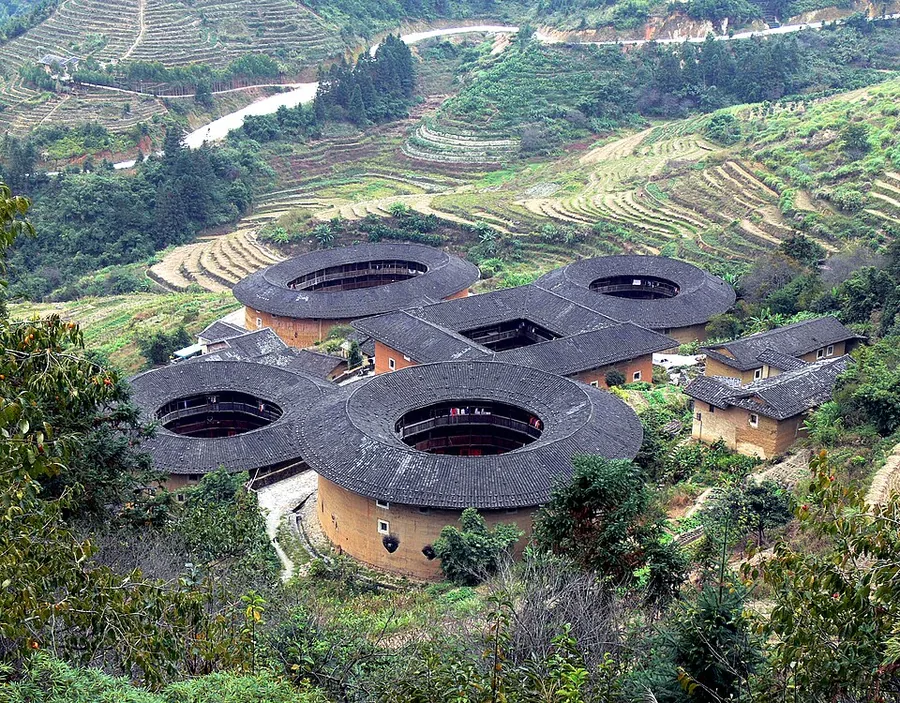
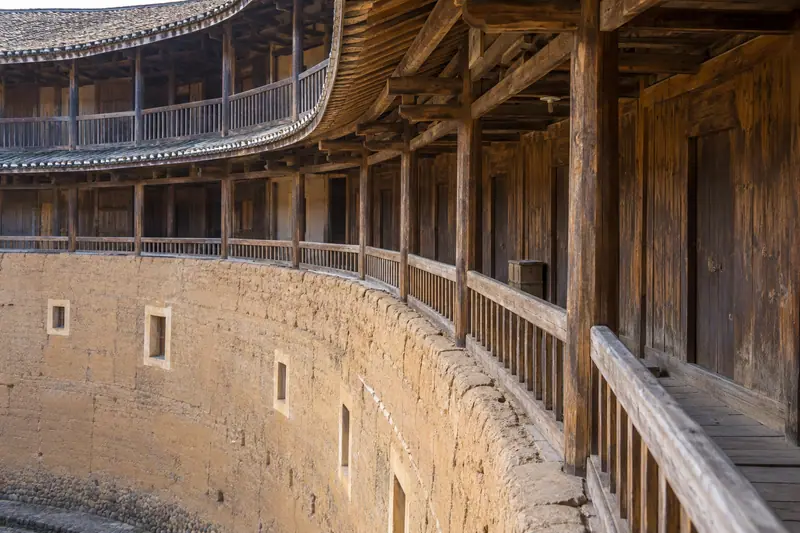
The central Buyun building anchors the arrangement, while the surrounding forms make the familiar view from above especially legible. At ground level, the thick walls and shared courtyards reveal how the buildings were inhabited. Respect residents’ private rooms and check which interiors are actually open on the day.
The cluster's central square building, Buyun Lou (步云楼), was built during the Kangxi era (1662-1672); it rises three storeys, with 26 rooms on each floor and four staircases. Around it were later built three round buildings, Hechang Lou (和昌楼), originally square and rebuilt in its present round form in 1953, Zhenchang Lou (振昌楼), built in 1930, and Ruiyun Lou (瑞云楼), built in 1936, together with an oval building, Wenchang Lou (文昌楼), built in 1966.
The cluster was listed as a Fujian provincial heritage site in 1996 and a Major Historical and Cultural Site Protected at the National Level (全国重点文物保护单位) in 2001; Tianluokeng village was named a first-group Chinese historical and cultural village in 2003. On July 7, 2008, at UNESCO's 32nd session in Quebec City, the cluster was inscribed as one of 46 Fujian Tulou World Heritage Sites.
What to look for
- The square Buyun building surrounded by round and oval tulou.
- The contrast between the hillside overview and the enclosed residential courtyards.
Background & history
Tianluokeng tulou cluster is one of the better known groups of Fujian tulou. It is located in the village of Tianluokeng (lit. 'snail pit') in the town of Shuyang, Nanjing County, southern Fujian province. The cluster consists of a square earth building at the center of a quincunx, surrounded by four round earth buildings (or more exactly, 3 round earth buildings and one oval shape earth building), figuratively nicknamed "four dishes one soup". A tulou (lit. "earth building") is a unique architecture found only in the mountainous areas bordering Fujian and Guangdong in southern China. The "earth building" is an enclosed building, usually square or circular in shape, with a very thick earth wall (up to 6 feet thick) and wooden skeletons, from three to five stories high, housing up to 80 families. These earth buildings have only one entrance, guarded by 4–5-inch-thick (100–130 mm) wooden doors re-enforced with an outer shell of iron plate. The top level of these earth building have gun holes for defense against bandits.
Excerpt from Wikipedia: Tianluokeng Tulou cluster · Wikipedia contributors · CC BY-SA 4.0. Selected introductory sentences; formatting simplified. Background information, not current visitor-service advice.
Location & getting there
Getting to Tianluokeng Tulou Cluster
Go to Tianluokeng Village in Shuyang Town, Nanjing County. Arrange the final mountain-road transfer specifically to the Tianluokeng cluster, and check the current scenic transport connection between the viewpoints and village.
Combine your visit
A suggested sequence linking the specific features of this visit.
-
Upper cluster viewpoint
Read the relationship of all five buildings on the slope.
-
Buyun building courtyard
Compare the square central residence with the surrounding circular forms.
-
Village lane around the tulou
Look closely at the thick outer walls and lived-in entrances.
This order is editorial. Confirm access and any transfers between stops; it does not establish a walking route, same-day connection or common admission ticket.
Find Tianluokeng Tulou Cluster
田螺坑土楼群 · 漳州市
The pin marks the area, not the entrance.
More places nearby
Approximate straight-line distances between map pins, not travel distances.
Chengqi Lou 承启楼
10 km awayChengqi Lou stands in Gaobei village in Yongding, Longyan. Completed in 1709 after construction begun in the Ming period, it is a circular earth building associated with the Jiang clan.
View guide →Chuxi tulou cluster 初溪土楼群
16 km awayChuxi is a Xu-clan village where earthen residences stand together in a mountain setting. Jiqing Lou is especially distinctive for its concentric rings and many separate stairways, which divide the outer structure into family…
View guide →Longyan Museum 龙岩市博物馆
54 km awayLongyan City Museum uses the rounded architectural language of Yongding’s tulou to introduce western Fujian. Its Hakka Homeland exhibition traces migration through documents, photographs, objects and reconstructed settings…
View guide →Sources & visit information
The linked encyclopedia sources support background and place descriptions. Current opening hours, ticket prices, booking rules and transport schedules have not been independently verified for this guide. Confirm them with the venue or operator before travelling.
- Tianluokeng Tulou cluster ↗
- Chinese Wikipedia: 田螺坑土楼群 (revision 91914630, 2026-03-16) ↗
- English Wikipedia: Tianluokeng Tulou cluster (revision 1366157091, 2026-07-26) ↗
Visitor information adapted and edited from Wikipedia contributors, “Tianluokeng Tulou cluster” · CC BY-SA 4.0. Source revision 1366157091.
Background paragraphs translated and condensed from Wikipedia contributors, "田螺坑土楼群", Chinese Wikipedia · CC BY-SA 4.0. Source revision 91914630.
Background paragraphs condensed from Wikipedia contributors, "Tianluokeng Tulou cluster", English Wikipedia · CC BY-SA 4.0. Source revision 1366157091.
Image credits & notes (1)
- Tianluokeng Tulou Cluster, Nanjing County, Fujian.Photo: Gisling · CC BY-SA 3.0Resized for the web; the photo itself has not been edited.
