

Explore the region
Tap any red Chinese text to hear it in Mandarin.
In brief: A broad meadow grassland west of Labrang in Xiahe County, where the Daxia River crosses open pasture and summer brings green slopes, wild flowers and working pastoral landscapes. It is best approached as a landscape outing with a confirmed road destination, not as a compact attraction with one universal gate.
Why visit
Sangke is a meadow grassland in Xiahe County, Gannan Tibetan Autonomous Prefecture. Xiahe County lists it as a national AA-rated tourist attraction and describes more than 3,000 metres of average elevation and about 70 square kilometres of pasture. The county’s own approach description follows the Daxia River west from Labrang, making the grassland a natural open-country extension to a stay in Xiahe rather than a separate urban centre.
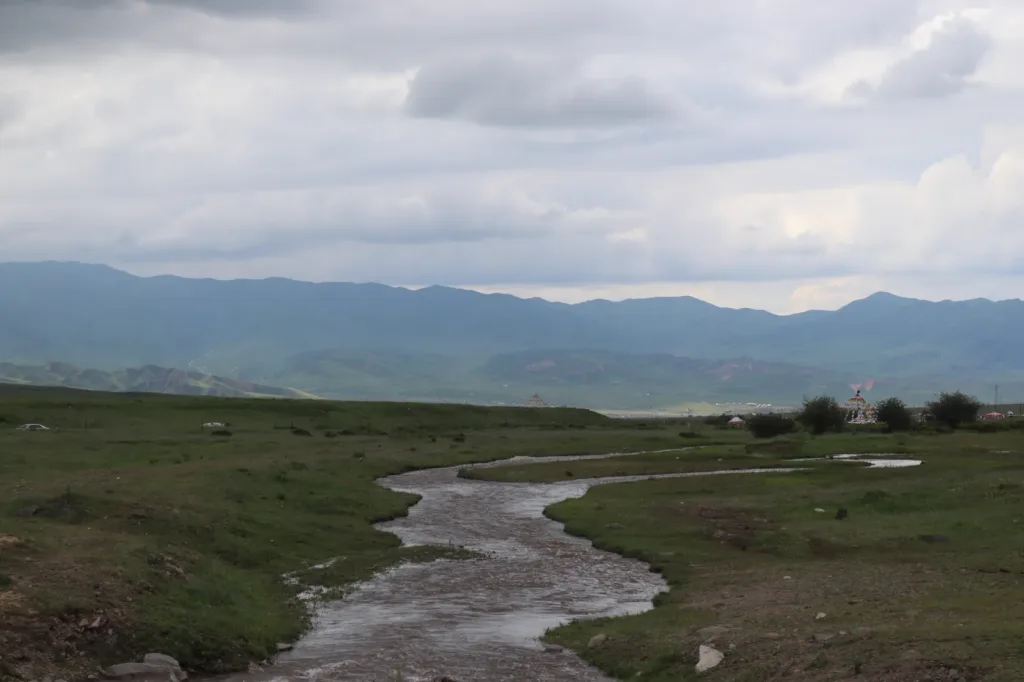
The main experience is scale and texture: the Daxia River winding through pasture, low hills and open sightlines, with cattle, sheep and seasonal tents forming part of a living pastoral setting. A second county account calls Sangke one of Gannan’s main pastoral bases. Read the landscape as working pasture, not as a staged performance or a promise that every visit will have the same animals, tents or activities.
Summer is the clearest season for the classic green-grass view. The county describes summer flowers across the meadow, while a Xinhua photo feature recorded green grass, a rapeseed-flower field and Tianjing Camp on 10 July 2025. Those are useful seasonal reference points, not a guarantee that a particular flower field or camp activity will be present on your date.
The county also links Sangke’s historical reputation to large Tibetan Buddhist religious observances held on the grassland. No current public ceremony calendar is established by the sources used here, so treat this as historical context rather than a scheduled visitor event. If you encounter a religious gathering, follow local instructions and ask before photographing people, rituals or animals.
What to look for
Start with the river-and-meadow relationship rather than searching for a single landmark. From a permitted roadside or visitor area, notice how the water line, pasture and mountain horizon open out together. In summer, look for wild flowers and the changing colour of the grass; the 2025 Xinhua feature also shows the kind of cultivated flower scene that may appear in the grassland landscape.
Facilities may change independently of the open pasture. Xinhua’s July 2025 report identifies Tianjing Camp in its photo captions. The Gannan prefectural government separately reported the completion of Anduo Ranch Sangke Camp in July 2025, describing it as a grassland facility linked to pastoral and yak-themed tourism. These names should not be treated as interchangeable, and neither report supplies a current general opening schedule or activity list.
Arrival and leaving
The most dependable geographic instruction is the county’s description of travelling west from Labrang along the Daxia River. An older provincial tourism directory also describes a direct road to Sangke, but gives a different distance reference from the county page. Use the road approach and the Chinese destination name rather than relying on one distance figure.
Sangke is a broad grassland, not a single building with a universally documented visitor gate. Before setting out, search for 桑科草原 Sāngkē Cǎoyuán with 夏河县 Xiàhé Xiàn in Amap or Gaode Maps and confirm the exact drop-off with your accommodation, driver or the specific camp you intend to visit. The material available for this guide does not verify a regular public bus, fixed tourist shuttle, exact entrance name or current return timetable. If you travel by taxi or hired car, arrange the return pickup before entering the open grassland; do not assume a car will be waiting at an unmarked viewpoint.
A 2025 prefectural-government report says a provincial road passes the Anduo Ranch Sangke Camp, but it does not identify a public passenger route or establish that the camp is the correct entrance for every visit. Keep to marked or permitted roads and paths. Do not drive across pasture, enter private herding areas or treat open land as unrestricted access.
Conditions and courtesy
At more than 3,000 metres, weather and exposure can change quickly. Bring sun protection, water and a warm layer, and leave enough daylight for the return journey. The consulted official pages do not publish a current winter road advisory, general opening hours, admission policy or seasonal transport schedule; check these locally before travelling in the cold season rather than assuming that summer camp services continue.
Sangke is both a tourism landscape and a pastoral place. Ask before entering a tent or approaching livestock, keep noise low, and do not feed or chase animals. If a religious event is taking place, observe from the space and distance requested by local organisers. These small choices protect the working landscape that makes the visit meaningful.
Find Sangke Grassland
桑科草原 · 夏河县
The pin marks the area, not the entrance.
Sources & visit information
Sources checked on 1 November 2026. Hours, tickets, reservations and transport can change; confirm with the operator before you go.
Image credits & notes (1)
- A stream crossing the meadow at Sangke Grassland near Saichi in Xiahe County, with the mountain backdrop and pastoral landscape visible. Photo: LiuxingyPhoto: CC BY-SA 4.0