

Explore the region
Tap any red Chinese text to hear it in Mandarin.
Why visit
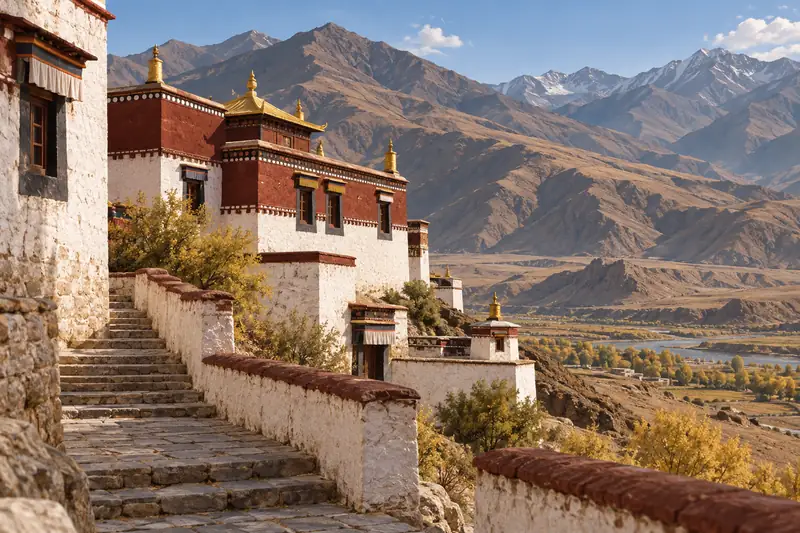
Chanding Monastery is a Tibetan Buddhist monastery in Zhuoni County town, in Gannan Tibetan Autonomous Prefecture. It stands on a terrace on Baitu Ridge to the north-west of town, above the Tao River. This is an urban-edge religious site rather than a remote scenic-area ticket stop: the approach is part of Zhuoni town, while the monastery itself remains a place of worship.
The monastery also helps explain the name Zhuoni. A local account connects the place-name to two tall Chinese red pines once associated with the monastery site; the Tibetan name was later used for the town and county.
A layered history
The dates in local accounts are not identical. The Zhuoni county government’s history says that in 1254 the Sakya master Phagspa selected the site while travelling through Zhuoni, left his disciple Sherab Yeshe to establish a monastery, and gave it foundation objects including a sandalwood standing Buddha. It says that the monastery changed from the Sakya school to the Gelug school in 1459, and that the Kangxi emperor bestowed the name Chanding Monastery in 1710.
A prefecture tourism overview instead dates the monastery’s construction to 1295 and gives Phagspa a more direct role in choosing the site, founding it and directing the work. Because these official accounts disagree, it is better to treat 1254 and 1295 as competing dates in the local historical record than to present one as an uncontested foundation year.
The result is a monastery whose significance is not only architectural. The county account places it among the important Sakya monasteries of the plateau before its Gelug conversion and describes its later relationship with the Gelug systems of Gannan. It also records a major printing project: 108 volumes of the Kanjur and 309 volumes of the Tanjur were carved between 1721 and 1772, with a printing hall built for the blocks. The volumes and blocks were later destroyed in wartime, so do not assume that a complete historic printing library is on display today.
What to look for
Begin with the site itself. From the terrace, the official description looks out across Zhuoni and the Tao River, with wooded ridges around the town. Inside the complex, look for the layout described around the upper and lower great assembly halls: a north–south axis with a deliberately symmetrical plan.
Then look up and look closely. The county account lists glazed roof tiles, gilded ornaments, dharma wheels, victory banners and vases. At closer range it describes carved brackets, coffered ceilings and beam frames, together with images, thangkas, wall paintings and appliqué work in the halls. These are details to observe from permitted areas, not an invitation to enter closed rooms or photograph without consent.
The prefecture’s published Zhuoni itinerary identifies Chanding Monastery as a provincial-level protected cultural site and places it on a county-town day route with the Yang Tusi Revolutionary Memorial Hall and old Tao inkstone workshops. That makes the monastery easy to pair with Zhuoni’s local history and craft traditions without pretending that it is part of a distant scenic park.
Getting there and getting back
Plan to reach Zhuoni county town first. The prefecture’s published itinerary has a “Cooperation direction” arrival into Zhuoni, followed by a county-town visit that includes Chanding Monastery; it does not publish a monastery bus line, a rail station at the gate, or a fixed transfer time.
For the final leg, search 禅定寺 Chándìng Sì or 卓尼大寺 Zhuóní Dàsì in Amap/Gaode Maps and show the Chinese name to a legal taxi or licensed ride-hailing driver. The official descriptions place the monastery on the north-western/northern terrace above town but do not identify a separate current visitor gate or a guaranteed English map pin. Confirm the gate locally, and arrange the return to town before you go up. A 2025 county transport notice mentions a Minxian–Zhuoni scheduled passenger service, but gives no current timetable or station details, so treat it only as a route lead and verify it before travel. The same notice warns visitors to use licensed taxis, licensed ride-hailing or public transport rather than unlicensed paid rides.
Before entering
This is a religious site, not a museum set. Wear clothing that covers shoulders and knees, keep voices low, follow signs and instructions, and ask before entering halls, joining any devotional activity or taking photographs. Gansu’s culture-and-tourism authority specifically advises visitors to respect local religious customs, dress appropriately and follow site rules.
The sources checked for this draft do not establish current opening hours, admission, reservation, interior access, winter activity schedules or a passport-specific visitor procedure. Do not infer a Tibet Autonomous Region permit requirement for Gannan. Foreign visitors should carry their passport and confirm current access and any registration requirement with the monastery or Zhuoni tourism authorities before setting out, especially in winter when weather and road conditions can change.
Find Chanding Monastery
禅定寺 · 卓尼县
The pin marks the area, not the entrance.
Sources & visit information
Sources checked on 1 November 2026. Hours, tickets, reservations and transport can change; confirm with the operator before you go.