

Explore the region
Tap any red Chinese text to hear it in Mandarin.
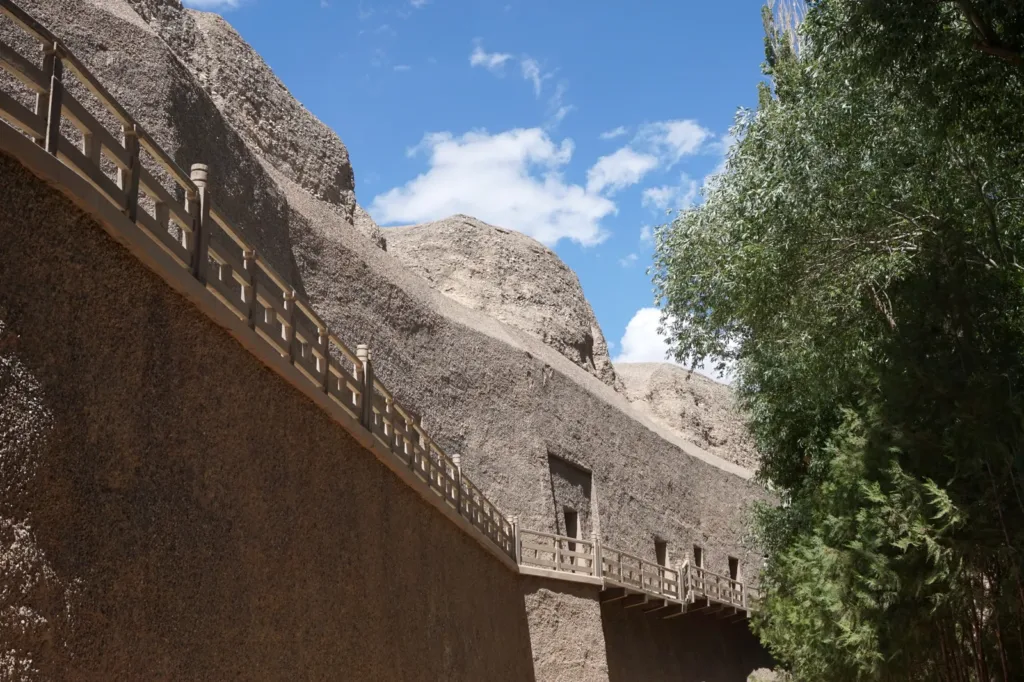
The Western Thousand Buddha Caves (西千佛洞) sit about 35 km southwest of Dunhuang, beside the Dang River valley and near the Dang River Reservoir. The name simply places this group west of Mogao, the “Thousand Buddha Caves” better known to international visitors. This is not a single cave hall: caves 1–19 cluster on the north cliff, while caves 20–22 lie 2–2.5 km farther downstream.
The surviving sequence runs from the Northern Wei through the Yuan, with 22 numbered caves, 34 painted clay sculptures and more than 800 square metres of murals. The site is valuable partly because later repairs and repainting remain visible: several periods can meet in one cave rather than presenting one untouched style. The official account also singles out Cave 11’s unusual round, tent-like plan as an exception among Dunhuang caves.
What to look for
Start with the setting. The cliff, the river corridor and the separation between the main group and the downstream caves explain why this feels like a working archaeological site rather than a compact museum. The numbered caves include different layouts—such as central-pillar and inverted-truncated-pyramid forms—so look at the relationship between each room’s shape, its painted surfaces and its sculpture instead of trying to read every image as one period.
The art is related to Mogao but not identical to it. The official description records one Northern Wei cave, one Western Wei cave, four Northern Zhou caves, three Sui caves, several Tang caves, and later Five Dynasties, Uyghur and Yuan examples. Many sculptures were remade in the Qing and Republican periods, while the murals retain styles broadly related to contemporary Mogao painting.
Plan your visit
The Dunhuang Academy lists the caves as open year-round. From 1 April to 30 November, the visiting hours are 08:30–17:30 and ticket sales run 08:30–17:00. From 1 December to 31 March, visiting hours are 09:00–17:00 and ticket sales run 09:00–16:30. The listed full ticket is RMB 30 per person per visit; the page also lists a RMB 15 concession tier with eligibility rules. Online booking is offered through the operator’s official WeChat account, but the accessible notice does not explain passport-specific booking or inspection procedures. Confirm those details before travelling, using the visitor hotline 400-833-3715.
The cave area is conservation-led. Flammable, explosive, toxic, corrosive or strongly scented items and pets are prohibited. Backpacks, cameras, selfie sticks and video cameras are not to be taken into the cave-visiting area; the ticket office provides free storage. Do not touch murals or sculptures. Heavy rain, snow or strong sandstorms can stop the visit, with online tickets refunded or held tickets changed or refunded at the ticket office.
Getting there
The official address is 西千佛洞, 甘肃省酒泉市敦煌市区西南约35公里,215国道近党河水库. There is no metro connection, and the operator’s public page does not list a dedicated public bus or site shuttle. The practical plan is a private car, a taxi with the driver waiting, or a pre-arranged western-route day trip; a China Southern travel guide also places Western Thousand Buddha Caves on the Dunhuang–Yangguan western route and recommends a chartered car, but its timetable and quoted price are not current operating information.
Keep 西千佛洞 Xī Qiānfó Dòng and 敦煌市 Dūnhuáng Shì ready for map searches, confirm the visitor entrance with the operator, and arrange the return before leaving the city. Do not assume a car can be summoned from the cave area after closing. If you combine the visit with Yangguan, allow enough road time for the separate site and its return journey rather than treating the caves as a short city excursion.
Find Western Thousand Buddha Caves
西千佛洞 · 敦煌市
The pin marks the area, not the entrance.
Sources & visit information
Sources checked on 23 October 2026. Hours, tickets, reservations and transport can change; confirm with the operator before you go.
- Dunhuang Academy: Western Thousand Buddha Caves visitor information ↗
- Dunhuang Academy: Introduction to the Western Thousand Buddha Caves ↗
- Dunhuang Academy: Western Thousand Buddha Caves Heritage Conservation Research Institute ↗
- China Southern: Two-day Dunhuang sightseeing route ↗
- Wikipedia: 西千佛洞 ↗
- Dunhuang Academy official homepage and site locations ↗
Image credits & notes (1)
- A cliffside walkway and cave openings at Western Thousand Buddha Caves in Dunhuang. Photo: 三猎Photo: CC BY-SA 4.0