


Photo adjustments
Proportionally resized and converted to WebP without cropping, retouching or changing the photographed subject.
Explore the region
About Tiantishan Grottoes
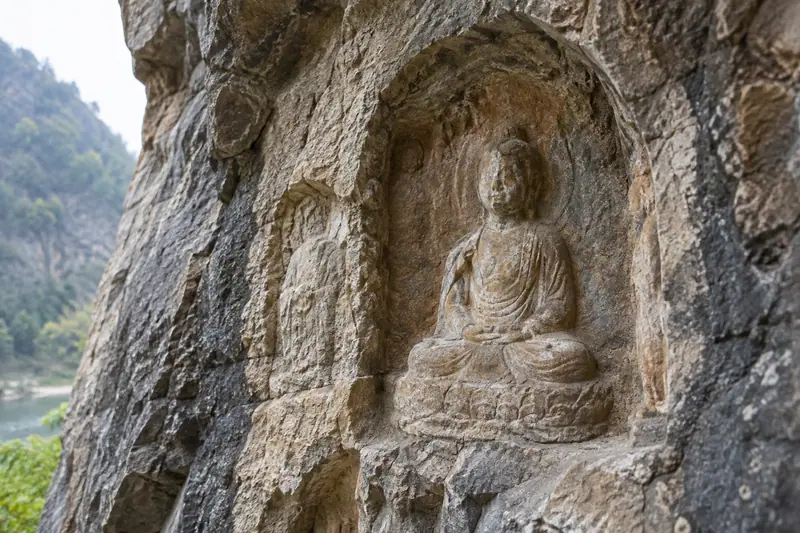
Some sculptures and murals were removed when the reservoir was built, while the great cave was protected by a barrier against the water. The surviving giant Buddha group and the cliff face should therefore be read alongside the story of relocation and conservation. This is a compact but significant stop on the Buddhist-art route through Liangzhou.
The caves were originally known as the Liangzhou Caves, a name recorded in the Jishenzhou Sanbao Gantong Lu (集神州三宝感通录). Carving began under the Northern Liang ruler Juqu Mengxun (沮渠蒙逊) between 412 and 439, and further caves were opened or rebuilt during the Northern Wei, Northern Zhou, Sui, Tang, Western Xia and Yuan dynasties; by the Ming and Qing periods the site had become a Lama monastery. Only 16 caves, on three tiers, survived to the early 1950s.
Caves 1, 4, 17 and 18 date from the Northern Liang period; the rest follow Sui- and Tang-dynasty designs repaired in later centuries. The caves hold more than 100 sculptures and several hundred square metres of murals, along with early Chinese and Tibetan sutra manuscripts and Han- and Tang-dynasty silk paintings. Northern Liang murals depict thousand Buddhas, apsaras, bodhisattvas and heavenly kings; Tang-period murals add musicians, donor portraits and a thousand-armed Guanyin.
In 1994 the Peking University archaeologist Su Bai (宿白) concluded from fieldwork that Chinese cave-temple art originated at the Liangzhou Caves, proposing the scholarly concept of a “Liangzhou model,” of which Tiantishan is the surviving example. In 2001 the caves were designated a Major Historical and Cultural Site Protected at the National Level as one of China's earliest Buddhist grotto sites.
What to look for
- The monumental Buddha group in the great cave.
- The cliff and protective barrier beside the reservoir, showing the challenges of conserving the site.
Location & getting there
Getting to Tiantishan Grottoes
Approach through Dengshan Village in Zhangyi Town, south of Wuwei. Arrange a dedicated road transfer to the Tiantishan entrance beside the Huangyang River reservoir, rather than treating it as an urban Wuwei stop.
Combine your visit
A suggested order for the documented features and stops.
-
Site history and conservation interpretation
Understand why parts of the collection were relocated.
-
Great-cave viewing area
Examine the monumental group from the authorised route.
-
Reservoir-side viewpoint
Relate the cliff and protective works to the surrounding water.
This is an editorial sequence. Check access and any road or boat transfers; it does not establish a walking route, common ticket or guaranteed same-day connection.
Find Tiantishan Grottoes
天梯山石窟 · 武威
The pin marks the area, not the entrance.
More places nearby
Approximate straight-line distances between map pins, not travel distances.
Wuwei Baita Temple 武威白塔寺
22 km awayBaita Temple is associated with Sakya Pandita’s stay in Liangzhou and the region’s thirteenth-century Tibetan Buddhist history. The present landscape combines preserved remains with substantial reconstruction, including the main…
View guide →Wuwei Confucian Temple 武威文庙
41 km awayWuwei’s Confucian Temple brings together a temple to Confucius and a separate Wenchang precinct associated with literary attainment. That pairing gives the complex a clear theme: learning was both an educational practice and an…
View guide →Leitai Han Culture Museum 雷台汉文化博物馆
43 km awayLeitai is the archaeological setting where the bronze galloping horse and a remarkable procession of bronze horses, vehicles and attendants were discovered. Its interpretation focuses on the wealth, movement and ceremonial life…
View guide →Sources & visit information
The sources below support the place-specific description and arrival information. Suggested combinations are editorial planning ideas; confirm current opening, entry arrangements and transport services for your date.
- 天梯山石窟 ↗
- Wuwei ↗
- Chinese Wikipedia: 天梯山石窟 (revision 92634415, 2026-05-12) ↗
- English Wikipedia: Tiantishan Caves (revision 1342554710, 2026-03-09) ↗
Visitor information adapted and edited from Wikipedia contributors, “天梯山石窟” · CC BY-SA 4.0. Source revision 92634415.
Visitor information adapted and edited from Wikivoyage contributors, “Wuwei” · CC BY-SA 4.0. Source revision 5194006.
Background paragraphs translated and condensed from Wikipedia contributors, "天梯山石窟", Chinese Wikipedia · CC BY-SA 4.0. Source revision 92634415.
Background paragraphs condensed from Wikipedia contributors, "Tiantishan Caves", English Wikipedia · CC BY-SA 4.0. Source revision 1342554710.