

Photo adjustments
Full frame retained; proportionally resized and converted to WebP. No retouching or changes to the photographed subject. Card displays may crop the view.
Explore the region
About Yongtai Fortress
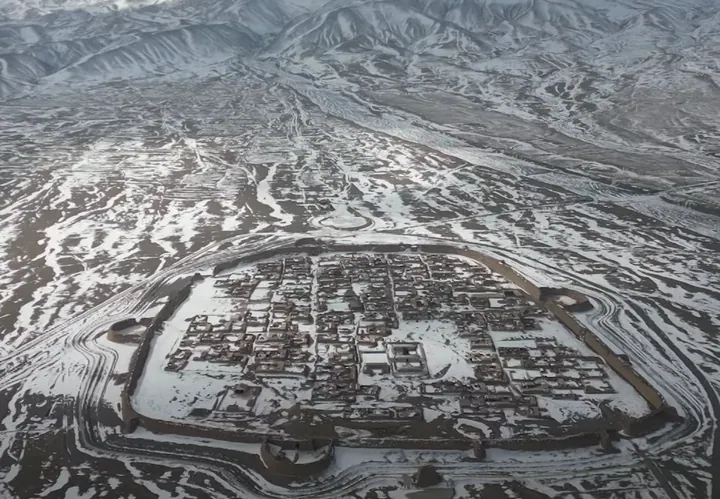
Its outline led to the nickname Turtle City, with the south gate and projecting barbican suggesting the head. Passing that entrance reveals a quieter settlement within the defensive shell. The most useful comparison is between the carefully controlled gateway and the broad earth walls: both show how local materials were shaped into a fortified place.
Construction began in 1606 (万历三十四年) under the supervision of the Minister of War, Li Wen (李汶), and was completed in the sixth month of 1608. The fortress was built by the Ming rulers to defend against attacks from northern minorities and stationed 2,000 infantrymen and 500 cavalry. It was listed as a Major Historical and Cultural Site Protected at the National Level (全国重点文物保护单位) in 2006.
The fortress has a perimeter of 1,710 meters, measuring 520 meters east to west and 500 meters north to south. Its walls, built of rammed loess mixed with sand, stand 8 to 12 meters high, with a base 6 meters wide narrowing to 5 meters at the top. Due to desertification, the village within the walls is now mostly abandoned, its population having fallen from about 1,500 in the 1950s to around 100 today.
What to look for
- The south gate and projecting barbican at the entrance to the enclosure.
- The tall rammed-earth walls and the settlement’s turtle-like plan.
Location & getting there
Getting to Yongtai Fortress
Travel to Yongtai Village in the Sitan area of Jingtai County and approach through the southern gate area. Arrange the return road transfer in advance; the settlement is separate from both Jingtai town and the Yellow River Stone Forest.
Combine your visit
A suggested order for the documented features and stops.
-
South gate and barbican
Understand the controlled defensive entrance.
-
Internal lanes
Compare the inhabited settlement with its military enclosure.
-
Public exterior wall viewpoints
Step back to read the earthwork profile without climbing fragile sections.
This is an editorial sequence. Check access and any road or boat transfers; it does not establish a walking route, common ticket or guaranteed same-day connection.

Find Yongtai Fortress
永泰古城 · 白银
The pin marks the area, not the entrance.
More places nearby
Approximate straight-line distances between map pins, not travel distances.
Yellow River Stone Forest 黄河石林
20 km awayThe Yellow River Stone Forest combines tall yellow-brown columns with a sharp river bend and the cultivated green space around Longwan Village. In Yinmagou, cliffs and narrow rock forms rise beside the valley route, while higher…
View guide →Tiantishan Grottoes 天梯山石窟
109 km awayTiantishan’s Buddhist caves stand beside the Huangyang River reservoir, a setting that changed the site’s preservation history. Some sculptures and murals were removed when the reservoir was built, while the great cave was…
View guide →Gansu Bamboo Slips Museum 甘肃简牍博物馆
118 km awayGansu Bamboo Slips Museum makes small written objects speak about large networks and ordinary lives. Wood and bamboo records preserve accounts, correspondence and administrative traces from the northwestern frontier. The…
View guide →Sources & visit information
The sources below support the place-specific description and arrival information. Suggested combinations are editorial planning ideas; confirm current opening, entry arrangements and transport services for your date.
- www.jingtai.gov.cn ↗
- www.baiyin.gov.cn ↗
- 永泰城址 ↗
- Chinese Wikipedia: 永泰城址 (revision 90815628, 2025-12-24) ↗
- English Wikipedia: Yongtai Fortress (revision 1365399384, 2026-07-22) ↗
Visitor information adapted and edited from Wikipedia contributors, “永泰城址” · CC BY-SA 4.0. Source revision 90815628.
Background paragraphs translated and condensed from Wikipedia contributors, "永泰城址", Chinese Wikipedia · CC BY-SA 4.0. Source revision 90815628.
Background paragraphs condensed from Wikipedia contributors, "Yongtai Fortress", English Wikipedia · CC BY-SA 4.0. Source revision 1365399384.