

Explore the region
Tap any red Chinese text to hear it in Mandarin.
Mati is not a single cave in the city centre. The official tourist description places the scenic area about 65 km from Zhangye city and names seven parts: Shengguo Temple, Puguang Temple, Thousand Buddha Cave, Jinta Temple, and the Upper, Middle and Lower Guanyin Caves. Other official descriptions use South and North Mati Temples for part of the same complex, so keep the wider destination name—马蹄石窟群旅游景区—when planning the visit. The site has more than 70 cave niches and belongs to the national key protected heritage list.
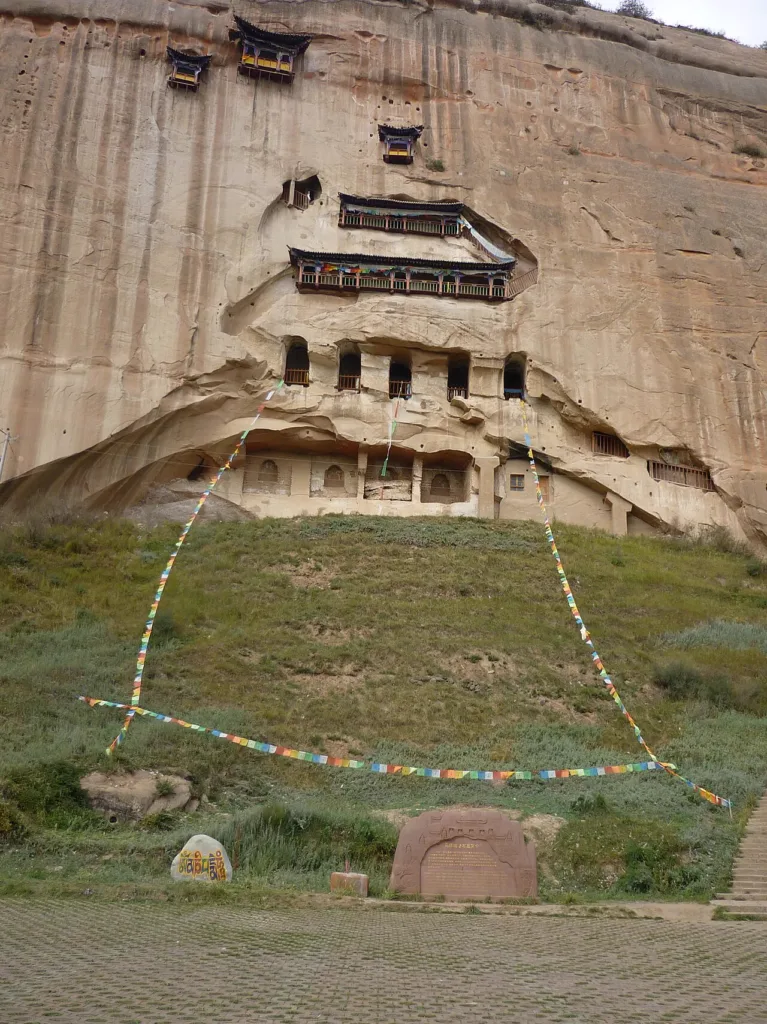
The most recognisable climb is the North Temple’s Thirty-Three Heavens grotto. Twenty-one caves are cut into seven levels of the cliff, with narrow, steep steps and passages inside the rock. In the Jinta Temple section, look for the two central caves and the high-relief, polychrome flying apsaras highlighted by the site’s cultural accounts. At Thousand Buddha Cave, the relief-stupa area gives the visit a different scale: less one monumental climb, more a close look at how sculpture follows the cliff.
The grottoes began in the Northern Liang period, more than 1,600 years ago, and later Buddhist layers include both Chinese and Tibetan traditions. This is a place to look slowly at the relationship between the carved cliff, the stairways and the painted or sculpted figures, rather than to treat every cave as a separate checklist. The steps are not a minor detail: recent reporting describes the Thirty-Three Heavens ascent as challenging, and the site’s stewards keep staff at viewpoints and grotto approaches to guide visitors and protect the heritage.
Visiting the site
Recent official reporting confirms an operating visitor centre with staffed ticket windows and online self-service ticket terminals, as well as a scenic shuttle linking 迎宾门 (Welcome Gate), 千佛洞 (Thousand Buddha Cave) and 中心停车场 (Central Parking Area). It also records visitors climbing the North Temple grotto during the October 2025 holiday. Treat those details as evidence of the recent operating arrangement, not as a permanent timetable or a promise that every grotto group is open on every date. Check the latest notice for opening hours, ticket products, any reservation requirement, and which sections are accessible before setting out.
Wear shoes with a secure grip and allow extra energy for stairs. The Thirty-Three Heavens route is narrow and steep in places. Mountain weather can change quickly, and a closure or controlled entry may affect a particular cave even when the wider tourism area is receiving visitors. The sources read for this guide do not publish a separate passport procedure for foreign visitors, so confirm the current ticketing and identity-check process with the scenic area before travel.
Getting there and getting back
The address to use is 马蹄石窟群旅游景区 Mǎtí Shíkū Qún Lǚyóu Jǐngqū, in 马蹄藏族乡, 肃南裕固族自治县, 张掖市, 甘肃省. The county’s official yearbook places the tourism area under Linsong Mountain in Mati Tibetan Township; the Zhangye government listing gives the distance from Zhangye city as about 65 km.
For a road journey from Zhangye, the city transport bureau identifies S301 as the ecological-cultural and grotto-art corridor from Ganzhou to Mati Temple. If you arrive through 张掖西站综合客运枢纽 (Zhangye West Comprehensive Passenger Transport Hub), the same bureau describes the hub as having tourist-distribution functions, but the page does not publish a current direct Mati departure, timetable or fare. Confirm the day’s service at the hub or through the local 张掖出行 departure information rather than assuming that a city bus runs at a fixed time.
For a taxi, hired car or arranged transfer, show the driver the Chinese destination 马蹄石窟群旅游景区 Mǎtí Shíkū Qún Lǚyóu Jǐngqū and ask for the 迎宾门 Yíngbīn Mén or the visitor-centre ticket area. Do not use only “Mati Temple” if the map returns a different temple or a point in the wider mountain area. Arrange the outward and return road transfer before entering the scenic area: the official material confirms the internal shuttle between 迎宾门, 千佛洞 and 中心停车场, but it does not confirm a public return timetable from the remote scenic area to Zhangye. Return to the gate by the scenic shuttle and meet the pre-arranged vehicle there.
There is no metro access to this mountain site, and no fixed public-bus route, departure time or fare was confirmed in the sources read for this guide. That is a reason to verify the road leg, not to guess one. S301, the named Chinese destination, the Welcome Gate and the internal shuttle are the useful anchors for an independent visit.
Find Mati Temple Grottoes
马蹄寺石窟 · 肃南裕固族自治县
The pin marks the area, not the entrance.
Sources & visit information
Sources checked on 25 October 2026. Hours, tickets, reservations and transport can change; confirm with the operator before you go.
Image credits & notes (1)
- Cliffside cave-temple façades in the Matisi Grottoes (马蹄寺石窟群). Photo: Immanuel GielPhoto: CC BY-SA 3.0