

Explore the region
Tap any red Chinese text to hear it in Mandarin.
Why this site matters
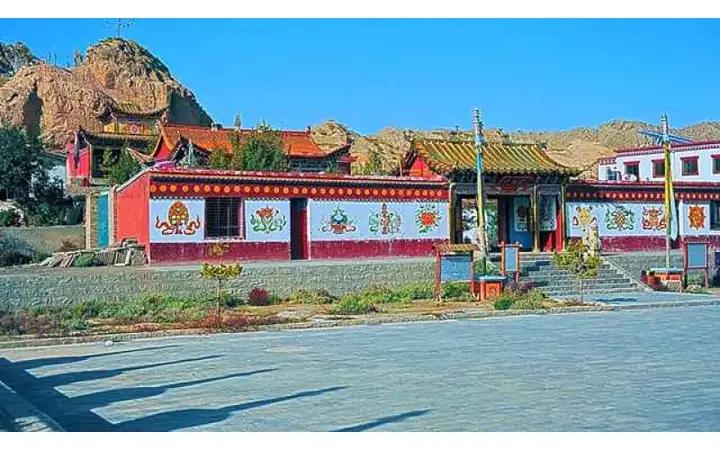
Wenshu Temple Grottoes is a mountain complex rather than a single decorated chamber. The official Zhangye tourism account describes two areas, front mountain and back mountain, with seven named components: Wenshu Temple, Baizi Tower, Puhua Temple, Thousand-Buddha Cave, Ten-Thousand-Buddha Pagoda, Five-Hundred-Arhat Hall and Guanyin Cave. It is listed as both a National Key Cultural Relic Protection Unit and a national 4A tourist attraction.
The site’s value is the way architecture, worship and painting remain together. Government cultural material places the caves within the early Hexi or “Liangzhou model” tradition: the important chambers use a near-square plan with a central pillar, domed ceilings and niches for images. The front-mountain Thousand-Buddha and Ten-Thousand-Buddha caves, and the back-mountain Ancient-Buddha and Thousand-Buddha caves, are among the named areas to look for.
The official tourism descriptions count more than 30 caves, over 500 Buddhist images and more than 1,200 square metres of murals. Look for repeated Buddha figures, preaching scenes, flying musicians and donor figures rather than expecting one single “main statue.” In the Ten-Thousand-Buddha Cave, a local government tourism feature specifically notes a Western Xia Maitreya Transformation mural and guardian-king images. The Five-Hundred-Arhat Hall and the rooms grouped around the Thousand-Buddha Cave add a later devotional layer to the older cave tradition.
This is still a religious setting as well as a protected monument. The local account describes Tibetan and Chinese Buddhism and Daoist elements in the wider complex. Walk quietly, do not touch painted or sculpted surfaces, and ask on site which interiors are open; a current English travel guide warns that protected caves can be gated or opened only by a custodian.
Location and getting there
The official scenic-area address is 文殊寺石窟群旅游景区,甘肃省张掖市肃南裕固族自治县祁丰乡文殊村01号. Administratively, this is in Qifeng Tibetan Township (祁丰藏族乡), Sunan Yugur Autonomous County, Zhangye City—not in Zhangye’s urban centre and not in Mati Temple. The village government places Wenshu Village beside the township seat and gives reference distances of 15 km from central Jiuquan and 20 km from central Jiayuguan; these are location references, not guaranteed journey times.
For the road approach, use 文殊寺石窟群旅游景区 Wénshū Sì Shíkū Qún Lǚyóu Jǐngqū or 文殊寺景区 Wénshū Sì Jǐngqū as the Chinese destination. A Sunan county tourism feature describes driving from the Jiayuguan G30 Lianhuo Expressway exit toward Wenshu Village and arriving at the scenic-area gate; from the gate, the visit continues on a marked footpath and steps through the mountain complex. This is a road-access description, not proof of a current tourist shuttle.
If you arrive by train, the relevant high-speed gateways are Zhangye West Railway Station (张掖西站), Jiuquan South Railway Station (酒泉南站) and Jiayuguan South Railway Station (嘉峪关南站) on the Lanzhou–Xinjiang high-speed railway corridor. They are transfer hubs, not cave entrances. The official pages I read do not publish a reliable current direct bus or scenic-area shuttle timetable. An English travel guide also describes public transport as limited, so the practical plan is a pre-arranged taxi, chartered car or hired driver from one of these hubs. Agree a return pickup before entering; do not assume that a late public connection will be waiting at the gate.
A current Qunar listing gives split visiting periods of 09:00–11:00 and 14:30–17:00, says advance reservation is required, and lists 0936-6164555 as the scenic-area phone. The official tourism pages do not confirm those operating details, so treat them as a lead to verify directly before setting out. The same caution applies to which caves are open, ticket prices and any rules for foreign visitors.
Find Wenshu Temple Grottoes
文殊寺石窟 · 肃南裕固族自治县
The pin marks the area, not the entrance.
Sources & visit information
Sources checked on 25 October 2026. Hours, tickets, reservations and transport can change; confirm with the operator before you go.
Image credits & notes (1)
- Wenshu Temple Grottoes · 文殊寺石窟Photo: dhlxs.netResized for the web; the photo itself has not been edited.