


Get to know Xinhui District

Photo adjustments
Full frame retained; proportionally resized and converted to WebP. No retouching or changes to the photographed subject. Card displays may crop the view.
- Administrative area
- District · 市辖区
- Part of
- Jiangmen
- Chinese name
- 新会区
- Local areas
- District guide
Area & population
- Area in the source
- 1,354.71 km²
- Population · 2016
- 757,988
Source: cited geographic source, as of the dates shown.
Setting and landscape
The land slopes from north-west to south-east. The Guifeng (圭峰), Gudou (古兜) and Niuguling (牛牯岭) uplands cover about 36 per cent of Xinhui; Shizitou (狮子头), the main peak of Gudou, is the highest point at 982 metres. Both the Xi River (西江) and the Tan cross the district, and the stretch of the Tan from Mingzuzui (溟祖咀) in Huicheng (会城) to the Yamen (崖门) mouth, where the two rivers' waters gather, is called Yinzhou Lake: 35.1 kilometres long and 1.5 to 2 kilometres wide.
History
The name dates from 420, when the Eastern Jin court created Xinhui Commandery (新会郡). In 1278 the Song grand tutor Zhang Shijie (张世杰) brought the boy emperor Zhao Bing (赵昺) to Yashan (崖山) in Xinhui and built a temporary palace. After the Yuan won the Battle of Yamen (崖山海战), the chancellor Lu Xiufu (陆秀夫) leapt into the sea with the emperor, and the Southern Song ended. Xinhui calls itself the birthplace of the Lingnan school of learning (岭南学派) and the Lingnan qin school (岭南琴派).
What to see
Liang Qichao's Former Residence (梁启超故居) in Chakeng village (茶坑村), Huicheng, is a national key cultural relics protection site: a grey-brick house from the Guangxu reign with the Yitang study (怡堂书室), built by Liang's great-grandfather, where he studied as a boy. A memorial hall south of the house, designed by Mo Bozhi (莫伯治), was completed in 2001.
The district also lists the Yashan battle site and Yashan Shrine (崖山祠), the Xinhui Academy (新会书院), and Yutai Temple (玉台寺) on Guifeng Mountain (圭峰山), one of Guangdong's four great temples. Guifeng Mountain national forest park and Bird Paradise (小鸟天堂) are 4A scenic areas. The oldest monument is the Sui-dynasty stone pagoda of Longxing Temple (龙兴寺石塔).
Food and local products
Chenpi is the dried peel of Xinhui's large red mandarin, sun-dried, sealed, dried again around the next Qingming festival and aged three years; the mandarin and the peel are both Chinese geographical-indication products. Restaurants serve deep-fried chenpi pork ribs (香炸陈皮骨), and hollowed mandarins are filled with Pu'er tea (柑普茶).
The wide, slow Xi River at Muzhou (睦洲) is good habitat for yellow-sand clams (黄沙蚬), best known as "bok-bok clams" (卜卜蚬): raw clams go into a pan of hot oil and make a "bok" sound as they open. Xinhui palm-leaf craft (新会葵艺), including fans decorated with a heated iron pen, joined the national intangible heritage list in 2008.
Highlights
- Liang Qichao's Former Residence 梁启超故居: National key relics site in Chakeng village: Guangxu-era brick house, the Yitang study and a 2001 memorial hall.
- Guifeng Mountain 圭峰山: National forest park and 4A scenic area with Yutai Temple, one of Guangdong's four great temples.
- Xinhui chenpi 新会陈皮: Mandarin peel aged three years; a Chinese geographical-indication product.
- Xinhui palm-leaf craft 新会葵艺: Fans and weaving from palm leaves; national intangible heritage since 2008.
Sources for this guide
新会区 - 维基百科,自由的百科全书 · Wikipedia · CC BY-SA 4.0
新会简介 - 新会区人民政府 · Xinhui District People's Government (district gazetteer office)
梁启超故居 - 新会区人民政府 · Xinhui District People's Government
Original English written from the listed sources and checked sentence by sentence against quoted extracts by a separate reviewer. Updated 2026-09-25.
Explore Xinhui District
Core places to explore, with English and Chinese names.
Places to explore around Xinhui District
 Entrance to Liang Qichao's Former Residence, marked with its nameplate, Xinhui District, Jiangmen · 江门市新会区梁启超故居入口及门牌 Source-recorded photograph date: 2008-05-03.
Liang Qichao Former Residence梁启超故居
Birthplace of Liang Qichao in Chakeng Village, Xinhui: Guangxu-era brick house and study, a national heritage site since 1996, with a memorial hall of 2001.
Read the place guide →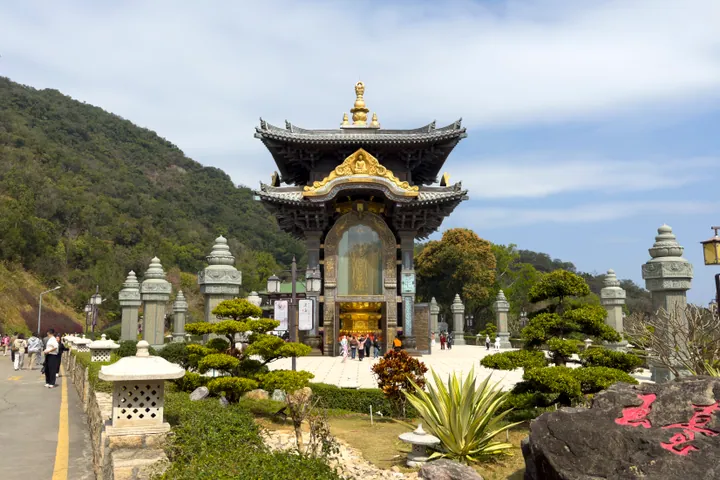 The four-faced Guanyin pavilion at Yutai Temple on Guifeng Mountain, Jiangmen · 江门圭峰山玉台寺四面观音像 Source-recorded photograph date: 2026-02-18 13:32:59.
Guifeng Mountain圭峰山
Forest park above Xinhui and Jiangmen with the Tang-founded Yutai Temple, a 1683 marble pagoda, a Yuan stupa and a summit lake.
Read the place guide →Banyan branches over the water at Birds Paradise · 小鸟天堂 Photograph date recorded by the source: 2005-08-13.Birds' Paradise小鸟天堂
Birds’ Paradise is a wetland and bird habitat at Tianma Village in Xinhui, Jiangmen. Its core is a small island covered by a dense banyan canopy. The trees and surrounding water form the essential landscape: branches, aerial…
Read the place guide →Local life & food
Xinhui District local specialties
新会区特色美食 · 1 specialties to discover
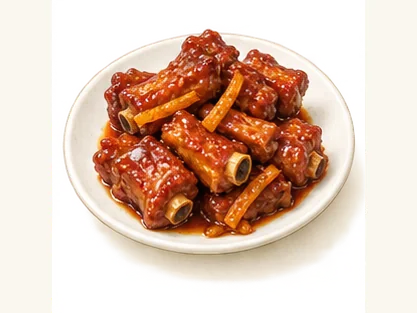 Xinhui tangerine-peel pork ribs 新会陈皮骨AI dish illustration / AI 菜品示意图
Dried peel brings a fragrant, slightly bitter citrus edge to the rich pork. The sauce may be sweet-savoury rather than sharply sour.
Source ↗Read the dish guide →All dish names · 全部菜名 (1)
More dishes from across Guangdong are in the Guangdong food guide.
Plan your visit
Getting there
Xinhui District is about 8 km in a straight line from central Jiangmen. Search for 新会区 in a map app to find stations and your accommodation.
Where to stay →Build your route
Liang Qichao Former Residence and Guifeng Mountain are both listed here. The linked place guides have entrance and visit details.
Continue with Jiangmen →More in Jiangmen
Sources & geographic information
Administrative names and parent areas: Official geographic directory · Reference date 2026-09-06.
Some facts checked against 新会区 — Wikipedia contributors, CC BY-SA 4.0.
Photo: Liang Qichao Former Residence · (Long night without wind) 长夜无风 · CC BY 3.0. Full frame retained; proportionally resized and converted to WebP. No retouching or changes to the photographed subject. Card displays may crop the view.

Photo: Guifeng Mountain · Tim Wu · CC BY-SA 4.0. Full frame retained; proportionally resized and converted to WebP. No retouching or changes to the photographed subject. Card displays may crop the view.

Photo: Birds' Paradise · Memes · CC BY-SA 3.0. Full frame retained; proportionally resized and converted to WebP. No retouching or changes to the photographed subject. Card displays may crop the view.

Map data © OpenStreetMap contributors. Pins mark approximate centres, not entrances or boundaries.